Book Reviews

The good, the bad, and the ugly about books I’ve recently read.

Review – The Tyrant’s Daughter by J.C. Carleson

the tyrant's daughter 2

When reading the summary of The Tyrant’s Daughter by J.C. Carleson, I hadn’t even considered it could be a YA novel. Written by a former CIA agent, the book follows an unnamed Middle-Eastern despot’s family after his assassination. His wife, daughter, and son flee to the United States with the help of a shady CIA officer, where they struggle to adapt to life as non-royals while watching their home country self-destruct on TV.

But this is a YA novel, written from the perspective of the assassinated leader’s fifteen-year-old daughter, Laila. Sheltered for most of her life, she’s blissfully unaware of the atrocities her father committed against his people before his death. To her this man wasn’t a tyrant or dictator, but a beloved family member. Laila’s move to the US brings new adjectives used to describe her home and her father, like brutal and tyrant, and she struggles to synthesize new information and old.

The reader sees the world through the filter of Laila’s experience and upbringing: a school dance shocks not only because of the gyrating, but also because the crowd of bodies brings flashbacks of angry mobs. Afflicted with undiagnosed PTSD, Laila steps into classic YA fiction scenes only to be quickly jolted out of them with reminders of how different her own values are from those of American society.

Ideas from this book developed from author J.C. Carleson’s real life experiences as a CIA officer. She spent time in Baghdad in 2003, and saw elaborate playhouses left behind at one of Saddam Hussein’s compounds after he fled, which included multiple levels, an intercom system, and an elevator. This caused her to wonder the mindset of the children playing in such a wonderland–did they understand the circumstances around the man who built them such toys? As these questions stewed in her mind, years later, she noticed her son’s nonchalant reaction to the noise explosions which became a regular part of their life on a military base. Rather than jump to sounds of war, he would simply turn up the volume of the TV.

The Tyrant’s Daughter manages to come across as not ignorantly US-centric, as a book written by an American about the Middle East for young readers certainly could. Maybe because of Carleson’s experience, there is depth here that questions our American world view as insistently correct. Laila’s American friends seem insecure and boy-obsessed, and Laila charts her best friend’s countless style phases through the photos decorating her wall, a reminder that our freedom to express ourselves through clothing never really makes us as comfortable as we’d like. As shocking and flawed as Laila’s own culture seems to be, ours is certainly far from perfect.

The Tyrant’s Daughter by J.C. Carleson on Amazon.com/Powells.com/Indiebound.org

If you liked this book, try these non-fiction titles:

Review – To Rise Again at a Decent Hour by Joshua Ferris

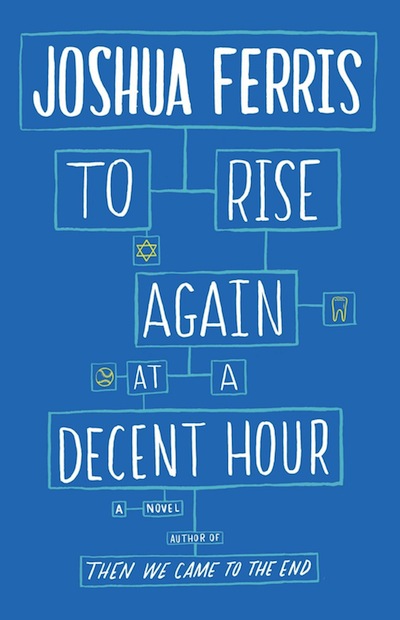
to rise again at a decent hour

I encouraged my patients to floss. It was hard to do some days. They should have flossed. Flossing prevents periodontal disease and can extend life up to seven years. It’s also time consuming and a general pain in the ass. That’s not the dentist talking. That’s the guy who comes home, four or five drinks in him, what a great evening, ha-has all around, and, the minute he takes up the floss, says to himself, What’s the point? In the end, the heart stops, the cells die, the neurons go dark, bacteria consumes the pancreas, flies lay their eggs, beetles chew through tendons and ligaments, the skin turns to cottage cheese, the bones dissolve, and the teeth float away with the tide. But then someone who never flossed a day in his life would come in, the picture of inconceivable self-neglect and unnecessary pain— rotted teeth, swollen gums, a live wire of infection running from enamel to nerve— and what I called hope, what I called courage, above all what I called defiance, again rose up in me, and I would go around the next day or two saying to all my patients, “You must floss, please floss, flossing makes all the difference.”

Joshua FerrisTo Rise Again at a Decent Hour

I unfortunately read this book in a month with several dentist appointments, for a crown (my first ever!) and multiple fillings.

“I’m reading a book about a dentist,” I said to my dentist. He’s the simple, happy sort of dentist who chats continuously while my mouth is forced open with a metal contraption for an hour and a half, chatting as he drills and buffs like we’re having a cup of coffee, oblivious to my non-participation in the conversation.

“Oh yeah? Is he a good guy, or a bad guy, or what?” My dentist asked. Considering this question, when presented with To Rise Again at a Decent Hour‘s protagonist, Paul O’Rourke–a dentist beleaguered, a man so without his own religion he obsesses over the families of the women he dates, their Jewish rites or Catholic sternness, a man so exhausted from working to afford his prestigious Manhattan office he has no time to enjoy the New York around him–I didn’t even know the answer to the question.

Like an alien anthropologist studying our civilization for the first time, Joshua Ferris has always written with fresh eyes on things most of us find unremarkable. He explored the desperation of the American office worker in his first novel, Then We Came to the End, and the madness of undiagnosed illness with The Unnamed. With To Rise Again at a Decent Hour, he presses further into the harshest landscapes of our modern culture, with an at times shocking, always funny, always sad examination of a dentist’s search for a religion that may not exist.

O’Rourke is struggling through the usual rituals of dentistry, regretting his decision to forgo a private office in his business’s floorplan, gazing into the eyes of his masked dental assistant and wondering what exactly she is thinking, when he discovers his identity has been hijacked online. The hijackers may or may not be part of the oldest, most secret religion of all time, and they begin using O’Rourke as a figurehead for tweets and posts about their sacred texts and past persecutions. Yes, this is an incredibly odd, brilliant book.

Joshua Ferris writes like the lovechild of Don DeLillo and Christopher Buckley, if those two authors were trapped as cubicle-mates in a droll office environment where technology constantly broke around them. Sometimes I worry that more than any other living author, Ferris will be remembered as the voice of our time period’s mad combination of consumption and lack of self care, our dizzy running on a wheel to nowhere. This worries me not because he’s a bad writer, but because his writing seems to reveal so much of modern society’s malaise while staying honest, never slipping into some sort of too-cool-hipster-Hollywood apathy.

To Rise Again at a Decent Hour is unique in that it is alarmingly funny, so depressing at times that it is hard not to laugh out loud. This bitter humor is Ferris’s specialty, it seems, as it runs through each of his previous books. Ferris is a fan of humor in fiction, and doesn’t think we see enough of it. He said in a recent Paris Review interview, “We’re here also to make one another laugh, and to use humor to mitigate some of the shit and misery that goes on. I think the best advice I could give a young writer would be ‘Don’t forget about the funny.’ Humor is a part of life, so make it a part of your fiction.”

Don’t be fooled, however. This is the humor of a man laughing his way to hell. Those hoping for a light read should look elsewhere. The funny is there, yes, but Ferris’s power lies in his razor-sharp depiction of some of the desperation and loneliness of daily life, and the greater questions hanging over these daily routines we all struggle through alone. Now please, don’t forget to floss.

To Rise Again at a Decent Hour on Amazon.com/Powells.com/Indiebound.org

I’m assuming that because of the Amazon/Hachette dispute, as I’m writing this the hardcover is $26 right now at Amazon, $18.20 at Powell’s.

Further Reading:

Review – The Luminaries by Eleanor Catton

the luminaries gif

Reading The Luminaries is like being dropped in the midst of New Zealand’s Otago Gold Rush, blindfolded and totally without reference, and then being spun round in circles by a stranger and let loose to feel around the landscapes and stand near their inhabitants, prospectors and bankers and Chinese diggers and tattooed Māori streaming around you, the women left to pleasure and care for these teeming throngs of men nearly knocking you over as they rush this way and that, and just as you feel overwhelming lost amidst these endless characters, totally without equilibrium in this many-plotted story centered in a town where everyone wants to make it rich, Eleanor Catton comes and takes you by the shoulder and steadies you for just a moment, and you breathe in the smells of dirty men and sea water as ships wreck upon the beach and scavengers look upon the ships and you sigh and know that despite there being too much information here, maybe just too much life here, for one book to ever express, you must keep reading.

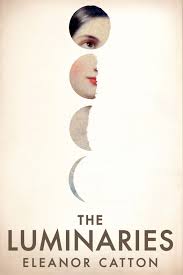
the luminaries full coverAnyone coming off of a Goldfinch buzz and wondering what their next ambitious, too-long book will be should look no further than The Luminaries. Both books are written with the crisp observations that make them so much more than plot recounted. These are stories of life, magnified. Stories of how life could be if we all drunk in details of each other’s quirks and charms, every insecurity and affect, every ugly part and every beautiful one, and then maximized them into sentence-formed still lives spilling over into paragraphs so illustrative of this human condition we’re stuck in they act like paintings on pages changing ordinary days into phenomenas, ordinary interactions into humorous, tragic, wonderful things worth documenting. This is how these books get to be close to 1,000 pages long–life magnified is a very big thing, indeed.

The Luminaries, as I’ve mentioned, is the story of New Zealand’s Otago Gold Rush, and the story of a plethora of characters drawn together by an unfortunate set of circumstances. Men in all sorts of businesses centered around profiting off of gold or the men who find it feel uneasily bamboozled, they all sense a caper of some sort, and yet trying to pin down who has down wrong when is like trying to sift the gold dust apart from the dirt. The plot is complicated, and meant to be, as that’s the fun and beauty of the thing. Also, this is a book that uses the word “whore” quite a bit. Prepare yourself for that.

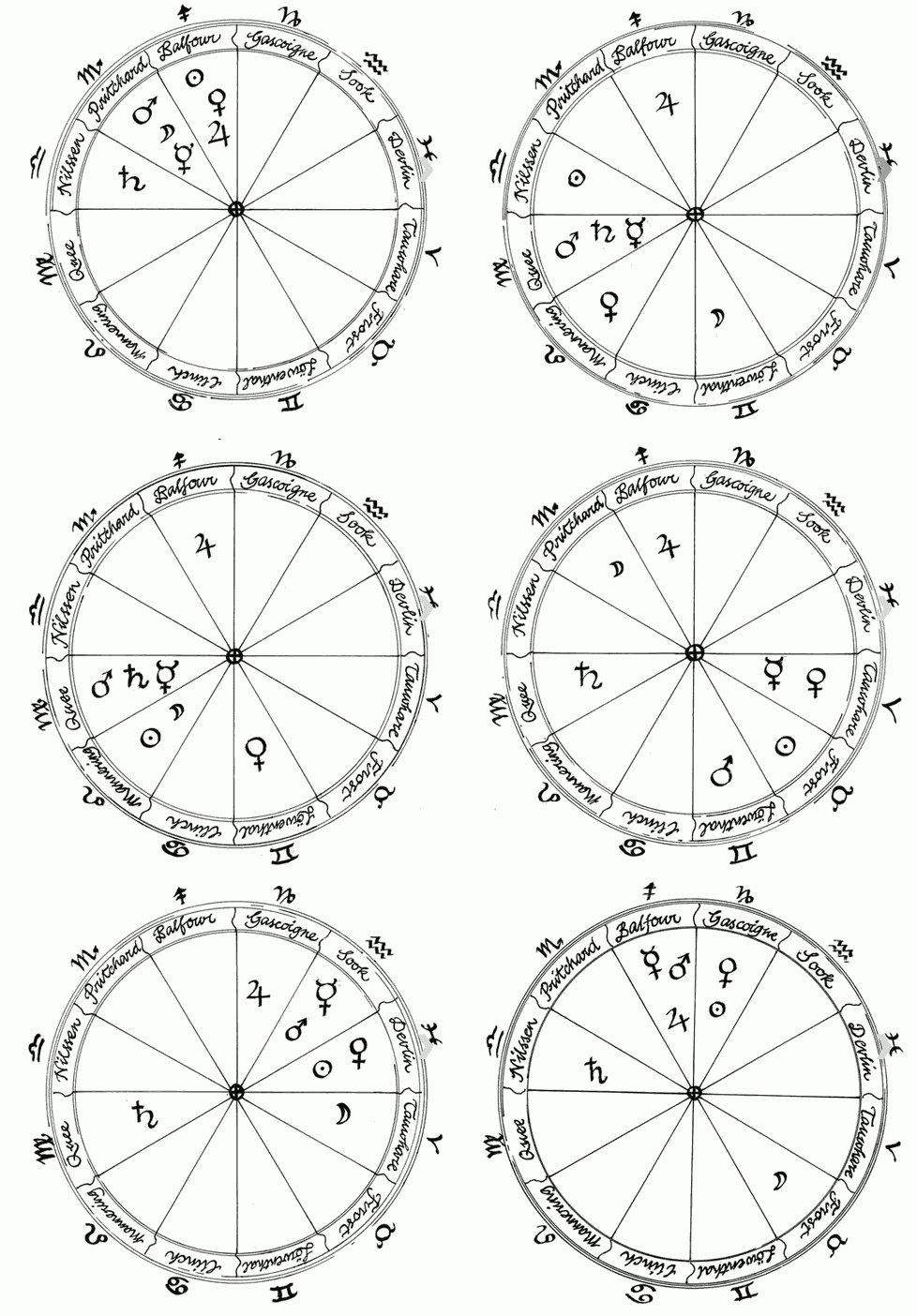
Catton includes all sorts of bells and whistles, but she really didn’t need to, as her writing stands on its own. There are astrological signs and charts of each character’s place on the zodiac, and there are chapter lengths that get progressively shorter by half until it seems almost hard to keep up with all the pieces that are being put together. As I listened to The Luminaries on audiobook, I missed much of this but gained narrator Mark Meadows deftly juggling the varied accents required amidst the cultural mish-mash of gold rush New Zealand. I appreciate getting lost in layers of meaning as much as the next book nerd, however, and I’ll be picking up a hard copy of the book to read again for further understanding of the whole astrological subtext.

I was quite fed up with non-linear narrative as a plot device, especially as so many authors now seem to use it as a cheap trick to create a sense of suspense where otherwise there would be none. The Luminaries, while not traditionally non-linear, told its story with such elegant disregard for linear storytelling that it renewed my faith in non-linear narrative. I wasn’t even aware of the story as non-linear until the elegant end of the book, which brought things to a fully circular close. “Oh,” I thought. “I see.” Books with a satisfying ending, that have so many twists and motives and lies and running through them, are rare indeed.

Eleanor Catton, author of The Luminaries via

Eleanor Catton, author of The Luminaries via

This was one of those books, that if you tune into the book world of things, became mildly controversial. The longest book to win the Man Booker Prize, by the youngest ever author to win it, The Luminaries is an astounding (literally record-breaking, although we save that sort of term for sports) achievement. After winning the prize, Eleanor Catton said in an interview with The Guardian that old male reviewers don’t take young women authors seriously, and they reviewed the book negatively. From the article:

I have observed that male writers tend to get asked what they think and women what they feel,” she says. “In my experience, and that of a lot of other women writers, all of the questions coming at them from interviewers tend to be about how lucky they are to be where they are – about luck and identity and how the idea struck them. The interviews much more seldom engage with the woman as a serious thinker, a philosopher, as a person with preoccupations that are going to sustain them for their lifetime.

I want to acknowledge Catton for voicing this issue, as a young woman of such mighty talent in the book biz. I’m sure this is something most women can relate to, as I have found myself sometimes saying to friends, “I wish people would want to know my mind, rather than see if I’m dateable.”

Some negative reviews by women asked why a young woman would write a book featuring only two women, one being a whore. This seems the saddest, most limiting sort of criticism–judging someone’s book content because of their sex seems to be an alarming double standard placed on a woman by a woman.

The Luminaries on Amazon.com/Indiebound.org 

Further Reading:

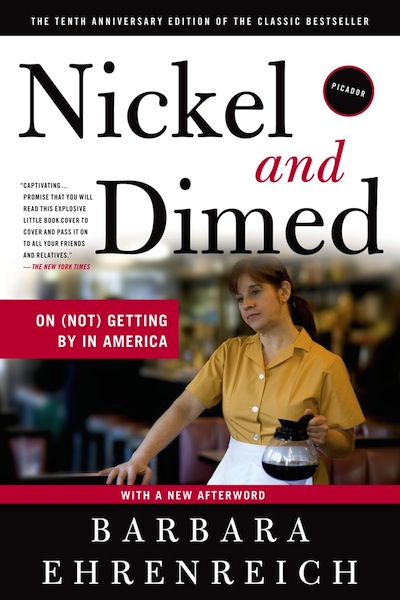
Review – Nickel and Dimed by Barbara Ehrenreich

nickel and dimed cover


Nickel and Dimed: On (Not) Getting By in America is wealthy and successful journalist and author Barbara Ehrenreich‘s experiment on living and working at the poverty level, seeking minimum wage jobs around the country and the housing she could afford based on her pay.

Ehrenreich’s ability to persuade was proven most memorable in the last chapter, where she takes off her minimum-wage job mask and allows herself the freedom to write a fiery, elegant critique of the American economy as that well-studied woman she is. I think the problem with fish-out-of-water journalism is that it focuses on the journalist’s experience, which by definition must be naively awkward: Ehrenreich is surprised managers are able to search her purse, and she goes into a staff meeting at a diner expecting discussion of marketing plans rather the usual rote rules and regulations. Take a fish out of water, it will flop and it will flail at every turn. Although Ehrenreich is an activist of all kinds, with a rich history of working towards social change, it is clear from some of her astonishment she has worked with quite a bit of autonomy for a long time now. This seems to me to almost diminish the experience of those who work around her, who have grown up working in retail and service industries, and know exactly what to expect, but still can’t make it. I would have much rather read a book where the eloquent Ehrenreich told one or two of their stories in detail, with her unadorned, jarring yet insightful commentary and research added along the way.

Her insights about low-paying, repetitive work and the things it does to your mind were so right on, these sorts of bizarre changes to your behavior and thought patterns. At one point, she says menial labor results in a type of “tunnel vision”:

“Work fills the landscape; coworkers swell to the size of family members or serious foes. Slights loom large, and a reprimand can reverberate into the night. If I make some vacuuming error, which I do often enough, I can expect to spend part of my evening reviewing it and rebutting the reprimand. . . “

Although not a minimum wage worker, this has certainly this has always been my work experience in the customer service and retail industries, and the experience of coworkers around me who obsess about mistakes and fear repercussions for slight infractions . Many years after working at a call center, I still have bizarre dreams of the queue of calls waiting to be answered, or of trying to stay away at my desk early in the morning, jerked awake by yet another ringing phone.

The chapter on working at Walmart was especially relatable for anyone who has worked retail, as Ehrenreich describes the bizarre animosity which develops between staff (who spend all day folding, straightening, organizing) and customers (who spend all day tossing beautifully arranged items about, picking them up with grubby fingers, allowing teething children to gnaw on merchandise as casually as they would a snack). Working in retail, there always seems to come a point of modern showdown: staff standing behind register, glaring at a customer who enters their store or area late in the day, daring them to touch any of the perfectly arranged, elegantly hung, exactly stacked merchandise. Your sense of reality goes, day in and day out, straightening the same area over and over again. Ehrenreich begins to feel this late in the day, as she tires of putting away go-backs in the Walmart women’s section:

“I cannot ignore the fact that it’s the customers’ sloppiness and idle whims that make me bend and crouch and run. They are the shoppers, I am the antishopper, whose goal is to make it look as if they’d never been in the store.”

At one point she comments that she relates to the clothes more than the customers, and feels protective of the space. All this, yes, is exactly my experience when working in retail. She has such a knack for perception, working in that environment such a short time but being able to describe the experience so exactly.

The glimpse into Walmart itself was terrifying to me, much more than Ehrenreich’s struggle to make it at a restaurant chain or housekeeping service. Although the cruelty of the home-dwellers towards the cleaners is cringe-inducing, to the point that I wished Ehrenreich would have revealed herself as a journalist and asked these people what they were thinking in acting in such a way, the true villain in Ehrenreich’s book is the corporation, and the supervisors loyal to it, all getting rich off the back-breaking work of people not able to afford more than a bag of chips for lunch or allowed to sit down when their feet ache. I knew Walmart was bad, I live in the Bay Area and its impossible not to absorb that sort of information just by breathing the air here, but I didn’t know how bad. After reading Ehrenreich’s experience at Walmart (no discussion of pay before orientation, and anti-union talk in orientation, especially), I knew I had to learn more.

I watched the 2005 documentary Walmart: The High Cost of Low Price, which acted as a nice addition to Nickel and Dimed. It featured ex-Walmart managers explaining the corporation’s extreme union-busting activities: flying in a specialist team by private jet to take over the store and install monitoring equipment at the first mention of the word ‘union’ by the staff. Clearly I’m a bit behind on learning about this stuff, but I can’t help but feel its good to know just the same.

Then the Walmart documentary reminded me of the “Who Is Dependent on Welfare” video which floating around the internet, which explains not only the concepts Ehrenreich wrote about in this book but also mentions the issue as it relates to Walmart specifically.

Reading this also made me think of There are No Children Here: The Story of Two Boys Growing Up in the Other America by Alex Kotlowitz, one of the most effective works of investigative journalism I’ve ever read. Kotlowitz, rather than focusing on his experience, documented the life of two boys living in Chicago’s Henry Horner Homes in the early nineties. More than reading about a privileged white man playing a game of trying to make ends meet and seeing if it can be done, Kotlowitz documented the sheer horror of day-to-day life for these two little people, each with their own shining little personalities being painfully shut down by constant violence and poverty, at Henry Horner Homes. And Ehrenreich touched on this here, but I would have loved for her to go so much further–I wish she would have offered to give these people a bit more of a voice. When Ehrenreich insists the poor are living in a state of emergency moment to moment, it seems like a much more fair solution to be witness to their struggle and offer them a voice and a platform for their actual crisis, rather than imitating or experience with that same crisis as an experiment.

Nickel and Dimed: On (Not) Getting By in America by Barbara Ehrenreich on Amazon.com/Indiebound.org

There are No Children Here: The Story of Two Boys Growing Up in the Other America by Alex Kotlowitz on Amazon.com/Indiebound.org

Review – The Martian by Andy Weir


the martian by andy weir_Fotor

If you love taking things apart and seeing how they work, if you had a soldering iron in middle school because you actually needed it for your various hobbies, or if you are obsessed with duct-taping solutions to life’s many problems, The Martian by Andy Weir is the perfect science-based thriller for you.

In Weir’s not-too-distant future, NASA has successfully sent two manned missions to Mars. The Martian focuses on the third Mars mission attempt, which goes badly in the most unpredictable of ways. Mark Watney, astronaut, botanist, and engineer, and protagonist is left behind when a dust storm causes the rest of the crew to evacuate in a blinded tizzy. Watney’s crew mates, thinking he has been mortally wounded, blast off the planet in the agreed-upon getaway craft, unwittingly leaving this single guy stranded on the Red Planet. Thus Watney becomes a sort of Martian himself, trying to frantically use all his knowledge in every clever, jury-rigged Survivorman-esque type trick in the book to stay alive until help can reach him. Sort of like the hardest test he’s ever taken, but hands-on, and often his oxygen, food, or water supply hangs in the balance. Billion dollar NASA-built equipment falls to pieces around him as he tries to push it past its intended use date or break it apart into more appropriate survival gear, and Watney plays genius-level whac-a-mole with complex problems in his struggle to stay alive long enough for rescue.

I confess I’m not a big fan of biology and chemistry myself, which is a bit frightening to realize as they are the basic building blocks of life, right? What can I say, I’m just an arts and letters type of girl. I found The Martian slow to get into as Watney tells his story through journal entries, detailing complex explanations and calculations of the many processes which Watney must depend on to survive, which went right over my head. I’m sure this aspect of the book was a welcome change from the usual thriller for the more skeptical among us, who are constantly bombarded with miraculous feats of survival with no explanation or logic behind them. If you wonder where the science is in much of your science fiction, its right here in The Martian, waiting for you.

Where the book came alive for me (and where my interests usually lie) was in NASA’s reaction to the predicament of this lone man stranded on Mars. Once characters at NASA are introduced, their struggle to balance the constant badgering of the media, and what comes to be the world’s obsession with this single man and his lone struggle for survival, with their own ultimate powerlessness over his situation created a much more interesting story. (Of course, CNN dedicates an entire program each evening to updating people on Watney’s status.)

The premise of The Martian is such an intriguing one that the book is difficult to resist, as the idea of a man being lost on an uninhabitable planet with only science to save him is haunting–there’s power there, as we made it to Mars, and then there’s fear there, as while we made it to Mars, we couldn’t make it back. As a firm grasp of science in the book is what makes the trip to Mars possible, that idea is then twisted when Watney must use those same skills, as an engineer, to harness the resources of a hostile planet and make it habitable. Can science dig us out of the messes we use it to plunge into? Watney, alone on Mars, armed with engineering and botany degrees and the supplies his team abandoned, attempts to answer that question.

The Martian by Andy Weir on Amazon.com/Indiebound.org

Further Reading:

Review – The Storied Life of A.J. Fikry by Gabrielle Zevin

the storied life

I do not like postmodernism, postapocalyptic settings, postmortem narrators, or magic realism. I rarely respond to supposedly clever formal devices, multiple fonts, pictures where they shouldn’t be—basically gimmicks of any kind. I find literary fiction about the Holocaust or any other major world tragedy to be distasteful. I do not like genre mash-ups a la the literary detective novel or the literary fantasy. Literary should be literary, and genre should be genre, and crossbreeding rarely results in anything satisfying. I do not like children’s books, especially ones with orphans, and I prefer not to clutter my shelves with young adult. I do not like anything over four hundred pages or under one hundred fifty pages. I am repulsed by ghostwritten novels by reality television stars, celebrity picture books, sports memoirs, movie tie-in editions, novelty items, and — I imagine this goes without saying — vampires.
― Gabrielle ZevinThe Storied Life of A. J. Fikry

If you are still pining for Ajax Penumbra, the lovable curmudgeon of a bookstore owner introduced in Mr. Penumbra’s 24 Hour Bookstore, than The Storied Life of A.J. Fikry is the book for you. We meet protagonist Fikry as he seems to be drinking, eating, and grouching himself to death. As the owner of Island Books, his community’s only bookstore, he stocks books strictly to his limited tastes. He lives above the bookstore, and he frequently blacks out over his plate of frozen noodles after an evening of heavy drinking alone.

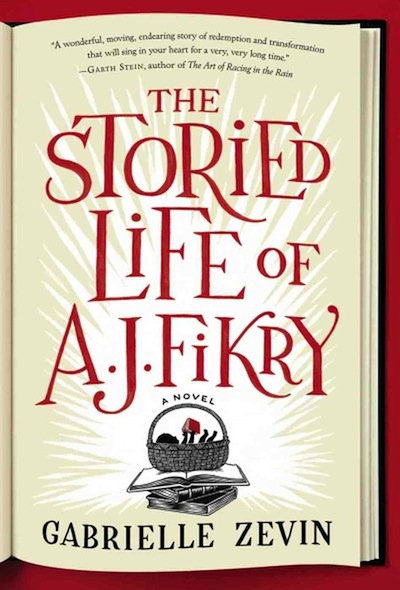
And then, an unfortunate (or fortunate?) series of events occurs: something is lost, and a little baby is gained. The mom abandons the baby to Fikry, hoping to give the charming tiny girl an opportunity to grow up amidst books and become quite a smart person someday. Yes, this explains the little baby in a basket on the book’s cover. As Fikry finds himself frantically googling how to raise a 2-year-old baby, the community rallies around him and his charming mystery child. Like magic, the irritable old man settles into his place in the world as a book lover who spreads that love to others, the curious baby reminding him that he has knowledge to share.

I knew I had to get this book when I received its (audio version) press release, with a quote from Scott Brick, the book’s narrator and my favorite narrator of all time, singing the novel’s praises:

I was told up front that The Storied Life of A.J. Fikry was a beautiful book, but I was still completely unprepared for just how beautiful. I was absolutely stunned by the experience of narrating Gabrielle Zevin’s latest book. It drew me in from the very first page. It was the kind of book that I might ordinarily find myself finishing after only three days in the studio, yet I found myself stretching it to four, then five, simply because I hated the idea of it being over. I wept while recording it, more than once. I’ve been blessed to narrate over 600 audiobooks thus far, and this book instantly pushed its way to the top of my list of absolute favorites. I told someone recently that I wish I could redo the book, and they asked, ‘Why, did you not like the way it turned out?’ I said ‘No, I just wish I could have that experience of reading every word again over and over again.’

Wow, right? If Scott Brick loved it that much, I’m all in. Although I didn’t get the audiobook version, the novel totally drew me in from its first pages, and I drank up the entire book over the course of a few days. The combination of flawed, honest, real characters and constant fiction references made for quite fun reading. Despite all the wit, there is a lot of heartbreak here, and I can usually do without a bit more of the sappy stuff. I appreciated Fikry’s clever banter with those around him much more than the commentary on love and loss. But beware, if you are the teary type–get your tissues ready.

The brilliance of The Storied Life of A.J. Fikry is in its book talk, as this is a book written for readers to truly appreciate. Fikry knows the town’s sheriff enjoys mysteries, and gradually suggests more complex mysteries until the policeman is reading Kate Atkinson’s Case HistoriesFinally the cop leaves genre behind entirely, and runs a book club out of Island Books for his police force. This is what happens to your friends when you are a lover of books, the story seems to be saying–it is impossible for that love not to rub off, even just a little bit, on those around you.

Reading is often isolating, in our world of constant competition for attention, where movies are now in IMAX 3D, video games now read your movements so you don’t even press buttons while you play, and Buzzfeed produces countless lists that spread insidiously through the internet just begging to be read like little itchy viruses. When so many things with bright lights and big noise compete for our spare time, reading for pleasure can sometimes get left behind with its quiet little books snuggled onto shelves or hidden within a flat e-reader. But books like The Storied Life of A.J. Fikry are a secret duck call to all the readers out there in the world, reminding us how powerful our pastime is, and how much stories matter. Human connections are made, vibrant discussions develop, and babies who read books blossom into book-loving writers themselves. Reading is, perhaps more than any other pastime, a study of human nature and human experience, and this is something The Storied Life of A.J. Fikry celebrates on every witty, heartbreaking page.

If you live in my home state of California, this is a great book to pick up at a local bookstore on May 3rd, CA Bookstore Day. What better way to celebrate the power of bookstores than with the story of Island Books and its owner.

The Storied Life of A.J. Fikry by Gabrielle Zevin on Amazon.com/Indiebound.org
Further reading:

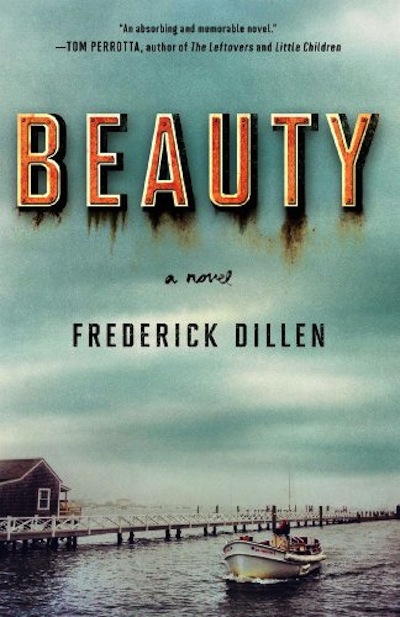
Review – Beauty by Frederick Dillen

beauty

Beauty by Frederick Dillen is a hopeful little book, drenched in all the optimism its title suggests. This is the story of capitalism falling in love with community, the tale of a fisherman totally unversed in corporate sexual harassment policies falling in love, and deep down at its heart a book about claiming that little bit of space you always knew you needed but never realized was right there, waiting for you, to call it home. It is an odd combination of corporate-love-fishing story, but short and sweet enough to make it all palatable.

A tall, no-frills firing machine, corporate undertaker Carol McLean looks factory workers in the eye as she tells them their jobs are lost. The sneering men who run her firm call her “the Beast,” an unwanted nickname none too affectionately parroted by those she leaves jobless and disassembled in her wake. Despite the humanity she struggles to bring to her job of seeing companies through their last days, it is brutal and wearing. When Carol gets the ironic call that she too is being let go, her final undertaking flips from a mission in disassembly to a project in keeping the small fish processing plant going as her own company. With dreamy fisherman Easy by her side, Carol steps out of her role as the Beast and tries to use her business-savvy for good.

If Joshua Ferris’s Then We Came to the End was the modern corporate worker’s swan song, a final cry of agony from the suffering cubicle-everyman before he came back to the office with a gun or a stress-related illness, then Beauty is the corporate worker’s battle cry, of taking the power back and making googly eyes at your love interest, all at the same time.

Beauty by Frederick Dillen on Amazon.com/Indiebound.org
Review – Girl with Glasses: My Optic History by Marissa Walsh

girl with glasses

Girl with Glasses: My Optic History by Marissa Walsh is the cheeky, charming, light-hearted type of read that only a certain type of young woman can appreciate. Having serious visual impairment myself, with ever-thickening frames and glasses from a young age, I can totally relate to the rites and rituals recounted here. Walsh tells her coming-of-age story through the lenses of each pair of glasses she wore, from her first, to her dalliance with those maddening contact lenses, into the pair she now wears with pride.

When I talk with the non-glasses-wearing crowd, I’m constantly baffled at how the other half lives. Some of my friends have never (!) visited an eye doctor, and are confused by my yearly appointments for vision checks and blurriness-inducing dilation. I still remember, even though I’m not sure how young I was, how much my view of the world changed after I got my first pair of glasses. My mom says I was in kindergarten, but I think surely it has to be more around 3rd grade. Wearing those glasses for the first time on the way home, I gained access to a world far outside what I thought was meant to be viewed by one little person. It seemed like I had these crisp new laser-like eyes, beaming directly to store signs bordering the street as I peered out the car window, causing me to exclaim about every sign I could see. All these new layers of the world I had previously dismissed as a blur of haze and fuzz, now transformed into something speaking just to me.

This is the fun of Girl with Glasses, the ridiculous memories of being coached by an ophthalmologist’s assistant to put in contacts, the frustration of glasses in the rain, the impossibility of trying on a new pair of glasses when you can’t see what they look like on your face because you need your real glasses to see, and other common commiserations only GWG’s can really understand. I could see this being especially appreciated by middle school and teenage girls who are waffling between glasses and contacts, trying to pick between the two.

Those looking for a deep, contemplative memoir should look elsewhere. This isn’t that kind of book. Girl with Glasses is a fast and silly read, full of witty one-liners that aren’t afraid to border on cheesy. A few reviewers complain about the generalizations–as GWG’s, they don’t fit the stereotypes here. I don’t think the author fits all the stereotypes of a GWG either, and I don’t think she’s making a case here for stereotypes being accurate. I think she’s trying to have fun with the stereotypes, and use them to describe herself when she’s able. I see this as a statement about the stereotypes around glasses, rather than a statement about the accuracy of those stereotypes. That being said, I don’t think there’s too much deep stuff here. This is meant to be fun and funny. I suspect Walsh just wanted to talk about this unique aspect of her childhood, which she knew many others out there must be going through as well. And what better way to discuss all the absurdities of life with glasses, then through humor.

If you pick up Girl with Glasses, make sure you grab a printed version. The audiobook narrator is alarmingly overemphatic to the point she sounds like she’s trying to amp up a kindergarten class up for playtime. Great for a quick commercial selling something, but horrible for hours of narration where the cheese becomes tiring.

Girl with Glasses by Marissa Walsh on Amazon.com/Powells.com

Further Reading:

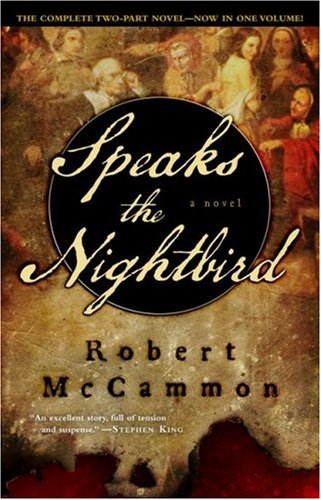
Review – Speaks the Nightbird by Robert McCammon

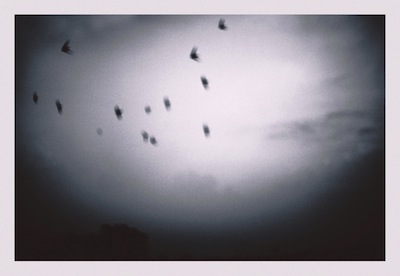
Photo by Paola Ramirez. Postcards from nowhere in particular (I). via.

Photo by Paola Ramirez. Postcards from nowhere in particular (I). via.

     “My voice is near its end, but this I have to tell you,” he whispered. “There was once a merchant. An eager, industrious young man. His business… required him to rise early and thus to bed early. But one evening… he stayed awake past his usual hour… and in so doing he heard the wondrous singing of something he’d never heard before: a nightbird. The next night, he managed to stay awake later… to hear more of the bird’s song. And, the following night. He became so… so intoxicated with the nightbird’s voice that he thought only of it during the day. Came the time when he spent all the night listening to that song. Could not carry out his business during the sunlit hours. Soon he turned his back altogether on the day, and gave himself over to the nightbird’s beautiful voice… much to the sad end of his career, his health… eventually his life.”

     “A fine parable,” Matthew said curtly. “Is there a point to it?”

     “You know its point. A parable, yes, but there’s great truth and warning in it.” He gave Matthew a piercing stare. “It is not enough to love the nightbird’s song. One must also love the nightbird. And… one must eventually fall in love with the night itself.”

speaks the nightbirdI’m surprised Robert McCammon isn’t talked about more in same breath as Stephen King, that he isn’t a more treasured part of our horror fiction landscape. After being simultaneously entranced and repelled by his apocalyptic fiction novel Swan Song, I wanted more. McCammon’s Speaks the Nightbird isn’t my normal pick of thriller, as it takes place in the harsh and wild landscape of Carolina in 1699, an as yet unsettled America looming in from all sides. Sometimes historical fiction bogs me down with its language, but the plot here held promise. An enterprising businessman has settled the town of Fount Royal further down the coast than the already established Charles Town. Into this struggling settlement, magistrate Isaac Woodward and his clerk Matthew Corbett arrive, summoned to put on trial a supposed witch. While the townspeople eagerly blame all their woes on the woman they call a witch, the young clerk Matthew Corbett, protagonist, refuses to believe such a simple but fantastical explanation, and investigates the various eccentricities of Fount Royal’s small citizenry.

The beauty of McCammon’s work, both here and in Swan Song, is his refusal to neglect any aspect of the story. Speaks the Nightbird begins with the magistrate and clerk’s journey into Fount Royal, and their disastrous attempt to stay overnight at an inn on the way. Many novels wouldn’t open with such bold, unpleasant scenes, but McCammon isn’t one to shy away from the grittier aspects of human nature. The reader’s discomfort grows right along with that of the clerk, Corbett: “He could feel the raw tension in the air between them, as nasty as the pinewood smoke.”

McCammon’s love of detail and willingness to walk the reader through each frightful scene step by step, ensuring that we stay with these characters every agonizing moment of their struggles is what makes his work great, but for me, some of the gore bordered on unreadable. Speaks the Nightbird contains some gut-wrenching descriptions of 17th century medicine, and one incredibly repelling barn scene between a man and his horse. Swan Song wades even further into the darkest depths of human nature, with unflinching descriptions of humanity trying to survive after nuclear attack. Is this pleasant reading? No. Is it powerful, and scary in a slow, smart way? Absolutely.

Speaks the Nightbird by Robert McCammon on Amazon.com/Indiebound.org

Swan Song by Robert McCammon on Amazon.com/Indiebound.org

Further reading:

Review – HHhH by Laurent Binet

Hhhh2

“When I watch the news, when I read the paper, when I meet people, when I hang out with friends and acquaintances, when I see how each of us struggles, as best we can, through life’s absurd meanderings, I think that the world is ridiculous, moving, and cruel. The same is true for this book: the story is cruel, the protagonists are moving, and I am ridiculous.” -Laurent Binet, HHhH

HHhH by Laurent Binet is oddly named but rightly so, as the Nazi tendency towards alliteration is just as uncanny as the rest of this historical metafiction novel. Sounding insane but purposeful, Laurent Binet struggles to tell the story of World War II’s Operation Anthropoid while also writing of his own shortcomings in research, distaste for other works of the time, and ultimately heartbreaking obsession with the exact details of a history lost to time.

Heydrich, aka "The Butcher"

Heydrich, aka “The Butcher”

The title stands for the Nazi phrase “Himmlers Hirn heiBt Heydrich,” translated to “Himmler’s brain is called Heydrich.” HHhH‘s villain, and the focus of an assassination attempt in Operation Anthropoid, is Reinhard Heydreich. A mastermind looming over Nazi history, Heydrich founded the Nazi intelligence organization, supposedly acted as the brains behind Heinrich Himmler, leading member of the Nazi party, and put in motion events which led to the Holocaust.

Operation Anthropoid itself, with Heydrich at its center, seems epic and book-worthy. Two parachutists planned to tumble from the sky and land in occupied Prague, where Heydrich worked out of a castle. These two parachutists, they’ll hide out. They’ll plot, they’ll assassinate Heydrich. They’ll die themselves. They are prepared for this. When the plan is executed, of course, things go wrong, as life often does.

Where HHhH seems to lose me is in its argument: Binet complains about the inaccuracies of other historical fiction in his novel, but by doing this he distances himself further from the truth of the story he wants to tell. Binet comes across as arrogant and pompous, and perhaps arrogance is necessary to write yourself into your own story like this, but for the first part of the novel I’m not sure it works. Binet often breaks out of the story to tell the reader he doesn’t know how something happened–rather than putting the reader into the story further, this seems to detract attention from the historical event and put attention directly back to the writer himself. It seems if he truly loved the story of Operation Anthropoid, as he professes in the book, he may have told the story itself in his eloquent and powerful prose, with the extensive research he completed, to the best of his ability. Giving the story he so appreciated to his readers, without his constant commentary, seems to me a better way to honor the actual historical event.

I think the most powerful books are written by authors humble enough to lose their own voice entirely in their work, sacrificing themselves totally for the sake of the story. I understand that Binet tries to pave the way for something new here, but I’m just not sure this new form is true to his stated intentions.

The power of HHhH is its second, unfortunately brief, part, where Binet finally recounts the assassination attempt and its aftermath with a powerful, dream-like precision. Like watching the entire scene in slow motion, Binet recounts the story he has been waiting a whole book to tell, and the details are haunting, the sentences crafted in perfect time with the action as it unfolds. Binet shows his ability to write well here, and he tells the story in such a crisp gasp of breath that I consumed this part quickly, wanting more. Ironically, this more traditional historical fiction, with its speculation and imprecision, is where Binet shines and the history itself seems to leap off the page.

HHhH on Amazon.com/Indiebound.org

Further reading: