Book Reviews

The good, the bad, and the ugly about books I’ve recently read.

Review – How Doctors Think by Jerome Groopman

how doctors think2

Medical students are taught that the evaluation of a patient should proceed in a discrete, linear way: you first take the patient’s history, then perform a physical examination, order tests, and analyze the results. Only after all the data are compiled should you formulate hypotheses about what might be wrong. These hypotheses should be winnowed by assigning statistical probabilities, based on existing databases, to each symptom, physical abnormality, and laboratory test; then you calculate the likely diagnosis. This is Bayesian analysis, a method of decision-making favored by those who construct algorithms and strictly adhere to evidence-based practice. But, in fact, few if any physicians work with this mathematical paradigm. The physical examination begins with the first visual impression in the waiting room, and with the tactile feedback gained by shaking a person’s hand. Hypotheses about the diagnosis come to a doctor’s mind even before a word of the medical history is spoken.
–Jerome Groopman, How Doctors Think

I’ve had some notably bad doctors’ appointments. According to How Doctors Think by Jerome Groopman, as a patient struggling to communicate with doctors, I’m not alone. The book opens with the true case of a young woman incorrectly diagnosed for fifteen years (!!!) with anorexia nervosa with bulimia, when she actually had celiac disease. As her weight kept drastically lowering, she was encouraged to eat simple carbohydrates in the form of cereal and pasta to gain weight. She consulted, according to Groopman, “endocrinologists, orthopedists, hematologists, infectious disease doctors, and, of course, psychologists and psychiatrists.” All of them missed the diagnosis of celiac. Out of desperation, the woman went to see a gastoenterologist, who looked beyond the previous diagnoses and discovered that it was the very foods she was encouraged to eat which were making her ill.

As the title suggests, this book is a sometimes terrifying, sometimes triumphant exploration of the way doctors think. Groopman talks to colleagues and experts in many different fields of medicine about their mistakes regarding judgement or emotion, the errors they often see other doctors making in practice or training, and cases that were remarkable because of their success or failure.

Groopman is a doctor himself, but that doesn’t keep him from needing medical care, and one chapter is devoted to his experiences seeking treatment from hand surgeons for his painful, inflamed wrist. Many of the top-rated surgeons present him with nonsensical diagnoses, and seem rushed or reluctant to answer questions. If this is how a fellow doctor is treated, I wonder, how can any of us without medical training expect to fare in this world of 15 minute appointments?

But this is why Groopman wrote How Doctors Think –to give those of us who can’t normally get inside a doctor’s brain, and may feel quite uncomfortable sitting in an exam room garbed only in a paper gown, a chance to communicate more clearly with the people who often make snap judgements about our health and livelihoods.

Groopman gives practical suggestions, including language or phrases patients can use to help doctors avoid cognitive errors. He recommends that patients acknowledge stereotypes they may fall into, as doctors rely on pattern recognition to do their work quickly and usually place patients into stereotypical categories. Acknowledging that you come across as a bit neurotic, but you do think you have a health condition despite this, can prevent a doctor from dismissing your concerns as hypochondria. He suggests mentioning your main fear to your doctor, even if it is something you saw while Googling or heard as a horror story about a friend of a friend. He also suggests discussing it directly if your doctor is having a hard time communicating with you or seems to dislike you. (However, when doctors were asked what they would do if they were seen as a patient by a doctor who had difficulty communicating, they answered that they would just get a new doctor.) I absorbed as a crucial point of the book that acknowledging medical care as a relationship consisting of communication between two people, with emotions and judgements and all that comes along with two individuals, can result in better health care.

There are some alarming statistics mentioned and then not explored too much–that doctors like sick patients the least, and that the physical symptoms of the mentally ill are often neglected, as their complaints are written off as part of their mental illness. If there was one thing I found unbalanced in the book, it was a lack of exploration surrounding the studies cited about doctors’ feelings towards their patients and medical bias in general.

Most of the book consists of Groopman’s interviews with other medical specialists about their thoughts on how they, and other, doctors think. They share with Groopman the memorable times they have been right, and the shattering times they have been wrong. All of this makes a great narrative, but amounts to anecdotal evidence of success or failure in medicine. Most of us aren’t able to see the shining stars of medicine that Groopman speaks with, which makes me appreciate the book’s practical advice more than its stunning examples of life-saving care.

How Doctors Think by Jerome Groopman on Amazon.com/Powell’s.com/Indiebound.org

If you like this book, try reading:

Review – Cop Town by Karin Slaughter

cop town

If there’s one thing I love in this world, it’s mystery fiction. Sometimes I need a good literary mystery, with headache and nightmare-inducing twists and turns. Sometimes, I crave something more straightforward. I picked up Karin Slaughter’s previous novel Criminal on one of these whims, hoping for an easy, enjoyable read. Criminal was part of Slaughter’s Will Trent series, and the story alternated between Will’s present storyline and the vivid, gritty life of his supervisor, Deputy Director Amanda Wagner, as she joined the police force in the 1970’s. Slaughter’s historical fiction stood out to me, as rookie cop Amanda Wagner dealt with rampant sexism on the police force and navigated some of Atlanta’s worst neighborhoods.

So you can imagine my excitement when I learned about Cop Town, Slaughter’s first stand alone novel, focusing entirely on women of Atlanta’s police force in the 1970’s. Amanda Wagner’s part of the story stood out to me in Criminal, and it definitely left me wanting more from that time period. It seems as if this is the world Slaughter is meant to explore and uncover: an “old boy” network in which the old boys are all haunted by various wars, a culture in which heavy drinking seems required to make it on the job, a police force where male cops aren’t your peers but cat-calling, leering father figures who won’t take you seriously.

In Cop Town, smart, observant Maggie Lawson works in this type of environment, and she reluctantly takes Kate Murphy under her wing as she flails (both literally and figuratively) in a uniform that is much too large for her. Someone is shooting Atlanta cops, killing them execution-style in the back of the head, and Maggie and Kate take it upon themselves to look for what the rest of the force, drunk and stuck in their own ways of thinking, can’t or won’t see.

There’s some discussion of the accuracy of all the racism and sexism portrayed in these books. Could the police force really have been that horrible for the first few women on the force? In both Criminal and Cop Town, Slaughter notes at the end of the novels her attention to accuracy and historical facts in research. But the books are, of course, fiction. I think this is why the work Voice of Witness is doing, and the concept of oral history/personal narrative in general, is so important. I would love to see Karin Slaughter tell the stories of some of the first women on police forces in America, as they relayed those experiences to her.

The larger thing to remember when reading Cop Town, however, is that this isn’t meant to be a textbook. This is a mystery. This will be a book you can’t wait to pick up, a book your heart beats a bit faster when you read, a book you feel a bit disoriented when you look up from because you were so lost inside its pages. Putting these protagonists in an unbelievably hostile work environment heightens the tension from all sides–there is a shooter loose on the streets of Atlanta, yes, but there are enemies everywhere else these young women turn.

Cop Town by Karin Slaughter on Amazon.com/Powell’s.com/Indiebound.org

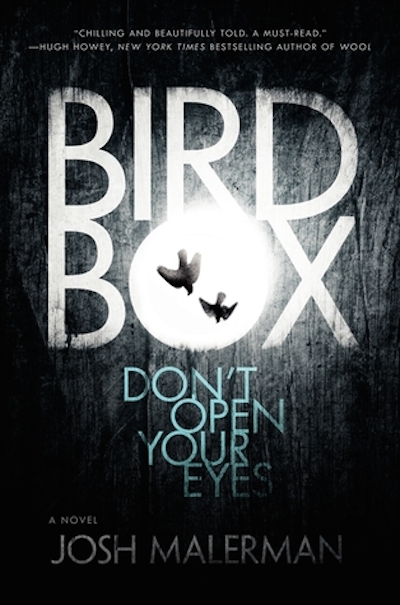
Review – Bird Box by Josh Malerman

bird box

In our entertainment-laden society, it is hard to create something scary. We live in the time of the seven (!) Saw movies, which coined the phrase “torture porn.” We’ve seen the evolution of Stephen King both in his novels and the screen, topiary bushes in the shapes of animals rushing towards us each time we leave them unwatched, clowns waiting to snatch us and carry us down gutters into their lairs, bubbles thrust down upon towns from the sky. We’ve known sweet women possessed and more stern but kind exorcists than we can count, guys keeping the faith even when their church has cast them out for their beliefs. And we’ve known haunted houses. Oh, the haunted houses we’ve known.

But Josh Malerman brings us, with Bird Box, the sort of hysterical fear Edgar Allen Poe builds to an almost unbearable height in his short story The Tell-Tale Heart. The air in this book is so thick with anxiety you can cut it with a knife, you can dive into it like it’s a pool. You could almost see the anxiety, if you could just open your eyes.

Because you must keep them closed: in Bird Box, people catch a glimpse of something which drives them mad. They start killing each other, killing themselves. Those unaffected start covering their windows, not leaving their homes. The unaffected choose to act as if they were blind, using brooms or canes to find their way when they must venture out. As time progresses, only those who blindfold themselves outside, to prevent seeing whatever sort of awful thing outside is poisoning humanity, survive.

This is a book of people stumbling in the dark, feeling for things they aren’t sure are there. This is a book in which the moment you decide to take off your blindfold and open your eyes could be your last sane moment on earth. This is a book that heavily relies on mood, one voice calling out slowly to another voice. “Are you still out there…?” “Yes, I’m still here.” “…Are you okay?”

In one of its most memorably terrifying scenes, getting water from a well (what should be a short distance from the safety of home) turns into a sensory delirium, all panic and doubt, as footsteps are heard or imagined, objects felt or brushed over, queries distorted by distance and fear. A short walk turns into an agonizing plunge through the unknown. Bird Box is very scary, indeed.

As those countless Saw films illustrate, brutality is a simple formula, blunt and easy to replicate. Much more difficult to execute is suspense. Suspense happens in all the moments we’ve trained ourselves to ignore, as we rush from one action film to the next, as we save reading only for our daily commutes. Malerman creates, with Bird Box, a world in which each statement, each movement or pause, is dripping with a delicious suspense that demands your full attention. Bird Box deserves a dark house and a warm cup of tea, it deserves your full attention as you pause and think, with each character: “Is this the moment to open your eyes, despite all that may be out there, waiting?”

Bird Box by Josh Malerman on Amazon.com/Powells.com/Indiebound.org

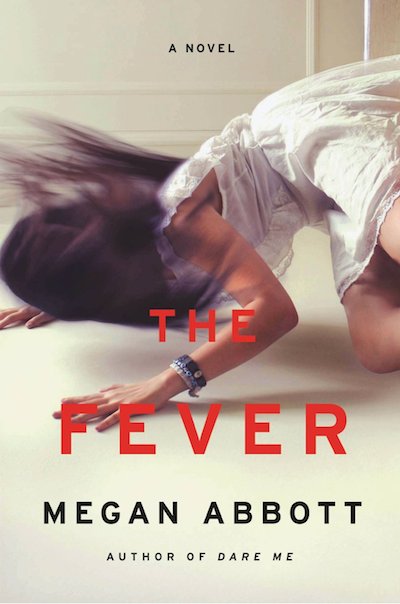
Review – The Fever by Megan Abbott

the fever

Something odd is happening to the teenage girls in the town of Dryden. The town itself seems a bit other-worldly, its dead lake fenced off and bright with glowing algae; its weather shocking, hot-to-cold in the blink of an eye; its rain almost heavy and almost acidic, shredding raincoats to pieces.

The girls who attend the town’s high school begin dropping like flies. Literally dropping, their desks and chairs pitching to the side as they seize and jerk and ramble incoherently. Journalists arrive. The hospital overflows. An event, it seems, is occurring.

The FeverMegan Abbott’s new novel, contains more than just the literal kind. There is also the frenzied burst from adolescent upwards into adulthood, making the book’s high school setting a veritable hothouse of blooming sexuality and judgement, all bright colored tights and testosterone, miniskirts and swoon. The agony and ecstasy of adolescence seems to be Abbott’s expertise, as her previous novel Dare Me focused on the heartless steeliness of the high school cheerleading squad, gone much too far.

As with any high school saga, The Fever‘s story wouldn’t be complete without nearly maniacal parents, losing their daughters to a mystery illness. Could it be the HPV vaccine, which the school recommended? Could it be that mysterious lake, fenced off and smelling odd, forbidden and beautiful? Could there be a haunting in Dryden, or perhaps something more sinister, but sadly, simply human?

High school seen through Abbott’s eyes isn’t a place you go and get educated, but a world unto itself. Anyone who was young once, who grew up awkward and gangly and full of hormones, knows this to be all too true. Abbot’s high school is a place where everything is known by everyone simultaneously, like magic. A place where there are multiple languages, spoken in glances and movements and jangly bracelets tousled on wrists. And a place where once things start going wrong, everyone is a suspect, and no one is safe.

The Fever by Megan Abbott on Powell’s.com/Indiebound.org/Amazon.com*

*Due to the Hachette/Amazon feud, if you are interested in buying the actual book I suggest buying at Powell’s.com or your local bookseller–the hardcover is $26.00 (full cover price) on Amazon as I’m writing this, and will take 2-4 weeks to ship. Yikes! Don’t let this confuse you, as the book is out, and if you want it now you can have it now. Powell’s.com will ship it within 1-3 days, or at your local retailer you can just pluck the book right off the shelf.

Review – Big Brother by Lionel Shriver

big brother

     The fact that my clothing has been visually available to other people I do not find upsetting. The body is another matter. It is mine; I have found it useful; but it is an avatar. Given that most people presumably contend with just this rattling disconnect between who they are to themselves and what they are to others, it’s perplexing why we’re still roundly obsessed with appearance. Having verified on our own accounts the feeble link between the who and the what, you’d think that from the age of three we’d have learned to look straight through the avatar as we do through a pane of glass.

     –Lionel Shriver, Big Brother

Oh, the banes of this human form: the never-ending maintenance our bodies require, the obligatory strings attached through bloodlines to those we must care for or neglect. In her most recent novel, Big Brother, Lionel Shriver asks the question, “How do we eat?” and finds the answer to be a resounding “not well.”

When Pandora, former catering whiz and expert chef, arrives at the airport to pick up her big brother for a visit, she’s shocked to see much more of the man than she used to know. Her brother has morphed into that class of people politely termed “morbidly obese,” more simply called very, very fat. Thus begins big brother Edison’s bull-in-a-china-shop visit with Pandora and her family, consisting of a series of startling cracks resonating through the home as things break, and never-ending awkward moments as huge amounts of food disappear from the fridge, as peanuts dropped on the floor are clambered after.

What makes Shriver a good, if inconsistent, author to me is her ability to examine the least human parts of our experiences together. She questioned the roles of motherhood in her school shooting shocker We Need To Talk About Kevinas a mother struggles to feel love for her dark, cruel son. And again, Shriver explores these limits of love and the obligations of family in Big Brother. The novel’s harsh characterizations of both the obsessively skinny and the overweight, its low boil of family tension bubbling up unbearably high, to resonant and unforgettable meltdowns (“…when I polish off a doughnut, that’s not doing anything to you!” Edison shouts at Pandora’s health-nut husband, at one point), seems reminiscent of what made We Need To Talk About Kevin so lulling and irresistible, so accurate in its unpleasantness, so precise in its displays of how we can fail in relationships, and how we can fail ourselves.

The accuracy here comes from intimate knowledge of the subject matter. Although unaware of this until done with the book and researching for this review, Shriver tells the New York Times Magazine that she has a strict diet and exercise regimen herself. She eats one meal a day, and runs 10 miles a day. She also had an obese brother who died young, at age 55. Tragically, much of this book seems to be inspired by our real life struggles to find contentment in eating when surrounded with abundance. As Pandora notes in the book, and any addict can understand, “The most sumptuous experience of ingestion is in-between: remembering the last bite and looking forward to the next one.”

Big Brother by Lionel Shriver on Amazon.com/Powell’s.com/Indiebound.org

We Need to Talk About Kevin on Amazon.com/Powell’s.com/Indiebound.org

If you liked Big Brother, check out these books:

A Few Of My Favorite Things

People often ask me about my favorite books. As a reader, I could (and often do) talk for quite a while about what favorite means and why it qualifies a thing as important. When I was younger, stumbling upon an author that forced me to read differently, and then as a result think differently, was a memorable and revelatory experience. I think of the books that have influenced my reading habits in some way as important.

I found refuge in diatribes of feminism during adolescence, reading essays over and over that spoke to me, tearing them out of books. I especially loved the essay “Blood Love“, from Christina Doza, in the book Listen Up. I tore it out of the book and folded it up and still have it today, nested in a box with old letters and pictures and other such memories.

i was amelia earhartOne of the first books I stumbled upon at the Sandy, Utah library which made me think of writing as something I totally understood, something quietly settled through its words despite the tragedy in its story, was the tiny novel I Was Amelia Earhart by Jane Mendelsohn, published in 1996. A surreal memoir of Earheart’s fated last flight, it begins: “The sky is flesh. The great blue belly arches up above the water and bends down behind the line of the horizon. It’s a sight that has exhausted its magnificence for me over the years, but now I seem to be seeing it for the first time.” Reading the Goodreads reviews now, I can see the overwriting they describe. But then, all I saw was a quiet unreality so clearly created I could melt into, losing myself completely to the story of a desperate Amelia and her alcoholic navigator.

bloggerrebeccaIn middle school, the first book I read for a class and truly loved (maybe even truly read all the way through) was Rebecca by Daphne DuMarier. It begins:

Last night I dreamt I went to Manderley again… I came upon it suddenly; the approach masked by the unnatural growth of a vast shrub that spread in all directions… There was Manderley, our Manderley, secretive and silent as it had always been, the gray stone shining in the moonlight of my dream, the mullioned windows reflecting the green lawns and terrace. Time could not wreck the perfect symmetry of those walls, nor the site itself, a jewel in the hollow of a hand.

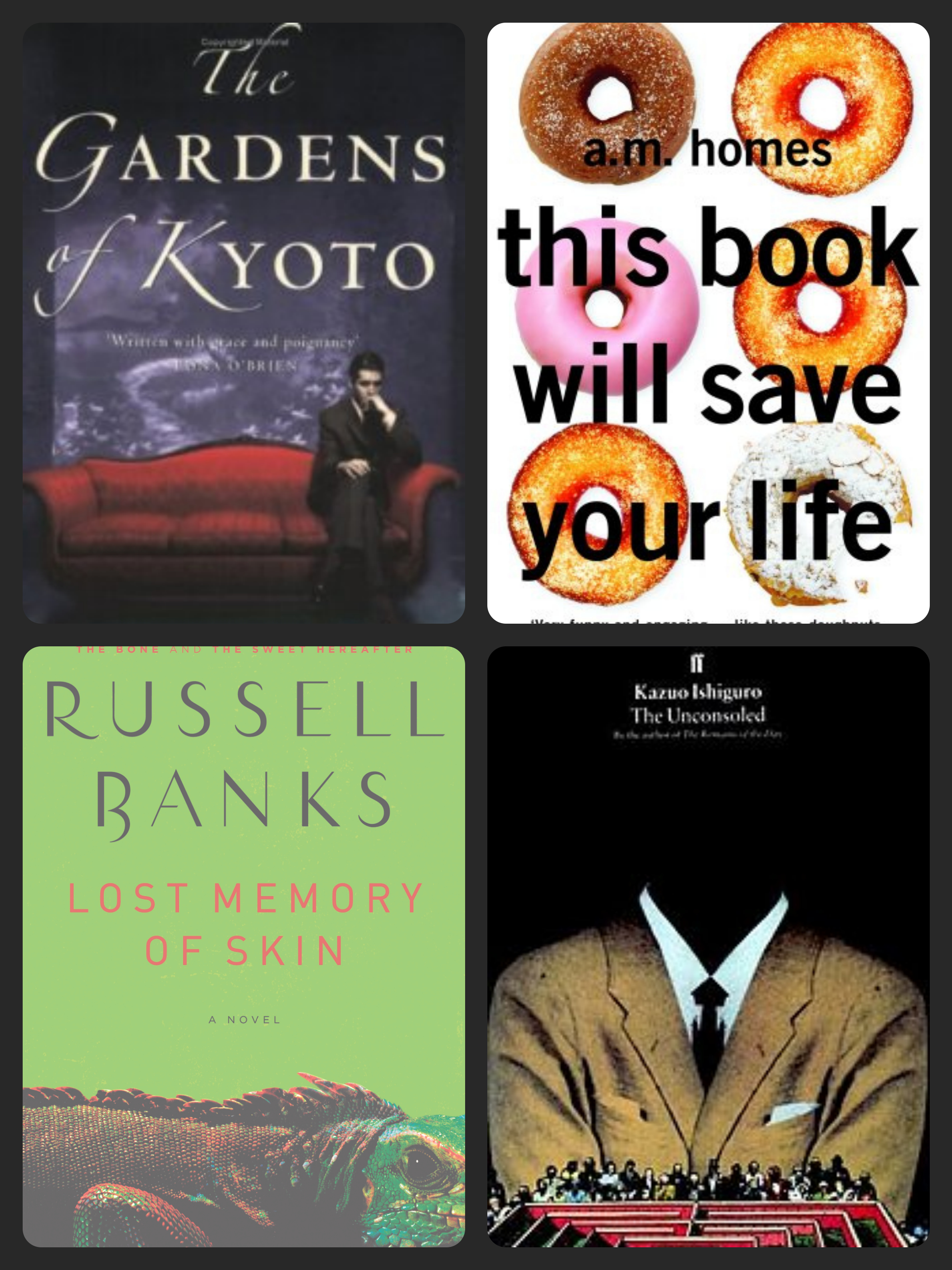
four books squareNow, I have a handful of books that I look to as favorites, most by authors with many books I adore. Kazuo Ishiguro‘s The Unconsoled is haunting and distant, like trying to read a book as it bends down a dark hallway away from you. The Gardens of Kyoto by Kate Walbert tells what appears to be the saddest, simplest story, with ends that begin to unravel as you flip the pages. Walbert writes the style of story I enjoy reading the most, of a seemingly innocent narrator relaying an enchanting past, details blurring and fading as the tale continues. Margaret Atwood is a master of this style as well, with both The Blind Assassin and Oryx and Crake illustrating the dangers and oddities of memory, as narrators enchant themselves more than their readers while relaying their histories. A.M. Homes‘s This Book Will Save Your Life puts the brakes on life’s cruise control as its main character begins to connect with the people he sees every day. In Lost Memory of Skin by Russell Banks, the wreckage of the tech age is a teenage sex offender.

by bloodFinally, Ellen Ullman‘s By Blood is all the right things–slightly insane and drawing the reader into that insanity, bursting with what seems like too much story in incredibly contrived situations that just might be believable, exploring worlds within worlds of heartbreak and loss. Any book exploring San Francisco’s darker moods is a book after my own heart. This one does so beautifully, as its narrator rides the empty N-Judah line through the fog and towards the wind and chill of Ocean Beach.

But for me, there’s always one book that is undoubtedly my favorite, which stands above the rest. What is it, you ask? More on that this weekend…

Review – The Good Nurse by Charles Graeber

the good nurse coverWhat could be more chilling than the most prolific serial killer in history? The cool and calculated corporations he worked for, hiding his tracks every step of the way.
 

On a windy day, the sort of day I call “earthquake weather” with no idea what earthquake weather feels like, imagining an anxiety in the air that starts at dirt level and works its way up to my sensory organs, my friend Lindsay and I sat in SFO’s cell phone lot. Our world-traveling friend Wendi was finally due to arrive home after months of globe-trotting. As we waited for any news of Wendi’s delayed flight, we watched the sun fade and others around us get the magic call from family members or friends and rush off towards the terminals, released from cell phone lot limbo. The wind blustered around our parked SUV, and we sat there, facing forward, and somehow realized the radio was cooing calmly about nursing and murder.

On NPR, journalist Charles Grabner was being interviewed about his book The Good Nurse. The not-so-good night nurse Charlie Cullen, referenced in the book’s title, may be the greatest serial killer of all time. He slipped his patients deadly cocktails, or stuck needles in random IV bags, and left a trail of devastation behind him so vast that even he isn’t able to recall all his victims.

Occasionally, sitting in the car, my friend would exclaim after some soundbite (angel of mercy, elderly deaths, autopsy, countless suicide attempts) “God, what are we listening to!” She’d threaten to turn off the radio. But we kept the radio on, as the car around us got dark, and when we ran out of things to talk about we listened to Grabner’s voice telling us what seemed to be an impossible yet true story of a murderer flitting from hospital to hospital, unstopped.

Finally, we got the call cell phone lots were made for: the flight had finally landed and our friend Wendi made it back to that California state of mind. Irrational thoughts immediately emptied my mind (what if we’re stuck in this cell phone lot forever, should we try to bond with the other people waiting in their cars, did the world end and only the people in this cell phone lot are left but we’re all unaware due to cell phone lot isolation), we turned our attentions from the murderous nurse to Wendi’s fabulous adventures abroad, and didn’t give Charlie Cullen another thought as we zipped away from SFO, human cargo safely in back seat, towards the Bay Bridge.

At least I didn’t, until now. I finally picked up The Good Nurse, as the words of its author, Charles Grabner, made an impression. This isn’t just the story of the “good nurse,” as Cullen claims himself to be at one point in the book. And thank goodness for that, as Cullen’s story is indecipherable at best. We may never know his exact motives, as he probably doesn’t know them himself. The Good Nurse doesn’t waste much time speculating on the psyche of a murderer. Rather, the book sticks to the facts. From the beginning of the story, the start of Cullen’s life, there is an alarming abundance of facts–little red flags dotting Cullen’s history.

charles cullen

Charles Cullen, the self-proclaimed “good nurse”

Charlie Cullen’s past is littered with the wreckage of constant struggle with oneself, a landfill of evidence illustrating an unsound mind: countless suicide attempts (over 20, with the first at age 9), domestic violence charges, multiple restraining orders, DUIs, and hospitalizations. Cullen struggled with alcohol abuse, and although this isn’t a heavy focus of the book, one imagines it could be, as so many crucial scenes involve a near sober Cullen drinking again, or hiding his drinking, or a Cullen delusional with drink becoming violent towards himself or others. At one point his fearful wife calls the police while a desperate and drunk Cullen tears the pages from his Alcoholics Anonymous texts, throwing them into the fire. When police arrive Cullen promptly takes an overdose and is rushed the hospital. As anyone who has struggled with alcoholism knows, whatever sort of awful things happen when someone drinks, the story always starts with the alcohol. An optimist might wonder what sort of alternative life this man could have found, had he managed to control the more dangerous of his impulses with 12-step programs, therapy, and medication.

But all this help is offered and rejected, and the first part of the book is an almost unbearably dark walk through Cullen’s history. The rote recitation of suicide attempts and sadistic behavior became so difficult to get through at one point I thought about stopping the book, but I trudged on through.

The bizarre behavior comes not only from the sadistic, alcoholic Cullen but from those he works for, as hospitaladministrators begin to notice they have an “odd duck” on their hands and amazingly, offer him time off with pay or a good recommendation as long as he agrees to leave. Hospital bureaucracy allows this man, who tampered with IV bags at his very first job, to leave a long line of in-house investigations or notes in personnel files in his wake, with no actual repercussions. He receives glowing recommendations, finds new jobs quickly, and is always well paid. One job calls him after a hospitalization at a psychiatric facility, where he was an inpatient after a suicide attempt, not to fire him but to see when he can begin working again.

Part Two of the book widens the story’s circle again, not only including the sad, disturbed Cullen and the neglectful, lawsuit-wary hospitals he floats through, but the street smart homicide cops who finally work the case, a pair of characters with dialogue begging for movie adaptation. Somerset Medical Center finally notifies the police about mysterious deaths in its hospital, in the vaguest way possible, when in a meeting with Detective Tim Braun and Detective Danny Baldwin, a lawyer for the hospital vaguely declares “the medical center isn’t reporting a homicide, but has experienced five unexplainable patient incidents. Last Friday, there was a sixth incident.” What?

And this is where the incredible story truly begins, not with the cold character of Cullen or the even more calculated choices made by hospital bureaucracy. But with these two guys, Tim and Danny, who swing by the mall to pick up a medical dictionary after their meeting with hospital. These homicide police are trained to look at a body, usually a body with some gunshot wounds, and instead are presented with a few memos, a few test results, and a ton of obfuscation. Assistance offered by hospitals is sparse and often incorrect, and every institution seems to oppose the detectives as they seek the truth: at times they go against their own supervisors, and they slowly creep towards facts hidden under layers and layers of hospital misinformation.

At every turn in Cullen’s past, individual people chose to not get involved, or to not rock the boat; all those individual people allowed Charlie Cullen to continue killing for years, across hospitals. He doesn’t even remember how many people he might have killed. The story of these two detectives, and eventually the informant who works with them, is a brilliant, shining example of the truth bubbling to the surface. The brutal weight of sadness surrounding this story is made a little more bearable knowing that in the end, the bad guy and even the bad corporations were no match for two good guys determined to know the truth.

Further reading:

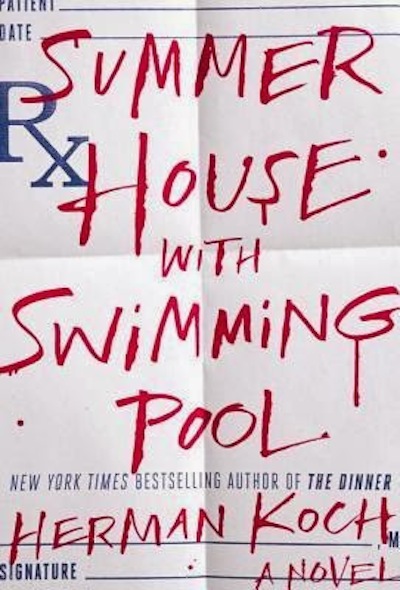
Review – Summer House with Swimming Pool by Herman Koch

summerhousewithswimmingpool

After last year’s English translation of Herman Koch’s internationally acclaimed The Dinner, an agonizing story of the anger and violence dragging under the surface at the dinner table, we know to except something searing and intimate from this master of the slow burn. I expected a car crash of a tale from Summer House with Swimming Pool, vehicles flipped and burned, while I’m left staring and braking as I pass by, unable to speed up and get going and leave the wreckage in my rear view.

I wasn’t disappointed. Koch seems to choose the most mundane names for these books, which drastically juxtapose with their messy and dark guts: a dinner, a summer house, a swimming pool. Simple things. The books, however, take on the most private and tragic of subjects–those around you turning violent and pedophiliac, nights where too much drink goes from fun to bad to irreparable too quickly, choosing to seek revenge on those who have wronged you or your family, allowing revenge to be taken while you sit back and watch the clock.

Summer House with Swimming Pool starts with Dr. Marc Schlosser, general practitioner, revealing to the reader his odd view of his craft and his patients. He seems almost maniacal as he rants of the artists who drink too much and then hide their vices from him, their doctor. He practices medicine with a careless abandon, spending twenty minutes with each patient to ensure they feel attended to while really dismissing most concerns outright. This part of the book, the lead up to the actual meat of the thing, seems to be the weakest, as the Schlosser’s character seems bordering on insanity, unbelievability.

But then, we get past Schlosser’s introduction to his private practice as he recounts what can only be called a tragedy, one of those awkward and beautifully rendered modern family portraits executed so startlingly well by Jonathan Franzen and A.M. Homes in the past. Schlosser and his wife and two kids go camping, and meet up with a patient of Schlosser’s. An actor, with a house. A summer house, with a swimming pool. The booze is flowing and from the beginning things are not quite right–motives are unclear, and Schlosser’s wife wants to leave this new gang of friends. As with so many things, enough small warning signs are ignored, enough unusual events made usual, enough heads turned in the wrong direction, that everything is okay until it all has suddenly, horribly spun out of control. Someone is hurt, and revenge is taken.

I just can’t say too much about this book without giving something or other away, as this is one of those books that illustrates so well our inability to ever truly know those around us, especially those closest to us. Clear your schedule if you pick this book up–I read it in a day or two, unable to stop until I knew what was truly going on, until I’d followed every paranoid twist and desperate turn to the final conclusion.

Summer House with Swimming Pool, just as The Dinner before it, reminds us that every individual has a uniquely intimate private life, swirling with their own motives and fears, their own lies and truths. Koch’s writing deals with, as some of the best writing does, these monstrosities we keep within ourselves or place onto others: the unknowable within us, the rage we hold inside or are unable to hold inside any longer, desires filled or unfulfilled, beliefs rightly or wrongly held. One of the gifts of literature is that we are able to read what other people are thinking, but books like this remind us that we are luckily unable to know what those around us are thinking in everyday life.

Summer House with Swimming Pool by Herman Koch on Amazon.com/Powell’s.com/Indiebound.org

If you like Herman Koch’s writing, try these books:

Related links:

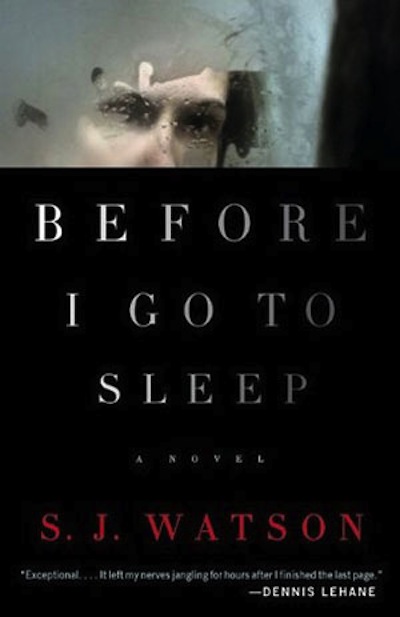
Review – Before I Go To Sleep by S. J. Watson

before i go to sleep

Imagine waking up in an unfamiliar bed. You vaguely recall going out with friends, assume you drank too much as the previous evening is blurry. You assume you went home with a guy you don’t know too well. Things are hazy. Looking up, you see a woman’s robe and slippers. An older woman’s robe and slippers. Looking over, you see an older man in the bed. You, being a twenty-something yourself, are confused. Did you somehow get picked up by an older, married man? Sliding quietly out of the bed and into the bathroom, the mirror image shocks you: the woman in the mirror isn’t the twenty-something you remember, but an older woman with an aged face you can’t recognized. You turn, and see pictures and notes on the bathroom wall. YOUR HUSBAND. BEN. The notes explain, plastered next to photos of you and the older guy from the bed. Photos of you both over a span of what must be decades–decades missing from your memory entirely.

He’s woken up now, this older man, and he’s standing in the bathroom door. You’ve never seen him before, you are sure. “I’m Ben,” he says. “I’m your husband. You had an accident. You don’t remember. But its okay.”

This is how each day begins for Before I Go To Sleep’s Christine, who has short term memory loss. She’s unable to form new memories the way most of us recall yesterday and three days ago–only her long term memories are deeply stored in her mind, sometimes hazy and sometimes bright and flashing, causing each day to be a shock of new realizations and old grasps at reality. All new memories formed wash away as she crawls into bed and falls asleep, causing the next morning to be a repeat of the jarring scene above, as she awakens confused. Each day is a puzzle for Christine, with acquaintances made strangers, routines unknown, and endless trust placed in those around her.

That trust, so crucial for her survival, as she awakes each day in bed with a stranger who walks her through their life together, begins to erode slowly when she gets a call from a Dr. Nash. He’s been seeing her secretly, he says, without her husband Ben’s approval. He recommended she keep a journal. The journal is hidden, and he tells her where to find it. In the front of the journal, Christine reads in her own handwriting: DON’T TRUST BEN.

And thus begins the mystery of Before I Go To Sleep, a puzzle where the entire plot has been erased with Christine’s short term memory. This is the worst type of unknown, a different sort of dread and fear–rather than not knowing who waits for her down a dark hallway, Christine is unable to remember her own motives for previous actions, or her own reasons for choosing to trust or distrust those in her life. She is unable to act as her own protector, holding those around her accountable for past events. She finds herself forced to take the word of her husband and her doctor about what she has said she wanted, or needed. She frantically writes in her journal, attempting to document everything each day, as she knows she won’t be able to remember it all clearly the next.

Before I Go To Sleep has been on my to-read list for years, as it was published in 2011 and I never got around to seeking it out. I happened upon it on a clearance shelf at a bookstore, and I’m glad I picked it up. I’m the type of person who always judges and calculates the mystery as its happening, and this was one I thought I had figured out towards the middle. I was ready to dismiss the book as too simple, with glaring hints everywhere about the plot’s outcome and an overly naive narrator. Luckily, there was a twist towards the end that I hadn’t expected, and it kept me interested and renewed my faith in the book. Thrillers like this are just the right level of easy to fall into, like a warm bath that isn’t too hot. Once you are in this book, you don’t want to get out again.

It is impossible not to compare this book, or really any short term memory psychological thriller, to the 2000 movie Memento (which was inspired by a short story, “Memento Mori.”) But there is non-fiction documenting short-term memory loss as well. Before I Go To Sleep‘s author S. J. Watson was influenced by Forever Today: A Memoir of Love and Amnesia by Deborah Wearing. Oliver Sacks discusses the case of an older man who believes himself to be a young sailor in his classic The Man Who Mistook His Wife For A Hat: And Other Clinical Tales. Sacks says of his work with this man, in “The Lost Mariner,” “I kept wondering, in this and later notes–unscientifically–about ‘a lost soul’, and how one might establish some continuity, some roots, for he was a man without roots, or rooted only in the remote past.” Sacks recommends his lost mariner keep a diary, just as Dr. Nash recommends to Christine in Before I Go To Sleep.

This type of mystery, which explores the weaknesses and faults of the human mind, is disorienting and a bit maddening. Presenting more than just an unreliable narrator, Before I Go To Sleep reminds us how delicate and frail our perception of the world is, and how easily that view can be shattered.

Before I Go To Sleep by S.J. Watson on Amazon.com/Barnesandnoble.com/Indiebound.org

If you liked Before I Go To Sleep, put these books on your to-read list:

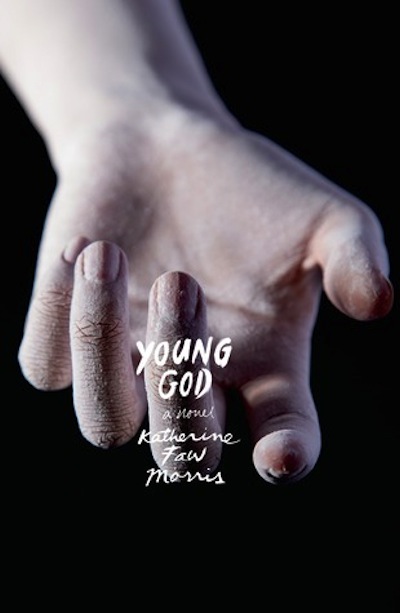
Review – Young God by Katherine Faw Morris

young god

Reading Young God is like being punched in the face over and over. It’s like eating sour candy until your tongue feels raw and your stomach aches but you just keep eating the candy anyways, knowing it isn’t fun anymore and it has possibly turned into a quite negative experience but dammit, there’s half a bag left. This book has few redeeming qualities but that doesn’t make it easy to put down.

We meet Young God‘s heroine Nikki, thirteen, in an opening scene that sets the tone for the rest of the novel: her momma falls off a diving cliff the wrong way, high on attention from a guy and who knows what else, and splits her head open. Nikki quickly runs from the scene of the accident with her mother’s lover and his backpack full of drugs, and the book is off and running at the pace of an adrenaline high. Nikki seems to be the girl the adage about years alone not truly measuring how much one has lived was made for, and this isn’t a tale of redemption as much as it is one of survival of the fittest and the maddest in a mad mad world.

Constantly fearing child services, just a call away, Nikki fights or flights her way from druggie guy to druggie dad, without the luxury of self-analyzation or insight surrounding the desperation of her situation. Things go from bad to worse, and from icky to really really icky, so if you can’t handle to darker stuff then this isn’t the book for you. It reminded me a bit of Tampa by Alissa Nutting in its breezy, un-analytic writing style of the most horrible aspects of human nature. Sometimes the murderers and rapists and pimps aren’t carrying on intense internal dialogue about life and ethics as they go about their dark business, these books seem to say. Sometimes people are just acting and reacting, bouncing off each other and feeding their animal drives and fleeing from consequences. A jarring statement to make, which leaves protagonists with little room for development, and even littler opportunity for us as the reader to comprehend any of their behavior. But hey, that’s life. To me this style of writing about this sort of subject is scarier than any horror novel.

I’m not sure how I feel about country noir as a genre in general. I haven’t read enough of it to make any sort of judgement, but I certainly hope we don’t see the emergence of Appalachian horror stories of poverty and blight as amusing simply because of the locale. The most intriguing characters aren’t stereotypes but the opposite, asking us to challenge our preconceived notions about the world and the way we see it. I became interested in this story after seeing a blurb shared on Elle’s Facebook page which declared the book a mix of Winter’s Bone and Breaking Bad. It feels to me as more a mix of Spun and Go Ask Alice. But Morris is a child of Appalachia herself, and she dated older men as a young rebellious thing trying to figure out her place in the world.

In the Elle interview, Morris says she cut down the novel from a longer version, and I would love to see the original story. I understand the purpose in editing it down to something brutally short for effect, but I need a bit more of a character’s internal dialogue to relate to their world. Young God is a story of drugs and violence, but its purposeful lack of depth makes it pulpy and a bit too grotesque for my taste.

If you like Young God, check out these books: 

Further reading: