
One of Us is haunted in all the right ways, with memories and rumors, psychic dogs channeling ghosts while very human monsters slip by undetected.
book reviews
Review – The Secret Place by Tana French

You forget what it was like. You’d swear on your life you never will, but year by year it falls away. How your temperature ran off the mercury, your heart galloped flat-out and never needed to rest, everything was pitched on the edge of shattering glass. How wanting something was like dying of thirst. How your skin was too fine to keep out any of the million things flooding by; every color boiled bright enough to scald you, any second of any day could send you soaring or rip you to bloody shreds.
That was when I really believed it, not as a detectives solid theory but right in my gut: a teenage girl could have killed Chris Harper. Had killed him.
Detective Frank Mackey’s daughter, Holly Mackey, has some bad luck where murder is concerned. We met her in Tana French‘s third Dublin Murder Squad book, Faithful Place. In that story, Holly, along with Detective Mackey and the rest of his family, seemed inescapably weaved into the investigation of a long-forgotten disappearance.
In French’s new novel, The Secret Place, it’s six years later, and Holly has sprouted up into a young woman, all sarcasm and hair-tosses. Once again, a murder investigation has found her. She comes to Detective Stephen Moran, also from Faithful Place, with a note she found on an anonymous board at her posh boarding school, Kilda’s. The note claims to know who killed a boy from a neighboring school on Kilda’s grounds last year. Last year, the investigation went nowhere. This year, Moran is determined to solve the case and move up to Murder from what he sees as the dead end of Cold Cases. Detective Antoinette Conway, a door-slamming, in-your-face woman in a Murder Squad that likes its women flirty and accommodating, agrees to let Moran ride along and talk to the girls. Holly came to him, after all.
Thus the setup for a day of teenage interrogations, alternated with flashbacks of Holly and her girl gang the previous year, leading up to the murder.
At first glance, The Secret Place seems to be a clash of two starkly different worlds. Placing these brash and calculating detectives into the dreamy, fantastical boarding school world of adolescent girls, with all their wide-eyed, moon-struck whimsy and best-friends-forever chatter, Tana French might as well have set this book on another planet. Moran and Conway could be wearing space suits as they walk through the bizarre landscape of the boarding school’s halls, listening to the choir’s melodies echoing from down a corridor, watching nuns walk slowly over the well-manicured lawns.
But slowly, slowly, French lets us see that perhaps these boarders are the detectives perfect match. The girls are compared to carnivorous jungle beasts multiple times–jaguars with sharp, ripping claws, “big cats released for the night.” At one point Detective Moran says he knows he’s outnumbered by some of them as if he saw three guys with “a bad walk roll around the corner and pick up the pace towards you.” These girls are giggling ugg-wearing thugs; they’re long-haired, lip-glossed, yes, but they’re manipulative, and maybe murderers.
Or are they? Moran seems to ebb back and forth in his views just as the girls seem to gain and lose their confidence. One moment these are young women in total control, and the next moment they’re kids, panicking, hysterical, too young and so easily manipulated. It seems like the detectives aren’t sure if it is naivety tripping them up, or its opposite.
As the long day passes, the girls are kept in seclusion from the rest of the school, made available for the detectives to interview in groups and individually, kept quarantined to prevent their teenage gossip and outbreaks of hysteria from catching. A less talented author could have made this feel tedious, as the single day of investigation alternates each chapter with a flashback to Holly and her three best friends before the murder took place.
But this isn’t a less talented author, this is Tana French, who takes the police procedural out of the squad room and finds it wherever she chooses–the darkness of the woods or the isolation of an abandoned construction site. She finds it here, too, amidst the art projects of teenage girls and the glades they find magic in at night. The flashbacks give the reader a chance to compare conclusions formed by the detectives in each interview with what actually plays out, what behaviors each girl reveals contrasted with her actual role in friendships and crimes, in an amateur sleuth’s ideal setup. Layers upon layers of motive and manipulation are peeled back in a way that seems possible only amongst teenage girls or incredibly dysfunctional families, where so much of what matters is how others behave.
And for those that are concerned (no spoiler alert needed), this is a Tana French novel that answers the question “Whodunnit?” clearly, so you won’t feel left cheated if you are looking for a solve. But don’t expect to understand everything that happens on the grounds of Kilda’s, as so much of the magic of adolescence isn’t meant for the outside world.
The Secret Place by Tana French on Amazon.com/Powell’s.com/Indiebound.org
If you like this book, try reading:
Review – The Arsonist by Sue Miller

The lesson was there were things you had to let go of, losses and mysteries you had to learn to live with.
Sue Miller‘s new book, The Arsonist, is about the biggest things that happen in the world and how anyone manages to keep going despite them, about the edges of the divides between us that we stand near and peer across, and most of all, about falling into or out of love, how easy and sudden and unexpected love creeps up on you or sprints away from you. Maybe, then, this is a book about how little control we really have in the world, and how coming to terms with that is never simple.
After 15 years of working for an NGO in Africa, Frankie has come home. She usually drops by for a visit, but this time she’s not sure she wants to go back. But how can she stay? She’s been setting up food stations, fighting hunger at refugee camps, and compared to where she was in the world, life in the quaint New Hampshire town her parents have retired to is a life of ease, abundance, and in the face of all the world’s plight, insignificance.
Frankie’s parents, Sylvia and Alfie, were once summer people in the town of Pomeroy, but in retirement they’ve chosen to move full-time to the old farmhouse which has acted as the family’s summer vacation home, hoping to ease the pressures of their own quiet crises with a quiet life. Intellectual Alfie’s memory loss seems to be getting worse and worse, and Sylvia keeps gulping down glasses of wine and early afternoon drinks, hoping to find a way to cope with what she fears could be the end of her husband as she knows him.
In the midst of all this disaster, big and little, global and familial, an additional, artificial one is created: fires begin to bloom at night, setting homes ablaze. When Frankie first hears the siren of the fire truck, a foreign sound to her after her time in Africa, she doesn’t recognize it, and thinks it must be some sort of animal. The local paper owner Bud, a city refugee himself, reports on the fires as he struggles to decipher Frankie’s intentions–will she stay or will she go? Is she capable, after seeing so much world out there, of caring about this small little piece of it here?
I’m a fan of long books, and I loved the time Miller took telling the beginning of this story. As other reviewers on both Goodreads and Amazon complained, however, the story is uneven, as the end quickly wraps up. If anything, though, I think this is a testament The Arsonist‘s ability to build characters that draw us in so much we are angry when they leave us. I could have happily read this book, doubled in length. I’m also a huge fan of leaving mysteries unsolved, and not wrapping up all the details precisely, and Miller manages to do this here, without leaving the reader feeling cheated. If you do finish this book wanting a simple conclusion to its many questions, big and small, you haven’t been paying attention.
The Arsonist by Sue Miller on Amazon.com/Powell’s.com/Indiebound.org
Review – The Quick by Lauren Owen
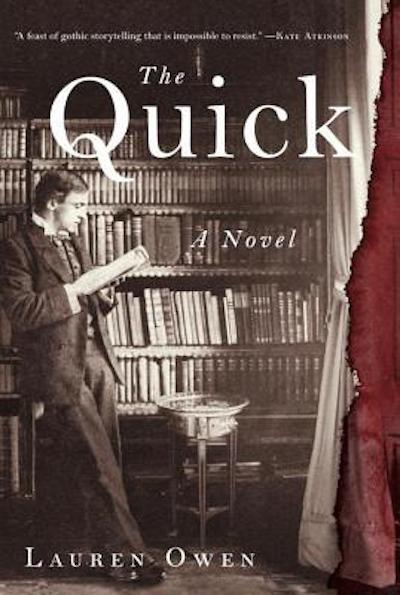
I’ve debated how to review Lauren Owen’s The Quick since finishing it a few days ago–I don’t think this is a novel with a twist, as much as it is a novel which dedicates a bit of itself to misdirection. Even the cover could be misleading, as I realized through summaries that this was going to be a novel of secret societies and suspense, but I assumed it would be more in the literary vein, like Alena Graedon’s The Word Exchange.
The Quick seems to tell the story of James and Charlotte Norbury, growing up with a distant father in their treasured but disintegrating Askew Hall. Where generations of the Norbury clan lived lavishly before them, James and Charlotte are mostly left to their own devices, losing track of time amidst old statues in the garden or building their bravery by creating tests of courage in the library.
James grows into a young man and sets off for the big city of London, as young men are wont to do. He’s determined to be a writer, and rarely leaves his flat, sitting up at his desk all hours and staining his hands with ink as he creates long classic poems. He finds himself living vicariously through his roomie Christopher Paige, who comes home late to divulge tales of London high society, heavy drinking, and debauchery.
But the story here hasn’t really begun, because much more than friendship is brewing between the aristocratic Christopher and the meek James. And even then, the story hasn’t really begun, because at a dinner party, James notices that Christopher’s brother looks ill–he seems so pale, and is he wounded? Is he bleeding?
As the book doesn’t directly introduce its subject matter, some readers may be frustrated. The Quick is a historical novel, yes, but it is a supernatural historical novel. All this high society, all this classic London aristocracy–there is something horrible bubbling underneath. There are fight scenes, there are wild street children getting shot in the feet, there are fires and desperate carriage rides to safety. The book includes journal entries, scribbled and ripped in places. Those hoping for the story of James and Charlotte to continue as it did in the style of the book’s beginning may be dismayed, as reality shifts around them, and the narrative drastically changes.
If you are seeking a mild-mannered historical novel, you may want to look elsewhere. If you are interested in what might be crouching in the shadows of that mild-mannered historical novel, overlooked and unexplored, then you’ll want to pick up The Quick.
The Quick by Lauren Owen on Amazon.com/Powell’s.com/Indiebound.org
The Quick reviewed on the New York Times Sunday Book Review – with all the spoilers I didn’t give, for those curious.
Review – The Night Season by Chelsea Cain
The Night Season is the fourth of Chelsea Cain‘s Gretchen Lowell and Archie Sheridan series, and I grabbed it on a whim, seeking a fast and easy mystery. In The Night Season, Portland is flooding and people are dying, and the two things may or may not be related. Gretchen Lowell, the beautiful and bewitching serial killer who previously batted Archie Sheridan around like a cat playing with a wounded mouse, moves from a central figure in the story to an ominous and ever-looming presence. She’s never really gone and certainly not forgotten, tucked away safely in prison for now, but still drowning Archie just as much as the water that floods into the city around him.
Let me start by saying California is in the midst of a drought, and all the rain in this book was making me crazy! We’ve had some days here where the humidity feels like it just can’t hold, like the sky will have to burst open and rain, but the rain doesn’t come. When the soggy, sand-bagged, and serial killer-infested floodwaters of a thriller make you pine for rain, you know something is very wrong.
For those unfamiliar with the twisted love story of the Gretchen Lowell and Archie Sheridan series, it started with Heartsick in 2007. That book introduced us to the bold, unabashed premise of a cop so enmeshed with the serial killer he hunted and ultimately put behind bars that he’s in love with her, that he needs her like he needs the next fix of the pain pills he’s popping. After tracking Gretchen Lowell for 10 years, Archie Sheridan wasn’t sure where the line between obsession and love was drawn, and that was just how the sadistic Lowell liked it. Heartsick overtly asked all sorts of important questions about the dependence of those who fight evil on that evil, in the same vein as Thomas Harris‘s Red Dragon and The Silence of the Lambs.
Despite the dark, depressing threads of possession running through these books, I love Cain’s comic characters, especially Archie Sheridan’s spunky sidekick, crime reporter Susan Ward. The Night Season features a cast full of oddballs, as we’d expect nothing less from Cain, but none are so odd that they become caricatures or stereotypes of real life. I would love to see a Susan Ward spin-off series where we explore her world a bit more without Sheridan, although I realize Cain would then be required to create an unusually high amount of odd happenings in Portland for Ward, as a journalist, to discover and document away from her police pals. There’s something innately likable about Ward and the gusto with which she crashes crime scenes, a gal who brings her hippie momma’s goat into the living room to keep him out of the rain, and who stomps about the floodwaters with punky hair and big boots.
And Ward does provide much needed comic relief–Cain doesn’t ever turn away from an opportunity to describe a gruesome scene, as these are definitely thrillers. Especially in Heartsick, the first book, there are some descriptive moments of torture where the gore factor is very, very high. If cozy mysteries are more your thing, and you steer clear of the blood and guts, you may want to think twice about checking out this series.
Chelsea Cain also has a new book out tomorrow, One Kick, which I’m hoping to read soon, as the premise sounds a bit cheeky but irresistible. Kick Lannigan was kidnapped as a kid, and trained by her abductor for five years to be a lethal killing machine. She pursued her odd abilities after her escape, and by her twenties she sounds like a well-rounded secret agent, as she’s studied martial arts and knife-throwing. Then, other children get kidnapped, and Kick realizes what she’s spent her life training for. If Kick is as oddly charming as Susan Ward, then One Kick sounds like a promising combination of misery, humor and ka-pow.
The Night Season by Chelsea Cain on Amazon.com/Powell’s.com/Indiebound.org
Heartsick (Gretchen Lowell and Archie Sheridan #1) on Amazon.com/Powell’s.com/Indiebound.org – this is only $2.99 on Kindle right now, a great deal.
One Kick on Amazon.com/Powell’s.com/Indiebound.org
ChelseaCain.com – she is going on tour for One Kick, with dates announced on her official site.
Review – Fourth of July Creek by Smith Henderson

Chromed long-haulers glinted like showgirls among logging trucks caked in oatmealy mud, white exhaust thrashing flamelike in the wind from their silvery stacks.
― Smith Henderson, Fourth of July Creek
Sometimes a book rises up out of nowhere, something unexpected and fresh for all the right reasons, with language so pretty it rolls off the tongue, molding the world around you into something so crisp and haunting it seems exactly like the way things are but at the same time so much more than you’ve ever perceived, like you’ve stepped out of real life and into the prettiest, messiest coloring book you’ve ever seen.
Fourth of July Creek’s story is sad but brilliant, and angry in a way that we all might be a little angry, as we’re all doing our best and sometimes that just doesn’t seem to be enough. Protagonist Pete Snow is far from the stereotypical social worker, a man working in rural Montana and partying out his pain when what he sees gets to be too much. Rather than creating a stereotypically “difficult” protagonist or the opposite, a soft spoken hero, Pete is somewhere in between, reminding us how much of our reality is acted out in places most books, movies, and magazines don’t dare visit.
What I wanted Pete to be, what role I expected him to fulfill in the novel from the start, was so far from where he ended up it was a startling reminder of how individual characters often fail to bloom into full realizations of human strength and failure, greatness and ugliness, all rolled into one.
The local, small high school calls Pete to handle a malnourished and dirty teenager who stumbles upon the grounds, and Pete begins to help this hesitant, wild boy and his father, a paranoid extremist who has seceded from society. Speckling this story is the story of Pete’s daughter, in interview format, and this separate storyline becomes a sort of call and response ode to how simply things go awry, to how easily we make decisions with little understanding of why, and ultimately, to how well we keep going despite it all.
I didn’t think twice when I started Fourth of July Creek–I had no idea what it was about, I just saw the title around a few places and thought I should read it, as my endless struggle to read all the books in the world continues. Right away, this book had me. Smith Henderson’s trawling, plodding use of language is eloquent in a peculiar way which feels true to the Montana country featured in the novel, also feels comfortable. Other reviews compared Henderson’s language, unavoidably, to Cormac McCarthy’s, but this is McCarthy’s country at its most human.
Rather than being overworked with grammatical fireworks, the book’s stunning language is nestled deep and snug within the story, within the pull of strained relationships and a man diving in to save everything or maybe nothing. It is (dare I say?) my best book of the year thus far. Give it a read, I urge you.
Fourth of July Creek on Amazon.com/Powell’s.com/Indiebound.org
Review – Cop Town by Karin Slaughter

If there’s one thing I love in this world, it’s mystery fiction. Sometimes I need a good literary mystery, with headache and nightmare-inducing twists and turns. Sometimes, I crave something more straightforward. I picked up Karin Slaughter’s previous novel Criminal on one of these whims, hoping for an easy, enjoyable read. Criminal was part of Slaughter’s Will Trent series, and the story alternated between Will’s present storyline and the vivid, gritty life of his supervisor, Deputy Director Amanda Wagner, as she joined the police force in the 1970’s. Slaughter’s historical fiction stood out to me, as rookie cop Amanda Wagner dealt with rampant sexism on the police force and navigated some of Atlanta’s worst neighborhoods.
So you can imagine my excitement when I learned about Cop Town, Slaughter’s first stand alone novel, focusing entirely on women of Atlanta’s police force in the 1970’s. Amanda Wagner’s part of the story stood out to me in Criminal, and it definitely left me wanting more from that time period. It seems as if this is the world Slaughter is meant to explore and uncover: an “old boy” network in which the old boys are all haunted by various wars, a culture in which heavy drinking seems required to make it on the job, a police force where male cops aren’t your peers but cat-calling, leering father figures who won’t take you seriously.
In Cop Town, smart, observant Maggie Lawson works in this type of environment, and she reluctantly takes Kate Murphy under her wing as she flails (both literally and figuratively) in a uniform that is much too large for her. Someone is shooting Atlanta cops, killing them execution-style in the back of the head, and Maggie and Kate take it upon themselves to look for what the rest of the force, drunk and stuck in their own ways of thinking, can’t or won’t see.
There’s some discussion of the accuracy of all the racism and sexism portrayed in these books. Could the police force really have been that horrible for the first few women on the force? In both Criminal and Cop Town, Slaughter notes at the end of the novels her attention to accuracy and historical facts in research. But the books are, of course, fiction. I think this is why the work Voice of Witness is doing, and the concept of oral history/personal narrative in general, is so important. I would love to see Karin Slaughter tell the stories of some of the first women on police forces in America, as they relayed those experiences to her.
The larger thing to remember when reading Cop Town, however, is that this isn’t meant to be a textbook. This is a mystery. This will be a book you can’t wait to pick up, a book your heart beats a bit faster when you read, a book you feel a bit disoriented when you look up from because you were so lost inside its pages. Putting these protagonists in an unbelievably hostile work environment heightens the tension from all sides–there is a shooter loose on the streets of Atlanta, yes, but there are enemies everywhere else these young women turn.
Cop Town by Karin Slaughter on Amazon.com/Powell’s.com/Indiebound.org
Review – Bird Box by Josh Malerman
In our entertainment-laden society, it is hard to create something scary. We live in the time of the seven (!) Saw movies, which coined the phrase “torture porn.” We’ve seen the evolution of Stephen King both in his novels and the screen, topiary bushes in the shapes of animals rushing towards us each time we leave them unwatched, clowns waiting to snatch us and carry us down gutters into their lairs, bubbles thrust down upon towns from the sky. We’ve known sweet women possessed and more stern but kind exorcists than we can count, guys keeping the faith even when their church has cast them out for their beliefs. And we’ve known haunted houses. Oh, the haunted houses we’ve known.
But Josh Malerman brings us, with Bird Box, the sort of hysterical fear Edgar Allen Poe builds to an almost unbearable height in his short story The Tell-Tale Heart. The air in this book is so thick with anxiety you can cut it with a knife, you can dive into it like it’s a pool. You could almost see the anxiety, if you could just open your eyes.
Because you must keep them closed: in Bird Box, people catch a glimpse of something which drives them mad. They start killing each other, killing themselves. Those unaffected start covering their windows, not leaving their homes. The unaffected choose to act as if they were blind, using brooms or canes to find their way when they must venture out. As time progresses, only those who blindfold themselves outside, to prevent seeing whatever sort of awful thing outside is poisoning humanity, survive.
This is a book of people stumbling in the dark, feeling for things they aren’t sure are there. This is a book in which the moment you decide to take off your blindfold and open your eyes could be your last sane moment on earth. This is a book that heavily relies on mood, one voice calling out slowly to another voice. “Are you still out there…?” “Yes, I’m still here.” “…Are you okay?”
In one of its most memorably terrifying scenes, getting water from a well (what should be a short distance from the safety of home) turns into a sensory delirium, all panic and doubt, as footsteps are heard or imagined, objects felt or brushed over, queries distorted by distance and fear. A short walk turns into an agonizing plunge through the unknown. Bird Box is very scary, indeed.
As those countless Saw films illustrate, brutality is a simple formula, blunt and easy to replicate. Much more difficult to execute is suspense. Suspense happens in all the moments we’ve trained ourselves to ignore, as we rush from one action film to the next, as we save reading only for our daily commutes. Malerman creates, with Bird Box, a world in which each statement, each movement or pause, is dripping with a delicious suspense that demands your full attention. Bird Box deserves a dark house and a warm cup of tea, it deserves your full attention as you pause and think, with each character: “Is this the moment to open your eyes, despite all that may be out there, waiting?”
Bird Box by Josh Malerman on Amazon.com/Powells.com/Indiebound.org
Review – Big Brother by Lionel Shriver

The fact that my clothing has been visually available to other people I do not find upsetting. The body is another matter. It is mine; I have found it useful; but it is an avatar. Given that most people presumably contend with just this rattling disconnect between who they are to themselves and what they are to others, it’s perplexing why we’re still roundly obsessed with appearance. Having verified on our own accounts the feeble link between the who and the what, you’d think that from the age of three we’d have learned to look straight through the avatar as we do through a pane of glass.
Oh, the banes of this human form: the never-ending maintenance our bodies require, the obligatory strings attached through bloodlines to those we must care for or neglect. In her most recent novel, Big Brother, Lionel Shriver asks the question, “How do we eat?” and finds the answer to be a resounding “not well.”
When Pandora, former catering whiz and expert chef, arrives at the airport to pick up her big brother for a visit, she’s shocked to see much more of the man than she used to know. Her brother has morphed into that class of people politely termed “morbidly obese,” more simply called very, very fat. Thus begins big brother Edison’s bull-in-a-china-shop visit with Pandora and her family, consisting of a series of startling cracks resonating through the home as things break, and never-ending awkward moments as huge amounts of food disappear from the fridge, as peanuts dropped on the floor are clambered after.
What makes Shriver a good, if inconsistent, author to me is her ability to examine the least human parts of our experiences together. She questioned the roles of motherhood in her school shooting shocker We Need To Talk About Kevin, as a mother struggles to feel love for her dark, cruel son. And again, Shriver explores these limits of love and the obligations of family in Big Brother. The novel’s harsh characterizations of both the obsessively skinny and the overweight, its low boil of family tension bubbling up unbearably high, to resonant and unforgettable meltdowns (“…when I polish off a doughnut, that’s not doing anything to you!” Edison shouts at Pandora’s health-nut husband, at one point), seems reminiscent of what made We Need To Talk About Kevin so lulling and irresistible, so accurate in its unpleasantness, so precise in its displays of how we can fail in relationships, and how we can fail ourselves.
The accuracy here comes from intimate knowledge of the subject matter. Although unaware of this until done with the book and researching for this review, Shriver tells the New York Times Magazine that she has a strict diet and exercise regimen herself. She eats one meal a day, and runs 10 miles a day. She also had an obese brother who died young, at age 55. Tragically, much of this book seems to be inspired by our real life struggles to find contentment in eating when surrounded with abundance. As Pandora notes in the book, and any addict can understand, “The most sumptuous experience of ingestion is in-between: remembering the last bite and looking forward to the next one.”
Big Brother by Lionel Shriver on Amazon.com/Powell’s.com/Indiebound.org
We Need to Talk About Kevin on Amazon.com/Powell’s.com/Indiebound.org
If you liked Big Brother, check out these books:
Review – Before I Go To Sleep by S. J. Watson
Imagine waking up in an unfamiliar bed. You vaguely recall going out with friends, assume you drank too much as the previous evening is blurry. You assume you went home with a guy you don’t know too well. Things are hazy. Looking up, you see a woman’s robe and slippers. An older woman’s robe and slippers. Looking over, you see an older man in the bed. You, being a twenty-something yourself, are confused. Did you somehow get picked up by an older, married man? Sliding quietly out of the bed and into the bathroom, the mirror image shocks you: the woman in the mirror isn’t the twenty-something you remember, but an older woman with an aged face you can’t recognized. You turn, and see pictures and notes on the bathroom wall. YOUR HUSBAND. BEN. The notes explain, plastered next to photos of you and the older guy from the bed. Photos of you both over a span of what must be decades–decades missing from your memory entirely.
He’s woken up now, this older man, and he’s standing in the bathroom door. You’ve never seen him before, you are sure. “I’m Ben,” he says. “I’m your husband. You had an accident. You don’t remember. But its okay.”
This is how each day begins for Before I Go To Sleep’s Christine, who has short term memory loss. She’s unable to form new memories the way most of us recall yesterday and three days ago–only her long term memories are deeply stored in her mind, sometimes hazy and sometimes bright and flashing, causing each day to be a shock of new realizations and old grasps at reality. All new memories formed wash away as she crawls into bed and falls asleep, causing the next morning to be a repeat of the jarring scene above, as she awakens confused. Each day is a puzzle for Christine, with acquaintances made strangers, routines unknown, and endless trust placed in those around her.
That trust, so crucial for her survival, as she awakes each day in bed with a stranger who walks her through their life together, begins to erode slowly when she gets a call from a Dr. Nash. He’s been seeing her secretly, he says, without her husband Ben’s approval. He recommended she keep a journal. The journal is hidden, and he tells her where to find it. In the front of the journal, Christine reads in her own handwriting: DON’T TRUST BEN.
And thus begins the mystery of Before I Go To Sleep, a puzzle where the entire plot has been erased with Christine’s short term memory. This is the worst type of unknown, a different sort of dread and fear–rather than not knowing who waits for her down a dark hallway, Christine is unable to remember her own motives for previous actions, or her own reasons for choosing to trust or distrust those in her life. She is unable to act as her own protector, holding those around her accountable for past events. She finds herself forced to take the word of her husband and her doctor about what she has said she wanted, or needed. She frantically writes in her journal, attempting to document everything each day, as she knows she won’t be able to remember it all clearly the next.
Before I Go To Sleep has been on my to-read list for years, as it was published in 2011 and I never got around to seeking it out. I happened upon it on a clearance shelf at a bookstore, and I’m glad I picked it up. I’m the type of person who always judges and calculates the mystery as its happening, and this was one I thought I had figured out towards the middle. I was ready to dismiss the book as too simple, with glaring hints everywhere about the plot’s outcome and an overly naive narrator. Luckily, there was a twist towards the end that I hadn’t expected, and it kept me interested and renewed my faith in the book. Thrillers like this are just the right level of easy to fall into, like a warm bath that isn’t too hot. Once you are in this book, you don’t want to get out again.
It is impossible not to compare this book, or really any short term memory psychological thriller, to the 2000 movie Memento (which was inspired by a short story, “Memento Mori.”) But there is non-fiction documenting short-term memory loss as well. Before I Go To Sleep‘s author S. J. Watson was influenced by Forever Today: A Memoir of Love and Amnesia by Deborah Wearing. Oliver Sacks discusses the case of an older man who believes himself to be a young sailor in his classic The Man Who Mistook His Wife For A Hat: And Other Clinical Tales. Sacks says of his work with this man, in “The Lost Mariner,” “I kept wondering, in this and later notes–unscientifically–about ‘a lost soul’, and how one might establish some continuity, some roots, for he was a man without roots, or rooted only in the remote past.” Sacks recommends his lost mariner keep a diary, just as Dr. Nash recommends to Christine in Before I Go To Sleep.
This type of mystery, which explores the weaknesses and faults of the human mind, is disorienting and a bit maddening. Presenting more than just an unreliable narrator, Before I Go To Sleep reminds us how delicate and frail our perception of the world is, and how easily that view can be shattered.
Before I Go To Sleep by S.J. Watson on Amazon.com/Barnesandnoble.com/Indiebound.org
If you liked Before I Go To Sleep, put these books on your to-read list:
- Dermaphoria by Craig Clevenger
- Into the Darkest Corner by Elizabeth Haynes
- The Unconsoled by Kazuo Ishiguro

