
Jennifer DuBois disclaims that Cartwheel is “loosely inspired by the story of Amanda Knox.” DuBois mirrors facts of the Knox case in her own plot: when the young, beautiful American Lily is accused of murdering her roommate in Buenos Aires, her DNA is on the knife and the bra strap, there’s a local boyfriend, and a job at a bar recently lost. And there is, of course, the cartwheel, which Lily does during a break between interviews just after her roommate’s death.
book reviews
In Jesse Ball’s Silence Once Begun, the Puzzle Proves a Point
In Jesse Ball’s most recent novel, Silence Once Begun, Ball goes bravely into the spaces between things, the quiet pauses between our conversations, the assumptions made in the absence of evidence, and our constant obsession with knowing and noise.
Tom Rob Smith’s The Farm Morphs Mom and Dad Into Spy Vs. Spy
The Farm begins with protagonist Daniel’s parents pitted against each other. Daniel feels submersed in a familial spy novel, where he doesn’t know who to trust or what to think.
Love Is Lost and Found in Peter Stamm’s All Days Are Night
This is a book about how life goes on, about how the clock ticks past moments both brilliant and brutal.
Halloween Treat Alert! Ghastle and Yule by Josh Malerman
Malerman’s Ghastle and Yule is the sort of calorie-free Halloween treat you can’t miss. It’s less than a dollar, so the price is right.
Jessica Hendry Nelson’s If Only You People Could Follow Directions Is An Intimate Look At One Family’s Struggle With Addiction
A little less lip. A little more faith. A little more higher power. A little more prayer, a little less wine. Cut the crap. Cut the line. Tuck the chin. Look left, right, faster, slower. Pick seven dandelions on the first day of spring. Hate less or more. Work harder. Chew slower. Be better. Look to god, God, GOD. Watch your language. Watch your back. Collect rocks. Lick ’em clean.
John Darnielle Quietly Releases the Wolves, withWolf in White Van

But at that moment all I could see was the wolf in the white van, so alive, so strong. Hidden from view, unnoticed, concealed. And I thought, maybe he’s real, this wolf, and he’s really out there in a white van somewhere, riding around. Maybe he’s in the far back, pacing back and forth, circling, the pads of his huge paws raw and cracking, his thick, sharp, claws dully clicking against the raised rusty steel track ridges on the floor. Maybe he’s sound asleep, or maybe he’s just pretending. And then the van stops somewhere, maybe, and somebody gets out and walks around the side to the back and grabs hold of the handle and flings the doors open wide. Maybe whoever’s kept him wears a mechanic’s jumpsuit and some sunglasses, and he hasn’t fed the great wolf for weeks, cruising the streets of the city at night, and the wolf’s crazy with hunger now; he can’t even think. Maybe he’s not locked up in the back at all: he could be riding in the passenger seat, like a dog, just sitting and staring out the open window, looking around, checking everybody out. Maybe he’s over in the other seat behind the steering wheel. Maybe he’s driving.–John Darnielle, Wolf in White Van
Sean Phillips, the disfigured narrator of John Darnielle‘s highly buzzed-about first novel Wolf in White Van, pushes said wolf in said white van into possible existence when young, a boy with an imagination capable of hijacking reality. Young Sean watches TV at all hours, eyes glazed, seeking “a sort of shelter.” After all the other networks have gone down late at night, the Christian network stays on and Sean stays glued, learning about how some rock music, when played backwards, plays satanic messages. Satanic messages like the simple, ominous, unclear, “wolf in white van.”
Darnielle has crafted this short, shocking novel with care, he’s built it just like one of those bewitched rock songs which contains a hungry wolf when played backwards. Less deft prose would crash this book. Here, the story you come to understand is something overwhelmingly large, almost repulsive, but so often not talked about in this deliberate, compassionate way.
Sean Phillips is imaginative above all else, game and fantasy-focused. After a disfiguring accident/incident in high school, he’s become a complete social isolate. Living reclusively to avoid scaring people with his marred face, he directs players through the post-nuclear meltdown world of Trace Italian, his mail-based role playing game. The game sounds amazing, and seems to be much more clear and simple to Sean than the real world.
Few manufactured landscapes are as foreign to me as the terrain of the angry adolescent male’s mind, so inexplicable I can’t even make generalizations about it here. Maybe this is why some of the most powerful books I’ve read attempt to take on this frontier, so often dropped from our cultural narrative as we focus on the sexualization of young girls. What about young guys, these days?
Russell Banks’s Lost Memory of Skin introduced a young man so disconnected from physical contact, so plugged into chat rooms and visual delight, that he didn’t yet have the mental acuity to realize when he stumbled into a ‘To Catch A Predator’-like trap. Dave Cullen’s Columbine revealed disconnected kids totally lost inside their own minds, fueled by fantasy much more than anything around them. Not bullied, not trench-coat mafioso, but hormone-laden, romantic and imaginative guys who romanced their deaths into something worth doing.
Wolf in White Van joins this group. If books offer us understanding, a mainline into another’s thought process, then the most powerful books are the ones in which we find ourselves, page by page, understanding those among us that seem the least human, the least comprehensible. What begins as a possibly sympathetic story, of a man with a disfiguring injury, evolves into a story with so many flashes of dissonance that the text seems to shift around you and you realize you have possibly been empathizing with, or sympathizing for, a monster. Or look at things a different way, and you realize monstrous acts are always committed by struggling humans, trying to keep their own dark wolves in control, navigating mazes of problem and solution deep within their own minds.
Sean explains at one point, “Some lessons you learn gradually and some you learn in a sudden moment, like a flash going off in a dark room.” Darnielle teaches in both ways here, building to a moment the reader knows is coming but stuns all the same. I’m not going to say too much about plot, other than that. If you’d like to know all the details, the reviews revealing them are out there. Wolf in White Van has already received a National Book Award nomination, and I don’t think this is the last we’ll hear about this little book.
The Liebster Award
Thanks so much to Ashley at For the Love of the Page and Emma at The Book Brief for nominating me for a Liebster Award.
The Liebster Award was created to help recognize new bloggers and welcome them to the blog-o-sphere. Ashley and Emma, I appreciate the electronic nod. Now let’s get to work!
- First, link and thank blogger(s) who nominated you.
- Then, answer the 11 questions your nominator gives you (I’m doing a combo!).
- Tag 11 other bloggers who have 200 or less followers.
- Finally, Ask the 11 bloggers you nominated 11 questions and let them know you nominated them!
First, the questions for me:
- If you could only read one book for the rest of your life, what would it be?
Ulysses by James Joyce, no doubt! I could definitely read that one forever. I think there are people who read it throughout the year, each year…
- Which country in the world would you most like to visit?
I’m not big on plane rides, so although I’ve visited Calgary, Canada, I’d love to go back to Canada and visit the areas of Quebec that inspired Louise Penney’s Inspector Gamache series. She makes the village life sound so cozy and delicious, albeit bathed in terror…
- What would be your number one book to movie conversion?
This is probably a tie–I think Chuck Pahalniuk’s Fight Club was actually made better by David Fincher’s movie adaptation, which is so rare that it was sort of remarkable. I also think Alex Garland’s The Beach is amazing; Danny Boyle’s film adaptation did a great job.
A close second to those two would be The Children of Men by P.D. James, adapted into the movie Children of Men by Alfonso Cuarón. The movie has a wildly different tone than the book, but it worked.
More recently, I watched Dennis Villeneuve’s Enemy, which was inspired by José Saramago’s novel The Double. It was the smartest movie I’ve seen in a while, as it didn’t attempt to explain anything to viewers yet everything you needed to understand the story was there.
- What’s your favorite book cover at the moment?
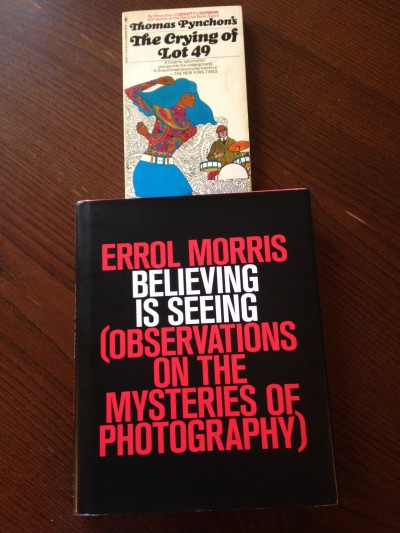
I really, really love book covers! Here are a couple of my faves, two older books I’m reading. Errol Morris is always so brilliant, really looking from the outside in at the way we think. And the Pynchon cover is retro and hip in an accidental way, very current as everything old is new again thanks to hipsters and irony and all that.
- What was the last book you personally recommended to someone?
I’ve been talking to a lot of people about David Quammen’s book on zoonotic diseases (including ebola), Spillover, lately.
- If you could take any book characters personal style, who would it be?
I really liked the kitschy, vintage librarian-gone-mad style of Anana Johnson in The Word Exchange. It wasn’t the most pleasant book to read, as the characters started speaking and writing in garbled language, but I appreciated Anana.
- What book are you reading right now?
What am I not reading right now? There’s a lot of booking going on around my apartment. I just finished A Vision of Fire, by Gillian Anderson and Jeff Rovin, out this Tuesday. That was pretty addictive and hard to put down. I started, after a friend’s recommendation, The Devil in the White City: Murder, Magic, and Madness at the Fair that Changed America by Erik Larson. On audiobook, I just started Alissa Wall’s terrifying Stolen Innocence, and I’m finishing up the slow prose memoir If Only You People Could Follow Directions by Jessica Hendry Nelson. Clearly I need to read something lighter next.
- If you could only read paperback or hardcovers for the rest of your life which would it be?
Paperbacks fo sho’! I have a lot of arm and shoulder troubles, and hardcovers can be killer.
- What stand alone book do you think really deserves a sequel?
This is such a geeky answer, but I’d love Errol Morris to write a follow-up to A Wilderness of Error. I think there’s a lot more to be said on the nature of truth and narrative building in relation to crime in the United States. I imagine a book not attached to a specific case might be taken more seriously.
- Who/what/where is your main source for book recommendations?
I don’t have a single main source, I’m big into browsing the new releases at bookstores and my library, reading interviews with authors where they talk about what they’re reading, and monitoring the hype surrounding releases on the internet (Goodreads, etc).
- What is the last book you added to your Goodreads to-read list?
Everything I Never Told You by Celeste Ng.
My eleven questions to the people that I’m tagging:
1. Did your parents read a lot when you were growing up? Do you think this influenced your love of books?
2. Do you listen to audiobooks? Why or why not?
3. If Stephen King and Joyce Carol Oates were thrown into a pit and forced to battle to the death, who do you think would win? Why?
4. What is the last book someone recommended to you? Are you going to read it?
5. If a family member wanted to write a tell-all memoir Running with Scissors style, would you tell them to go for it? Why or why not?
6. If you could choose one adult fiction/non-fiction book to have illustrated by a favorite artist, what would the book be? (Extra credit question: who would the artist be?)
7. What are your thoughts on blogging negative book reviews?
8. What made you decide to start a book blog?
9. What is the next book you are planning or hoping to buy?
10. What up-and-coming/indie author are you really excited about?
11. What is the one question you’d like to ask yourself about your love of books?
The people I’m tagging for this round are:
Review – Between Page and Screen by Amaranth Borsuk and Brad Bouse
Amaranth Borsuk and Brad Bouse‘s Between Page and Screen is one of the wildest books I’ve read. A collection of poetry found only when the page comes to the screen, the book itself features code which can be read by your computer’s camera at BetweenPageandScreen.com, thus presenting animated poems in an augmented reality–neither fully on the page, nor fully on the screen, but requiring both to exist.
The book’s boggling format is also its subject matter, as it consists of poems back and forth between feuding lovers P. and S. They’re recovering from a blowout and each trying to find their own place in the world as well as seek to understand the other. They may “share text’s fleshy network,” but they’re struggling to connect.
As this book is quite visual, and almost impossible to explain without some illustration, I’ve made a recording of my screen as I’m reading Between Page and Screen. Enjoy and pick up your own copy to get this crazy reading experience.
Between Page and Screen on Amazon.com/Powell’s.com/Indiebound.org

