Review – The Interrogator: An Education by Glenn L. Carle.

interrogator_custom-s6-c30

With Claire Danes regularly losing her marbles as a CIA agent on Homeland, and Jessica Chastain doing whatever it takes to get Bin Laden in Zero Dark Thirty, it seemed an appropriate time to read The Interrogator: An Education and glimpse what really happens in CIA interrogations.

Glenn Carle is a career spy for the CIA – he’s traveled the world, telling lies, manipulating agendas, gathering information.  The Interrogator is his memoir of being pulled off a desk job to interrogate a HVT (high value target), code named CAPTUS, possibly affiliated with Al Qaeda/Bin Laden.  Carle begins to realize the man he is meeting with is not the mastermind the CIA wants or needs him to be.  The CIA urges the interrogations to persist, and Carle finds himself in a unique moral dilemma.

Carle seems born to tell this tale – a spy with a penchant towards classic literature, a multilingual Harvard man who is just as comfortable sleeping in the jungle as debating politics and philosophy in the salons of Europe.  A contradiction, he stands as the lone intellectual in what he insinuates to be a meat-headed culture within the CIA.  His love of the classics shines through in his beautiful soliloquies on his situation (and what his situation means for the rest of us) throughout the book.  With an author less concise, these points could have easily strayed towards diatribe or rant.

I was bracing myself for a gore-filled memoir of torture, but this isn’t that book.  The amount of brutality here is limited to that which is suggested to Carle and which he always refuses, saying “We don’t do that.”

What stands out most about this book is what isn’t there – a huge amount of Carle’s account has been redacted by the CIA.  Although CAPTUS is never named in the book, his identity has been deduced as Pacha Wazir.  A Goodreads review lead me to an article called “Unredacting The Interrogator” at Harper’s online which sheds light on Pacha Wazir, as well as the locations featured in the book.

Carle meanders a bit, and the story is made better for it.  He dabbles in the stories of his personal life (his wife has struggled with alcoholism), explains his past and future roles at the CIA, takes time to expound on the inner-workings of the CIA, and analyzes the KUBARK manual and the effectiveness of torture in general.  He ends the book with specific suggestions he believes would improve the way the CIA develops its terrorism intelligence.  The book isn’t all straight information, however.  His writing is haunting, and it is hard to not be reminded of the noir detective fiction of the twenties and thirties as he describes himself as a lone man wandering the streets of a foreign land.

The most poignant scene for me, and the reason I think this book is an important read, is near the end.  Carle has come home from his mission and is at a dinner party.  Knowing he works for the CIA, a woman is asking “Why haven’t they found Bin Laden?  What are you guys doing?  If it was up to me, I’d just grab them all and make them talk.”  Carle’s experience illustrates how complicated a process tracking terrorism truly is, how the CIA is a bureaucracy like all other governmental agencies, how interrogation is a truly intimate process, and how a solution as simple as “making someone talk” by roughing them up is never the solution.

The Interrogator: An Education on Glenn Carle’s website

Further reading:

Harper’s “Unredacting The Interrogator”

Harper’s “The Interrogator: Six Questions for Glenn Carle”

On Franzen.

jonathan-franzen-TIME

Today, Huffpost Books tweeted, “A handy guide to why Jonathan Franzen pisses you off so much http://bit.ly/16zC8XH

And yet, he doesn’t.

I’m OK with Franzen as a grump, as a man who finds filming clips for Oprah so cheesy that he can’t help but say so.  I don’t need my authors to be shiny happy people.  I think many people are driven to express themselves through art due to pain and discomfort with their lives and the world around them, and their ability to tune into that wierd “Is there something wrong here?” frequency we all resonate with to some degree is what makes their work great.  As Franzen says in his essay Scavenging, “The pain of consciousness, the pain of knowing, grows apace with the information we have about the degradation of our planet and the insufficiency of our political system and the incivility of our society and the insolvency of our treasury and the injustice to one-fifth of our country and four-fifths of our world isn’t rich like us.  Traditionally, since religion lost its lock on the educated classes, writers on other artists have assumed extra pain to ease the burden for the rest of us, voluntarily shouldered some of the painful knowing in exchange for a shot at fame or immortality . . . Men and women with especially sharp vision undertook to be the wardens of our discontent.  They took the terror and ugliness and general lousiness of the world and returned it to the public as a gift:  as works of anger or sadness, perhaps, but always of beauty too.” (How to be Alone, 202)

Some have wondered why The Corrections or Freedom receive more attention than other books – is Jonathan Franzen a privileged white male author, steamrolling the rest?  As I discussed in a previous post, we know there is a documented phenomenon called The Matthew Effect, and success breeds success.  However, I believe Franzen’s fiction would be critically acclaimed regardless of who wrote it.  Freedom and The Corrections are each epic, aching odes to the loneliness and neurosis of Americans and the families they struggle to survive with.  These books manage to be timeless while being completely relevant.  I started to cite some quotes here from Freedom and The Corrections that illustrated this but thought they’d just go on and on, so here’s just one from each book:

“It’s all circling around the same problem of personal liberties,” Walter said. “People came to this country for either money or freedom. If you don’t have money, you cling to your freedoms all the more angrily. Even if smoking kills you, even if you can’t afford to feed your kids, even if your kids are getting shot down by maniacs with assault rifles. You may be poor, but the one thing nobody can take away from you is the freedom to fuck up your life whatever way you want to.” (Freedom, 361)

“So, what, you got cigarette burns, too?” Gitanes said.

Chip showed his palm, “It’s nothing.”

“Self-inflicted. You pathetic American.”

“Different kind of prison” Chip said.” (The Corrections, 135)

Franzen’s How to be Alone: Essays ends with a brief piece called “Meet Me in St Louis”.  In it, Franzen describes the activities required as preparation for Oprah’s Book Club.  At the producer’s request, he visits his hometown with a TV producer and cameraman to film some footage for air on the show.  As the essay opens,  Franzen repeatedly drives slowly over a bridge, attempting to look thoughtful and excited, while semis blare at him from behind and the producer speeds along next to him in a van with the sliding door open, filming and shouting orders into a walkie talkie.  For some reason the show is really insistent on filming in Franzen’s childhood home, something he wasn’t comfortable doing.  (He writes in the essay of the brutal grief he felt saying goodbye to the home, seeing the remains of his mother’s last lonely days before his death, how hard that final goodbye to a home he was raised in and lost both parents in truly was.)  He becomes so anxious during the filming process he gets a hot, itching rash.  A tree grows in his childhood front yard where the family scattered his father’s ashes, and he cedes this personal point to the producer, lets him in to this level of loss, and they begin filming at the tree.  The producer eggs him on, asking him to think of his dead father in order to display more emotion for the camera.  At that point, Franzen blurts out, “This is so fundamentally bogus!”  And for god’s sake, I would have done the same.

This is the man we’re angry with?  This itchy, stress-rashy, too heartbroken to step in an old home, admittedly clinically depressed, lonely man who expresses himself to us in such raw words in essays and books because, perhaps, it is the only way he knows how?  This man who is almost certainly constantly fretting the decline of the serious literary novel, whose life’s work is fading from our society before his very eyes, who can’t stop watching a television if he owns one?

What I’m thinking is, “Just let the man write, and then let the man publish what he writes.”  I don’t need artists to be made in the image I create for them.  I don’t ask for a certain form of cheery media darling to appreciate creators or their work, and I certainly appreciate the fact of writing, and reading, as a solitary activities.  It would be a bizarre world if we all ran around all smiles and handshakes, drinking redbull and ready for the next interview, just so excited to be here.

It makes me wonder how many of the great writers of our history would be treated if they were alive today, for their lack of social or media prowess.  I imagine Sylvia Plath as she portrays herself in The Bell Jar, fired from a magazine internship, trying to please the masses through tweets while working on her writing at her mother’s home.  I imagine James Joyce, tottering, struggling to see, with Nora at his side, peering into the Oprah cameraman’s lens.  The modern judgement we’d pass on Ernest Hemingway’s life:  all reckless drinking and fighting, all the mad love and near death, and then death.  We’d certainly classify him as a grump.  But it isn’t a writer’s job to be liked or kind, to be a film star or a guest on a TV show.  A writer’s ability to communicate needs to shine only on the page.

AMBER.

Amber alerts now squealing through my phone,
they’re chasing me down at home, in case I missed
the signs on the freeway or
the news on the tv and the internet,
they’re worried I’ll stumble upon a
childknapper, unprepared.

Perhaps in the dark,
fumbling for a glass of water.
Perhaps awaking to use the restroom at night:
flipping on the light switch and my white bathroom gleams
so bright with me and a young girl and a man holding a license plate and I know
exactly what to do.

Epic book of the day – Wool by Hugh Howey.

images

When a book features a blurb from Justin Cronin, author of the massive dystopian masterpiece The Passage, I’m ready to read.  Cronin says of Wool, “Howey’s WOOL is an epic feat of imagination.  You will live in this world.”  And he is for serious, as this book is the real thing.

I discovered Wool via an article on Howey’s underground success, and found I could download the first Part in the series for free for my Kindle through Amazon.  The book is broken into small easily consumable parts, short-story length interconnected tales of a future in which humans live in an underground silo.  I read Part One quick, and purchased Parts 1-5 right away.  This is everything that makes scifi worth reading:  the commentary on our social structures; exploration of our weird rituals and lore in societies; the struggles for control over knowledge, material wealth, and power in social systems.  I think this will be the new Hunger Games, a series that gets non-readers reading.  It is simple to understand and draws you in quick.

Wool – Part One blew my mind right away.  It reminded me a bit of how sucked in I was by the first chapter of Ender’s Game, called Third, when I read that for the first time in my childhood.  In the chapter Ender gets his monitor removed and brutally beats Stilson to prevent future bullying.  I thought it was so crazy the way Orson Scott Card drops in Ender’s age near the end – “Ender knew the unspoken rules of manly warfare, even though he was only six.”

That first part of Wool was so intriguing that it really brought me back to that Ender’s Game level of interest – I was dropped into this dystopian world, and right away I could see it all happening, all the rituals and beliefs and fears and concerns of these new people made so much sense to me.  I feel like the greatest science fiction I’ve read doesn’t stop to explain itself to the reader, it just lets the story play out while the reader watches from the sidelines and picks things up as the story goes along.

The concept of Wool, humans living in a silo underground, is one that has such a sweeping amount of plot to play with.  I’m always so interested in the myths and rituals and culture that build up in a society not like our own, and what these things say about our own culture.  I love the development of an entire world after ours in dystopian fiction (The Passage does such a great job of this, as does Oryx and Crake), and this book definitely leaves room to create a history of a people.  There are questions of maintaining power and control within the silo, and, without giving too much away, the daunting prospects of the entire world outside the silo’s safety.  And above all this, the constant sense of claustrophobia that comes with containment.

A group of people in an enclosed space always makes for interesting fiction – think of Stephen King’s Under the Dome.  I love cozy mysteries, and some of my favorite cozies take place in enclosed areas.  And Then There Were None by Agatha Christie takes place on an island during a storm, so guests are stranded.  The Beautiful Mystery by Louise Penny takes place in an isolated monastery, where the monks have little contact with the outside world and must be reached by boat or plane.  Science Fiction as a genre has a great opportunity to play with this tension by building situations where people are stuck together in enclosed spaces.

I’m excited to read the next part in the Wool series, called Shift.  I’m trying to put it off a bit for now, as I know I’ll just compulsively read it once I kindle it and get nothing else done in my life.

Wool – Part One by Hugh Howey on Amazon.com

Wool Omnibus Edition Parts 1-5 by Hugh Howey on Amazon.com

Shift Omnibus Edition Volume 2 by Hugh Howey on Amazon.com

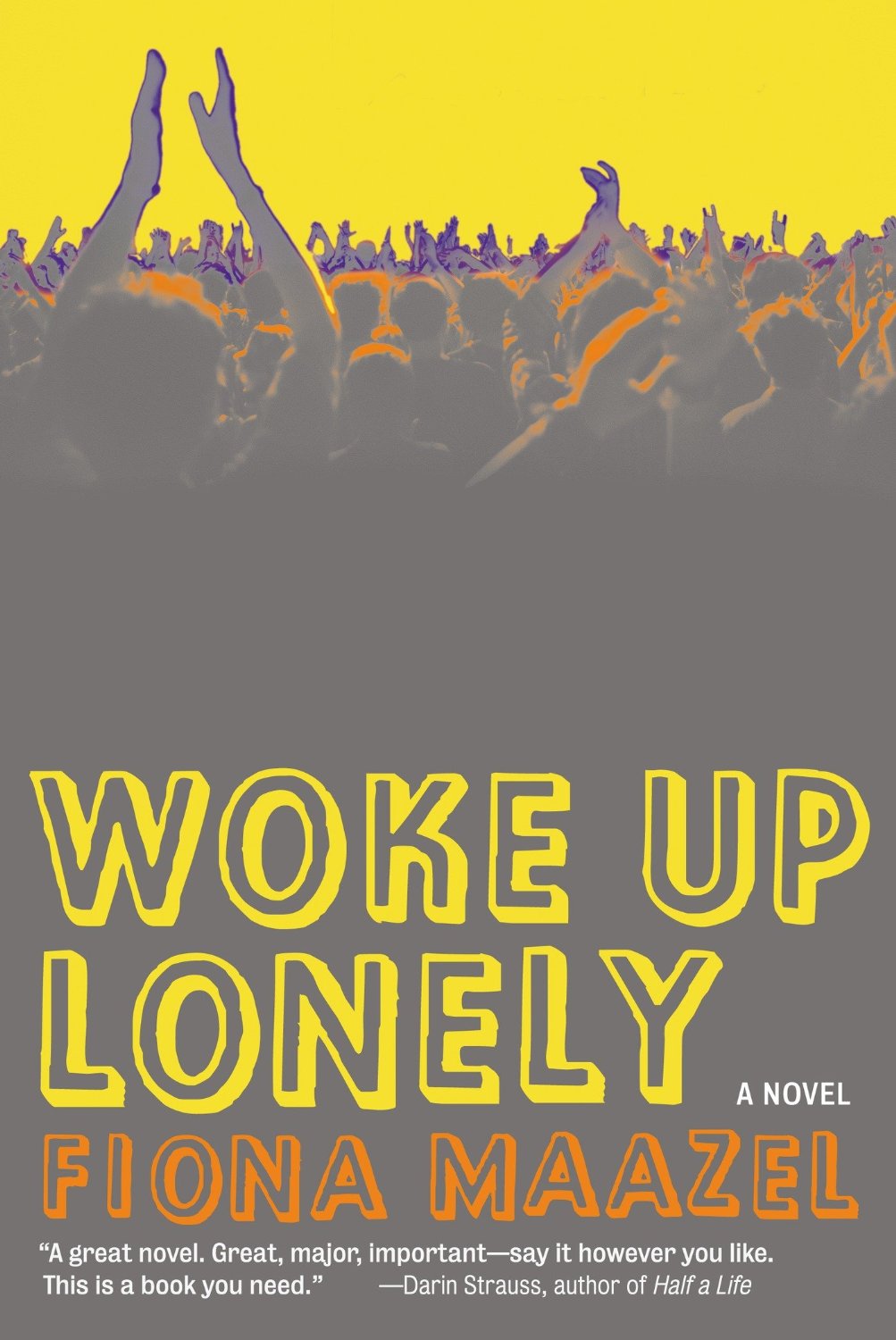
Review – Woke Up Lonely by Fiona Maazel.

814Qu72DxGL._SL1500_

I’m still processing this book – at several times near the beginning I hated it, and was sure I’d put it down at any minute.  And yet I kept reading, as Maazel’s writing hit me in beautiful gasps and starts, mixed in with and nearly masked by all the madness of her stretched-thin plot.

The summary in a chick-mag hooked me instantly – a man develops a cult to fight the pervasive loneliness of our times, only resulting in his further isolation as the cult grows.  When I checked this book out from the beautiful Walnut Creek library and glanced at the Goodreads reviews before I started reading, however, it was rated 3 stars.  This means average, and I was worried.  People weren’t digging Woke Up Lonely, for some reason.

If Chuck Pahalniuk and Christopher Buckley were lovers and decided to adopt an African baby, Fiona Maazel might be that baby in its infancy.  One of the blurbs on the back compares Maazel to George Saunders, and I was like “WOAH let’s not go that far – George Saunders is a master of the craft!”  But then, I guess, I can see it.

What I kept getting tripped up on here was the incredible (meant in the literal, hard to believe, way) plot.  This book has a ton of bells and whistles: corrupt government officials, North Korean leaders, spies with full time makeup artists building alter egos out of face paint, an entire subversive tunnel city under Cincinnati.  I guess what gives me pause in comparing Maazel to great authors is I felt that there was such simplicity in the premise of and the concepts in the book, and yet the book itself was full of Buckley-ish mayhem that was meant to be cynical/funny but just didn’t make any sense.  I thought the plot was all fine as long as I was looking at it from a distance, not focusing my eyes too hard.  But if I stopped to pause and think what was happening in the book, I was like “What is this crap that I am reading?”

The saving grace for the plot was the writing – the main characters’ long expositions on love and loneliness are so sad and true, and Maazel has a gift for poetic one liners, like:  “I was stunned but then not, because if Norman was his own season, he came every year.” and “We were not excitably poor or evangelical, but we were striking for how little capacity any of us had to dream of a life outside the one we had.”

I would have loved a more simplistic book that showcased Maazel’s crisp writing and her premise, loneliness in the 21st century.  If you are thinking of reading this book, get ready for a messy and bumpy ride.

Woke Up Lonely: A Novel by Fiona Maazel on Amazon.com

Review – The Sociopath Next Door by Martha Stout.

51Pgmpk2WBL._SL175_

Yes, I gave The Sociopath Next Door a chance despite its fairly cringeworthy cover and title.  Being a huge lover of mystery fiction, I do find myself drawn to explanations of the icy cold killers and the master manipulators among us.  I discovered this book via Jon Ronson’s The Psychopath Test: A Journey Through the Madness Industry, a fabulous audiobook that I highly recommend.  Audible.com noticed my interest in the so-called Madness Industry and recommended I give The Sociopath Next Door a shot.

Martha Stout does a great job of not only explaining what makes a sociopath different, but discussing what bonds most of us as humans together.  She talks about empathy as a human sense that sociopaths seem to lack.  I found most interesting her digressions into the psychology of empathy – how most humans make horrible soldiers and fail to fire their guns at the enemy unless directly ordered to, etc.

The pitch of Dr. Stout’s book is that sociopaths are rampant among us – there are more of them out there, she says, than there are schizophrenics or certain types of cancer sufferers.  We are mainly just unaware of this specific disorder as it isn’t discussed or is more debatable in the mainstream.  I’m not too concerned about meeting sociopaths in my day to day life or how to wrangle with them on the daily, but I did find Dr. Stout’s examinations of and extrapolations from the human psyche to be interesting and well worth a read.

The Sociopath Next Door at Powell’s Books

Review – Love, Life, and Elephants: An African Love Story by Daphne Sheldrick.

9781250033376

I’m going to be real, I gave up on this book after dragging myself through 11 hours of the 14 hour long audiobook. My breaking point came when – shocker! – the millionth animal struggling to survive under Daphne’s care, or trying to survive in the wild after leaving her care, dies.

I love animals, and I want to love people’s heart-warming stories of living with animals. I like the idea of these stories. I like my own life, lived with two cats. I worked at the Humane Society and fell under the spell of fluffy unfortunates on the daily. But here’s the deal: I can’t get through these books. The quirky Enslaved by Ducks by Bob Tarte, the kitschily titled book about the PTSD dude with a dog, this dame’s adventures interfering with wildlife after her people (she greatly regrets) fail to colonize Africa. I find these books sweet and mildly irritating and vaguely un-notable. I think Daphne’s descriptions and view of the jungle as enchanting and full of delight is beautifully expressed, and I’d love for her to write a fiction novel that focuses more on people and events in that sort of rare environment – I’d find that intriguing.

I also do find a bit of her cultural belief system the elephant (ha! obvious pun there) in the room. At one point she talks of how she fears a one vote per one person system for an independent Kenya, stating this would give Africans a majority vote over whites. The concept of someone publicly believing Africans should receive less of a vote than white settlers based on skin color is so offensive/racist it made me question if I should have purchased the book at all. On a more debatable thought level than every human being equal to one vote, her husband devotes himself to ending poaching in their area only to be confronted with ideas of overpopulation and arguments for culling. I wonder if this “we know best” attitude of cultural interference is healthy for anyone – the wildlife they have decided needs saving, the indigenous people whose ways of life they have decided to interfere with, etc.

Interestingly enough, when I posted my review of this book on Goodreads and read the other reviews I discovered another reviewer had taken these non-discussed issues, as well as his personal relationship with Daphne Sheldrick, and written a book called, aptly enough, The Elephants in the Room: An Excavation. It was written by Martin Rowe, is launching in September from Lantern Books, and I’m sure it will be an interesting read.

As a final note, this is another book I listened to on audio, and it was read by the author.  This rarely works and always disappoints me.  Daphne Sheldrick is now an older woman, telling the stories of a younger one.  It was harder for me to get over the older voice – like I was being told a bedtime story of a yesteryear, the bygone days that I’m sure Sheldrick pines for.  I think a younger narrator may have suited the story better.

Love, Life, and Elephants on Barnes & Noble.com

Quick Update

I have so much to blog and I am, unfortunately, computer-less at the moment!  I replaced my 2008 15-inch Macbook Pro with a brand-spankin-new 13-inch MacBook Pro and I’m waiting on a data transfer from old to new that has dragged on for almost a week.  The upside in all this is that I am petsitting my friend’s kitty Jedda while she is at a Canadian music festival, and I have hijacked her computer.

The lovely Jedda:

view-source:https://i0.wp.com/distilleryimage4.ak.instagram.com/b1f7442cfbbf11e2a34522000ae80008_7.jpg

And so with Jedda meowsing feverishly at my side, I shall try to squeeze in a quick blog here and there until I am bestowed with the incredible powers of my new laptop.

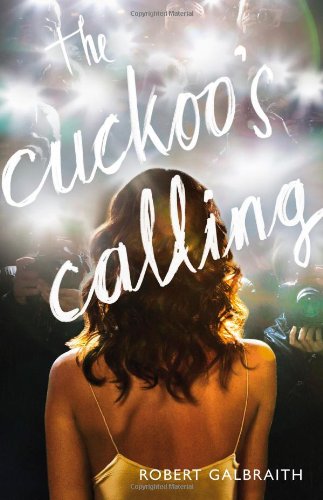
The Cuckoo’s Calling and The Matthew Effect.

51m4P63APoL

Let’s talk about this new JK Rowling book, shall we? Quick summary of events thus far: A new mystery novel is published in April, by “Robert Galbraith”, called The Cuckoo’s Calling. There’s no excitement at its release – according to the nytimes.com the book sells about 500 copies in the US.  And then, last week, the big reveal, in a tweet: Robert Galbraith is JK Rowling. This is leaked to the friend of the wife of someone at JK Rowling’s law firm, who tweeted a hint to a Sunday Times reporter. He investigated, confronted the Rowling camp, and they confirmed. This is the stuff epic films are made of.

And now we’re here, all caught up in this present moment. The secret is out, and it is big news. Bloggers, blogging.  Reporters, madly covering the story.  Readers, reading. And suddenly, this book is hot. I’m reading it – but I’m not alone, because everyone else is reading it. As I’m writing this, The Cuckoo’s Calling is #1 on Amazon.com both Kindle store and book store; it is #1 on Audible.com; bookstores are ordering more copies as they can’t keep it in stock.

And yet – we’re looking at the same book, the exact same work of mystery fiction, that has been in existence since April.  It was there, and none of us took note or cared to read it.

This is an amazing real life illustration of what sociologists call the Matthew effect, name from this Bible passage:  “For unto every one that hath shall be given, and he shall have abundance: but from him that hath not shall be taken even that which he hath.”  – Matthew 25:29, King James Version

The idea here is that success breeds success – the most renowned scientist gets all the credit for the discovery, although the others working under him or her may put in more work.  Researchers have shown that bestseller or top ranking lists influence what we think we like and what we decide to purchase.  If you are already famous, we want to make you more famous.  If you aren’t famous?  We might be a little less interested in what you’re selling, and it might be a little bit harder to break through.

JK Rowling illustrated this for us in a glaringly obvious way.  She made The Cuckoo’s Calling an overnight success, thanks to her existing fame.  The quality of her novel did not change. She is reportedly sad that she was outed so soon, and I am too.  It is now impossible to listen to The Cuckoo’s Calling on my delightful little wireless headphones without some sort of bias in mind.  As I’ve read most of the Potter books quite a while ago, and I read a ton of mystery fiction, I keep thinking of the writing as somehow cartoonish or fanciful.  But is that really there, in the book?  Or is it just in my mind, an association with a children’s author?  I can understand why JK Rowling would want to break away from all the baggage her other tales bring, as they are so stylized.

I think keeping her identity hidden would have been a wonderful sort of social experiment.  What would we all really say, if we never knew it was her?  More importantly, what would everyone not say as we were all too busy reading the other things we were planning to read, before this secret was revealed?  Would the book just fade away, a sequel never published?  The Matthew effect and book sales before the big reveal say yes, it’d be difficult for The Cuckoo’s Calling to gain success without that Rowling glimmer, shimmer, and shine that we all want to touch.

Further reading:

Robert Galbraith’s official page

nytimes review of Cuckoo’s Calling

Robert Merton’s ‘The Matthew Effect in Science”

The Matthew Effect: How Advantage Begets Further Advantage by Daniel Rigley on Amazon

Outliers: The Story of Success by Malcolm Gladwell on Amazon

I’m seeing double – the faces on the covers of magazines.

taylor-swift-covers-wonderland-magazine-april-2013 taylor-swift-covers-elle-march-2013 cover-taylor-swift

Taylor Swift on the cover of Wonderland (April/May), Elle (March), Vanity Fair (April).

kerry-washington-for-elle-magazine-june-2013-1-600x834 o-KARRY-WASHINGTON-VANITY-FAIR-COVER-570

Kerry Washington on the cover of Elle (June) and Vanity Fair (August).

jennifer-lawrence-covers-elle-december-2012 jennifer-lawrence-covers-vanity-fair-february-2013

Jennifer Lawrence on the cover of Elle (December 2012) and Vanity Fair (February 2013).

Is this normal?  Have I, by subscribing to Elle and Vanity Fair both, crossed some sort of target market barrier that was never meant to be breached?  It seems as if doubling up is happening an awful lot to be a coincidence – if a celebrity is featured on the cover of Elle or Vanity Fair, I can be fairly certain she’ll be featured on the other within the next couple months.  Is this considered a good thing, like proving each mag can get the “it” girl of the moment?  Are these two magazines feuding?  Is it chance?  Who knows?  If I said, “Can we get some variety up in here,” would the magazine publishers say back, “Can you just read a smaller selection of magazines so everything seems new?”  Elle is published by Hearst and Vanity Fair is published by Conde Nast, so it is hard to imagine some sort of two for one publicity deals going on.  I’m not sure about any of it, let alone if this an unusual phenomenon.  These are just the questions – I don’t have the answers.  And as cool as Jennifer Lawrence and Kerry Washington are, I’d love to see someone new stamped on that cover too.