Tana French’s Dublin Murder Squad Series Recapped

Tana French is one of my favorite living mystery authors, as her literary mysteries elevate the genre to a new level. Each of her new Dublin Murder Squad series grabs a character from the last and spins off, in a wildly different environment but with an equally ominous tone.

As The Secret Place was released yesterday, the fifth in the series, I’m going to devote this week to Tana French, starting with a summary of all the books today, for those starting The Secret Place and realizing they need a refresher on all the past drama, or for those hearing some of the hype surrounding The Secret Place and wondering what the Dublin Murder Squad books are all about. At the end of this week I’ll do a second post, for those eager to know more about the new book, with a more detailed The Secret Place review.

A big part of the suspense surrounding each new Dublin Murder Squad book is wondering who French will choose to write about next, as her characters rotate through the books in an addictive style—detectives touched upon in a previous book will grab an unseen wand and take their turn as protagonist as if French is having them all run a relay race. Much like real life, this shows how easy it is to put people in boxes until we take a look under their skin, and see what exactly makes them tick, or see what makes them quake in bed at night.

in the woodsWhat I warn you to remember is that I am a detective. Our relationship with truth is fundamental but cracked, refracting confusingly like fragmented glass. It is the core of our careers, the endgame of every move we make, and we pursue it with strategies painstakingly constructed of lies and concealment and every variation on deception.

Characters to know: Detectives Rob Ryan and Cassie Maddox.

Setting: The wood is all flicker and murmur and illusion. Its silence is a pointillist conspiracy of a million tiny noises— rustles, flurries, nameless truncated shrieks; its emptiness teems with secret life, scurrying just beyond the corner of your eye. Careful: bees zip in and out of cracks in the leaning oak; stop to turn any stone and strange larvae will wriggle irritably, while an earnest thread of ants twines up your ankle.”

In the Woods, French’s first novel and the first of the Dublin Murder Squad series, was released in 2007. Detectives Rob Ryan and Cassie Maddox investigate a girl murdered in the woods. Ryan has history with these woods. When he was a boy, the woods ate up three of his friends, leaving him terrified and holding onto a tree like the world was shaking around him, wearing blood-filled sneakers.

People make so many complaints about this book—mainly its main character is unlikeable, its mysteries are left unsolved, and the story itself is too long. To those complaints, I say this is a great introduction to the world of Tana French. This isn’t a story designed to please the reader. This is a story. It has too much heart of its own to care about yours. The questions French raises are those so often overlooked in mystery novels, and they take so much of what mystery relies on and remind us why it doesn’t make sense. Detectives are, perhaps, just as flawed as the criminals they seek to catch; some mysteries, and some chunks of time, may be lost and unknowable.

the likeness“When you’re too close to people, when you spend too much time with them and love them too dearly, sometimes you can’t see them.”

Characters to know: Detectives Cassie Maddox (Rob Ryan’s partner from In the Woods) and Frank Mackey.

Setting: “Then the drive gave a little twist and opened up into a great semicircular carriage sweep, white pebbles speckled through with weeds and daisies, and I saw Whitethorn House for the first time. The photos hadn’t done it justice…Every proportion was balanced so perfectly that the house looked like it had grown there, nested in with its back to the mountains and all Wicklow dropping away rich and gentle in front of it, poised between the pale arc of the carriage sweep and the blurred dark-and-green curves of the hills like a treasure held out in a cupped palm.”

French’s second novel, The Likeness, pivots to feature Detective Cassie Maddox. A woman who looks strikingly similar to Maddox is found murdered, and legendary Detective Frank Mackey (“still in his thirties and already running undercover operations; the best Undercover agent Ireland’s ever had, people said, reckless and fearless, a tightrope artist with no net, ever”) thinks the cops would be foolish not to jump on the likeness. Mackey asks Maddox to slide back into the murdered young woman’s life, baiting the murderer. Thus, a surreal setup: Maddox becomes Lexie Madison, graduate student. She inserts herself back into Madison’s life, as if the murder was an unsuccessful attack, returning to the house she lives in with four close friends. In an echo of Donna Tartt’s The Secret History, the group of four friends Madison lives with is very, very close; they shift from charming to suspect and back again.

faithful place“Here’s the real risk in Undercover, in the field and out: you create illusions for long enough, you start thinking you’re in control. It’s easy to slide into believing you’re the hypnotist here, the mirage master, the smart cookie who knows what’s real and how all the tricks are done. The fact is you’re still just another slack-jawed mark in the audience. No matter how good you are, this world is always going to be better at this game. It’s more cunning than you are, it’s faster and it’s a whole lot more ruthless. All you can do is try to keep up, know your weak spots and never stop expecting the sucker punch.”

Characters to know: Faithful Place introduces a bunch of names to remember, all surrounding Detective Frank Mackey (Cassie Maddox’s boss from The Likeness). Make note of Holly Mackey (Frank’s daughter), and Detectives Stephen Moran (a floater who works with Frank on the case) and Scorcher Kennedy (Frank’s nemesis).

Setting: “Faithful Place is two rows of eight houses, old redbricks with steps going up to the main hall door. Back in the eighties each one had three or four households, maybe more. A household was anything from Mad Johnny Malone, who had been in World War I and would show you his Ypres tattoo, through Sallie Hearne, who wasn’t exactly a hooker but had to support all those kids somehow. If you were on the dole, you got a basement flat and a Vitamin D deficiency; if someone had a job, you got at least part of the first floor; if your family had been there a few generations, you got seniority and top-floor rooms where no one walked on your head.”

Faithful Place, the third in the series, was my least favorite of the Dublin Murder Squad series thus far. This surprised me, as I was so eager for a book featuring Frank Mackey after we were introduced to his character. Mackey is called back to Faithful Place, the rough and tumble neighborhood of his youth, where his broken family still resides, when a suitcase is found in an old building. It isn’t Frank’s suitcase, but that of his high school sweetheart, Rosie. Mackey and this girl, they were in love. They were all ready to ditch Faithful Place together, get married, make it big somewhere far away from the poverty of their childhoods. And then Rosie disappeared. The discovery of the suitcase brings Mackey back to a home he’d like to forget, to an unsolved mystery which left his heart broken, and to a community which no longer trusts him.

broken harbor“I’m the least fanciful guy around, but on nights when I wonder whether there was any point to my day, I think about this: the first thing we ever did, when we started turning into humans, was draw a line across the cave door and say: Wild stays out. What I do is what the first men did. They built walls to keep back the sea. They fought the wolves for the hearth fire.”

Characters to know: Detectives Scorcher Kennedy (Frank’s nemesis from Faithful Place) and newbie Richie Curran.

Setting: “As we got deeper into the estate, the houses got sketchier, like watching a film in reverse. Pretty soon they were random collections of walls and scaffolding, with the odd gaping hole for a window; where the housefronts were missing the rooms were littered with broken ladders, lengths of pipe, rotting cement bags. Every time we turned a corner I expected to see a swarm of builders at work, but the nearest we got was a battered yellow digger in a vacant lot, listing sideways among churned-up mud and scattered mounds of dirt…No one lived here. I tried to aim us back in the general direction of the entrance, but the estate was built like one of those old hedge mazes, all cul-de-sacs and hairpin turns, and almost straightaway we were lost.”

Broken Harbor was by far my favorite book of the series, again surprising me as I hadn’t thought I’d enjoy a book focusing on Scorcher Kennedy after his introduction in Faithful Place. The concept here was bizarre, but very, very scary. Ocean View intended to be a development of premier homes, designed with childcare and a leisure center, but economic downturn left the project half-standing and abandoned, a wasteland of construction and aspirations. The Spain family purchased and moved into their home before the project ran into trouble, expecting to join a thriving community rather than an unkempt and graffitied construction site. But none of that matters now–the Spain children and their father have been found murdered, and Jenny Spain, wife and mother, is in the ICU. Scorcher Kennedy is put on the case, and finds large holes smashed into the Spain’s home’s walls, baby monitors watching corners instead of children. This family was haunted, but by what? Or whom?

the secret place“Teenage girls: you’ll never understand. I’ve got sisters. I learned to just leave it.”

Characters to know: Remember everyone from Faithful Place? Here they are. Holly Mackey (Frank Mackey’s daughter), Detective Stephen Moran (still eager to make it onto the Murder Squad), and the firecracker Detective Antoinette Conway.

Setting: “On the first Sunday afternoon of September, the boarders come back to St. Kilda’s. They come under a sky whose clean-stripped blue could still belong to summer, except for the V of birds practicing off in one corner of the picture. They come screaming triple exclamation marks and jump-hugging in corridors that smell of dreamy summer emptiness and fresh paint; they come with peeling tans and holiday stories, new haircuts and new-grown breasts that make them look strange and aloof, at first, even to their best friends. And after a while Miss McKenna’s welcome speech is over, and the tea urns and good biscuits have been packed away; the parents have done the hugs and the embarrassing last-minute warnings about homework and inhalers, a few first-years have cried; the last forgotten things have been brought back, and the sounds of cars have faded down the drive and dissolved into the outside world. All that’s left is the boarders, and the Matron and the couple of staff who drew the short straws, and the school.”

I was not expecting French’s next novel, her next police procedural, to feature a bevy of adolescent girls at a boarding school. But French always pleasantly surprises me. The Secret Place alternates between Holly Mackey’s past at St. Kilda’s, her all female boarding school, and the present, in which Detectives Moran and Conway are investigating the murder of a male student from the neighboring all-male school on St. Kilda’s grounds. This was released yesterday, and in my next post I’ll go into more detail, for those who want to know more.

Review – The Noble Hustle: Poker, Beef Jerky, and Death by Colson Whitehead

the noble hustle 2

I have a good poker face because I am half dead inside. My particular combo of slack features, negligible affect, and soulless gaze has helped my game ever since I started playing twenty years ago, when I was ignorant of pot odds and M-theory and four-betting, and it gave me a boost as I collected my trove of lore, game by game, hand by hand. It has not helped me human relationships–wise over the years, but surely I’m not alone here. Anyone whose peculiar mix of genetic material and formative experiences has resulted in a near-expressionless mask can relate. Nature giveth, taketh, etc. You make the best of the hand you’re dealt.

Colson Whitehead writes uniquely brilliant and wordy novels, centering around such oddball and brilliant concepts it’s difficult not to wonder if something is going on with this guy. In The Noble Hustle, Whitehead’s secret is revealed under the pretense of poker memoir–he hails from the Republic of Anhedonia, where a poker face comes naturally. This revelation sets the tone for the book, in which Whitehead explores the rapid evolution of poker post-online gambling as he quickly evolves himself, prepping for the World Series of Poker in Las Vegas, NV.

Whitehead, representing his homeland at the WSOP. (via)

Whitehead, representing his
homeland at the WSOP. (via)

The book bloomed from a Grantland magazine article, “Occasional Dispatches from the Republic of Anhedonia.” Grantland staked Whitehead, a (very) amateur player with a regular monthly Brooklyn writers game, to play in the World Series. That means they paid his $10,000 entrance fee, asked him to write about his experience, and if he reigned supreme in his clash with the titans, he’d get to keep his winnings.

Whitehead preps, as anyone would for any sort of epic battle, and these are some of the most memorable scenes. He finds himself a mentor in a fellow writer who demurely answers “housewife” at the poker table when others ask her profession. He calls her Coach. He chooses his poker nickname (the ‘Unsubscribe Kid’). As a test of Whitehead’s writing ability, he’s tasked with explaining a complicated game and the complicated theories behind playing it in a short book. I was lost right away, but I wasn’t reading for the poker lingo. I was reading for Whitehead’s writing, and just as with his novels, Whitehead is able to build brilliantly with language, here with darkly funny commentary of America’s Leisure Industrial Complexes and his struggle to fit in amongst the bling and shine of Las Vegas.

The most interesting parts of the book for me were the vignettes of Whitehead’s younger days, pre-success. He recounts driving cross country with friends Darren and Dan, visiting Vegas and eventually crashing on a friend’s floor in Berkeley. I was thinking as I read, “Could it be? Does genius attract genius like that?” And yes, it could be, Colson Whitehead was cruising the country with Darren Aronofsky, brilliant filmmaker of Black Swan and The Wrestler, among many others. Whitehead also roomed in college, and subsequently roamed Vegas, with the founder of The Source magazine.

The Noble Hustle staggers ground between niche literature and being for the masses–those who understand the game well might find the explanations tedious but love the storyline, and those who aren’t familiar with the game at all might get lost in Whitehead’s final descriptions of the play. The New York Times review gave Whitehead a hard time for draping the entire memoir in these hints of malcontent, with his Anhedonia schtick, and I’m not sure what I think about that. At first I tended to agree, but you can’t be mad at a guy for not being shiny happy person, can you? Overall, any die-hard Whitehead fan shouldn’t miss this chance to glimpse the writer’s life, history, and native land.

The Noble Hustle by Colson Whitehead on Amazon.com/Powell’s.com/Indiebound.org

Review – The Arsonist by Sue Miller

the arsonist 2

The lesson was there were things you had to let go of, losses and mysteries you had to learn to live with.

Sue Miller‘s new book, The Arsonist, is about the biggest things that happen in the world and how anyone manages to keep going despite them, about the edges of the divides between us that we stand near and peer across, and most of all, about falling into or out of love, how easy and sudden and unexpected love creeps up on you or sprints away from you. Maybe, then, this is a book about how little control we really have in the world, and how coming to terms with that is never simple.

After 15 years of working for an NGO in Africa, Frankie has come home. She usually drops by for a visit, but this time she’s not sure she wants to go back. But how can she stay? She’s been setting up food stations, fighting hunger at refugee camps, and compared to where she was in the world, life in the quaint New Hampshire town her parents have retired to is a life of ease, abundance, and in the face of all the world’s plight, insignificance.

Frankie’s parents, Sylvia and Alfie, were once summer people in the town of Pomeroy, but in retirement they’ve chosen to move full-time to the old farmhouse which has acted as the family’s summer vacation home, hoping to ease the pressures of their own quiet crises with a quiet life. Intellectual Alfie’s memory loss seems to be getting worse and worse, and Sylvia keeps gulping down glasses of wine and early afternoon drinks, hoping to find a way to cope with what she fears could be the end of her husband as she knows him.

In the midst of all this disaster, big and little, global and familial, an additional, artificial one is created: fires begin to bloom at night, setting homes ablaze. When Frankie first hears the siren of the fire truck, a foreign sound to her after her time in Africa, she doesn’t recognize it, and thinks it must be some sort of animal. The local paper owner Bud, a city refugee himself, reports on the fires as he struggles to decipher Frankie’s intentions–will she stay or will she go? Is she capable, after seeing so much world out there, of caring about this small little piece of it here?

I’m a fan of long books, and I loved the time Miller took telling the beginning of this story. As other reviewers on both Goodreads and Amazon complained, however, the story is uneven, as the end quickly wraps up. If anything, though, I think this is a testament The Arsonist‘s ability to build characters that draw us in so much we are angry when they leave us. I could have happily read this book, doubled in length. I’m also a huge fan of leaving mysteries unsolved, and not wrapping up all the details precisely, and Miller manages to do this here, without leaving the reader feeling cheated. If you do finish this book wanting a simple conclusion to its many questions, big and small, you haven’t been paying attention.

The Arsonist by Sue Miller on Amazon.com/Powell’s.com/Indiebound.org

Review – The Quick by Lauren Owen

the quick

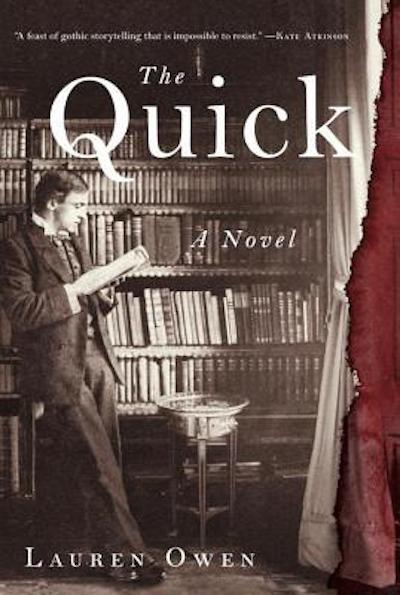
I’ve debated how to review Lauren Owen’s The Quick since finishing it a few days ago–I don’t think this is a novel with a twist, as much as it is a novel which dedicates a bit of itself to misdirection. Even the cover could be misleading, as I realized through summaries that this was going to be a novel of secret societies and suspense, but I assumed it would be more in the literary vein, like Alena Graedon’s The Word Exchange.

The Quick seems to tell the story of James and Charlotte Norbury, growing up with a distant father in their treasured but disintegrating Askew Hall. Where generations of the Norbury clan lived lavishly before them, James and Charlotte are mostly left to their own devices, losing track of time amidst old statues in the garden or building their bravery by creating tests of courage in the library.

James grows into a young man and sets off for the big city of London, as young men are wont to do. He’s determined to be a writer, and rarely leaves his flat, sitting up at his desk all hours and staining his hands with ink as he creates long classic poems. He finds himself living vicariously through his roomie Christopher Paige, who comes home late to divulge tales of London high society, heavy drinking, and debauchery.

But the story here hasn’t really begun, because much more than friendship is brewing between the aristocratic Christopher and the meek James. And even then, the story hasn’t really begun, because at a dinner party, James notices that Christopher’s brother looks ill–he seems so pale, and is he wounded? Is he bleeding?

As the book doesn’t directly introduce its subject matter, some readers may be frustrated. The Quick is a historical novel, yes, but it is a supernatural historical novel. All this high society, all this classic London aristocracy–there is something horrible bubbling underneath. There are fight scenes, there are wild street children getting shot in the feet, there are fires and desperate carriage rides to safety. The book includes journal entries, scribbled and ripped in places. Those hoping for the story of James and Charlotte to continue as it did in the style of the book’s beginning may be dismayed, as reality shifts around them, and the narrative drastically changes.

If you are seeking a mild-mannered historical novel, you may want to look elsewhere. If you are interested in what might be crouching in the shadows of that mild-mannered historical novel, overlooked and unexplored, then you’ll want to pick up The Quick.

The Quick by Lauren Owen on Amazon.com/Powell’s.com/Indiebound.org

The Quick reviewed on the New York Times Sunday Book Review – with all the spoilers I didn’t give, for those curious.

Review – The Night Season by Chelsea Cain

the-night-season

The Night Season is the fourth of Chelsea Cain‘s Gretchen Lowell and Archie Sheridan series, and I grabbed it on a whim, seeking a fast and easy mystery. In The Night Season, Portland is flooding and people are dying, and the two things may or may not be related. Gretchen Lowell, the beautiful and bewitching serial killer who previously batted Archie Sheridan around like a cat playing with a wounded mouse, moves from a central figure in the story to an ominous and ever-looming presence. She’s never really gone and certainly not forgotten, tucked away safely in prison for now, but still drowning Archie just as much as the water that floods into the city around him.

Let me start by saying California is in the midst of a drought, and all the rain in this book was making me crazy! We’ve had some days here where the humidity feels like it just can’t hold, like the sky will have to burst open and rain, but the rain doesn’t come. When the soggy, sand-bagged, and serial killer-infested floodwaters of a thriller make you pine for rain, you know something is very wrong.

For those unfamiliar with the twisted love story of the Gretchen Lowell and Archie Sheridan series, it started with Heartsick in 2007. That book introduced us to the bold, unabashed premise of a cop so enmeshed with the serial killer he hunted and ultimately put behind bars that he’s in love with her, that he needs her like he needs the next fix of the pain pills he’s popping. After tracking Gretchen Lowell for 10 years, Archie Sheridan wasn’t sure where the line between obsession and love was drawn, and that was just how the sadistic Lowell liked it. Heartsick overtly asked all sorts of important questions about the dependence of those who fight evil on that evil, in the same vein as Thomas Harris‘s Red Dragon and The Silence of the Lambs.

Despite the dark, depressing threads of possession running through these books, I love Cain’s comic characters, especially Archie Sheridan’s spunky sidekick, crime reporter Susan Ward. The Night Season features a cast full of oddballs, as we’d expect nothing less from Cain, but none are so odd that they become caricatures or stereotypes of real life. I would love to see a Susan Ward spin-off series where we explore her world a bit more without Sheridan, although I realize Cain would then be required to create an unusually high amount of odd happenings in Portland for Ward, as a journalist, to discover and document away from her police pals. There’s something innately likable about Ward and the gusto with which she crashes crime scenes, a gal who brings her hippie momma’s goat into the living room to keep him out of the rain, and who stomps about the floodwaters with punky hair and big boots.

And Ward does provide much needed comic relief–Cain doesn’t ever turn away from an opportunity to describe a gruesome scene, as these are definitely thrillers. Especially in Heartsick, the first book, there are some descriptive moments of torture where the gore factor is very, very high. If cozy mysteries are more your thing, and you steer clear of the blood and guts, you may want to think twice about checking out this series.

Chelsea Cain also has a new book out tomorrow, One Kick, which I’m hoping to read soon, as the premise sounds a bit cheeky but irresistible. Kick Lannigan was kidnapped as a kid, and trained by her abductor for five years to be a lethal killing machine. She pursued her odd abilities after her escape, and by her twenties she sounds like a well-rounded secret agent, as she’s studied martial arts and knife-throwing. Then, other children get kidnapped, and Kick realizes what she’s spent her life training for. If Kick is as oddly charming as Susan Ward, then One Kick sounds like a promising combination of misery, humor and ka-pow.

The Night Season by Chelsea Cain on Amazon.com/Powell’s.com/Indiebound.org

Heartsick (Gretchen Lowell and Archie Sheridan #1) on Amazon.com/Powell’s.com/Indiebound.org – this is only $2.99 on Kindle right now, a great deal.

One Kick on Amazon.com/Powell’s.com/Indiebound.org

ChelseaCain.com – she is going on tour for One Kick, with dates announced on her official site.

Who was Piper Kerman’s girlfriend?

Since reviewing Piper Kerman’s memoir, I’ve gotten questions about this aspect of the memoir that inspired the Netflix hit series quite a bit. Just who was Piper Kerman’s girlfriend, that heroin-smuggling femme fatale?

laura prepon

Laura Prepon as Alex Vause (via)

In the series, Kerman’s girlfriend Alex Vause is played by the saucy, sexy Laura Prepon. But even Prepon hasn’t met the inspiration for her character. She explained the mystery in an interview with Vulture.com:

You didn’t get to meet Alex before or during season one. Is she still MIA?
She is MIA, girl. I do not know where she is. And it’s kind of like … we don’t talk about the real Alex — I don’t know. I did want to meet her, but they were like, “That’s not possible.” So I don’t know where the hell she is.

Were you given any reason why it wasn’t possible?
I wasn’t, actually. Honestly, even though we’re based on the real people, the thing about our show is they really let us do our vision of these women. I know that I look nothing like the real Alex, whereas Taylor, you can see the resemblance between her and the real Piper. But also with Taylor, Jenji was like, “We’re doing your version of Piper. Don’t worry about trying to be Piper Kerman.”

I guess I’m asking less because I want to know how you used the real Alex as inspiration, and more because I feel this need to know where she is. We get the satisfaction of knowing where Piper is now, but not Alex.
I understand, totally. Trust me! But, yeah, that’s just not possible. [Laughs.

Where do you imagine her today? In the scene where Alex and Piper are talking about whether or not you could have a future together, Alex says something like, “I’m good at moving large amounts of heroin.” Is that what she’s doing?
Honestly, whatever she’s doing, she’s definitely in a position of power. Because Alex is a power-hungry girl. She’s all about survival; she loves that whole [drug] world because she was in control of it. Wherever she can be, she wants to be in a position of power — and that’s also her relationship with Piper. We always talked [on set] about how I’m the spider and Piper’s the fly. Like when we were doing the strip scene and I was on the bed and she was dancing for me, we talked a lot about that scene and the director was like, “Listen, you do not go to her — she always comes to you.” But then Alex falls in love with this girl, and Piper really does a number on her, and Alex doesn’t know how to deal with it.

It is important to note that on this part of Kerman’s story, the series has already strayed from the book. Strayed extremely far! In the memoir, Kerman explains that she was kept in the same prison with her ex for only a brief time period after being transferred back to Chicago, as they were both needed to testify at a co-defendants trial.

So what is up with the “real” Alex?

In April, Vanity Fair journalist Sue Carswell tracked down the woman who features so pivotally in Kerman’s story, through newpaper articles about the case. Catherine Cleary Wolters, Kerman’s ex-girlfriend from her memoir, agreed to tell her story to Vanity Fair. Wolters is writing a memoir of her own, cleverly titled Out of Orange.

cleary wolters

Catherine Cleary Wolters, Piper Kerman’s
romantic interest from her memoir. (via)

Although the show’s writers takes huge liberties with Kerman’s original memoir, jailing the two characters together for an extended period of time (which allows them ample opportunity for hook-ups, break-ups, and other such drama), Cleary Wolters also seems to recount the details of their actual love affair differently than they were explained by Kerman in her memoir. In the Vanity Fair piece, she says:

“When we were traveling together I started developing a crush on her. And eventually that turned into a crazy mad love affair,” Wolters says. “But that was after she had already done the deed that made her complicit.”

“We weren’t girlfriends,” Wolters adds for good measure. “We were friends with benefits . . . I was not the older sexy, glamorous lesbian who snatched her from her pristine Smith College cradle.”

For having her private life thrust into the spotlight, Cleary Wolters has flown amazingly under the radar and I can see her memoir being a huge blockbuster, rising up out of nowhere with what sounds to be a much more interesting personal story than Kerman herself.

Amazingly, Cleary Wolters also is an author with three unpublished novels, the Vanity Fair article said. I couldn’t find anymore information online about these books, but if there was ever a time people would be interested in reading them, it certainly seems like that time is now.

You can also read the full article by Sue Carswell, The Real Alex of Orange Is the New Black Speaks for the First Time: “I Was Not Piper’s First, and I Certainly Did Not Seduce Her,” on VanityFair.com.

Review – The Sanctuary of Illness: A Memoir of Heart Disease by Thomas Larson

Sanctuary

Thomas Larson packs tons of emotion into this tiny memoir, and I went from being repelled by glimpses of his life I didn’t need to know about, to being moved almost to tears as I read while sitting on a very hard stool in a very crowded Apple Store, waiting for my appointment at the Genius Bar. Highlighting almost every paragraph, wondering how socially inappropriate it would be to cry about a memoir to a tech support guy–The Sanctuary of Illness had me like this so many times, but then always took things a little too far, causing me to reel from its total disclosure and turn away from sad, brilliant insight Larson free associates onto the page.

Larson is a man doomed, by that perhaps least onerous but most prevalent condition in the U.S. today. His father died of heart disease at sixty-one, and his older brother died of heart disease at forty-two. The book opens with Larson’s first heart attack, which he realizes is upon him as he’s teaching a class. Anyone who has ever been devastatingly ill in any way, from a panic attack to the stomach flu to a migraine to a heart attack like that which strikes Larson, can relate to his attempts to maintain social norms despite a failing body. What makes Larson’s writing so memorable is that this isn’t memoir filtered, this isn’t someone after the fact trying to put a bright spin on things. He portrays everything, and we’re there with him in the bathroom, we’re there with him as he’s mildly delusional, telling his class he has to leave, somehow driving himself to the hospital, blinking through random glimpses of emergency angioplasty. This isn’t illness, minus the ugly parts, less the endless indignities that might make the reader want to squirm. This is Larson exposed, at his most vulnerable, his heart literally failing as he watches.

This complete openness is also, to be quite unfair, what I disliked about The Sanctuary of Illness, as sometimes I wished for more filter between author and reader. Larson’s concerns about impotence early in the memoir are answered later with vivid glimpses of his sex life, fueled by Viagra, that still haunt me. A few sentences stand out as inappropriately, awkwardly much too pornographic for the rest of the book (disturbing all its reviewers, it seems). His explorations into therapy with his wife illustrate how devastating heart attacks can be for a significant other, and how deep the fear of death really goes in a rift between a couple, but again, this is really intimate stuff. And perhaps that is why we don’t talk about heart disease more in our society, as that leading killer which can strike from nowhere unannounced, lightning in illness form. Heart disease has such a brilliant and clear connection with death, looking at it straight on almost hurts.

But maybe we should. Heart disease is the leading cause of death for both men and women in the United States, and Larson’s story is a not only an explanation of the disease itself, and his struggle through it, but also an examination of all the various quirks and curiosities that surround it in our society: why men who feel like they’re dying choose to get in a truck and drive, alone, rather than seek help; the delicate and every-mysterious line, post-diagnosis, between angina and anxiety, heartburn and heart attack; talking about heart disease while eating out at a restaurant with friends, all of them made uncomfortable by what is or isn’t on their plates. The Sanctuary of Illness presents everything about heart disease, whether the reader would like to see it or not. Larson, in all his unglamorous over-exposure, trudges as an explorer, on a path so many of us seem fated to follow but few of us seem able to discuss.

The Sanctuary of Illness by Thomas Larson on Amazon.com/Powell’s.com/Indiebound.org

Important Book of the Day – Spillover by David Quammen

spillover

Let’s keep an eye on wild creatures. As we besiege them, as we corner them, as we exterminate them and eat them, we’re getting their diseases.
–David Quammen, Spillover

I find myself referring to David Quammen’s Spillover quite a bit lately, as the most severe outbreak of Ebola in history spreads through West Africa. An Ebola-infected doctor has returned to Atlanta for treatment, and all sorts of questions are popping up about zoonotic diseases and their effects. This outbreak has acted as an instant reminder that we all need to care about zoonotic diseases, and that we can’t dismiss them as the concerns of health-care workers or those on other continents.

David Quammen is an award-winning science writer, and Spillover, as an almost 600 page exploration of zoonotic diseases, would be an unbearable read if it wasn’t for Quammen’s honest but bold ability to weave the stories together. Rather than coming across as a textbook, despite the almost incomprehensibly complicated subject matter presented at times, this reads as true thriller, perhaps the scariest thriller you’ll ever read.

Quammen meets brilliant, interesting researchers who are incredibly afraid, and the story of the Hendra virus is told not through numbers or complicated terms but through the story of that first dead mare, Drama Series. Who found her, and what happened after that.

Spillover reveals a world in which humans are pushing up against the wilds once left to animals, and animals are, in turn, making us sick. There’s Drama Series and her untimely demise. And then a chimp on a river, and the agonizing, winding story of SIV and HIV and the possible emergence of AIDS. Throughout these tales, research citations, developments from history, and thoughts from the scientific community create a full picture.

I never understood how exactly zoonotic diseases worked until reading this book. I never understood why Bird Flu was called Bird Flu, or even that the flu came from birds at all. I didn’t know what all those numbers and letters meant that go along with the next flu threat, labels ascribed to some sort of emerging potential pandemic. Spillover taught me the basics of all this, what exactly is rational fear and what doesn’t make sense or seems to be media hype, and even why getting my flu shot each year is so important.

Quammen manages to convey huge amounts of information to his reader without losing the story’s gripping narrative. As the outbreak continues in Africa, and as Ebola lands in Atlanta, albeit in a highly controlled environment, it seems a very good idea to educate yourself on the basic ideas of zoonotic disease.

Spillover by David Quammen on Amazon.com/Powell’s.com/Indiebound.org

Review – The Leftovers by Tom Perotta

the leftovers big

Tom Perotta’s 2011 novel, The Leftovers, about a town recovering from a rapture-like event, is the basis for HBO’s brooding new series of the same name. Perotta is no stranger to book-to-screen adaptations: he wrote both Little Children and Election.

The Leftovers, as a novel, has little of the darker style and mysterious mood conveyed with in the HBO series. The novel feels overwhelming, funny, and sad in the same way that Colson Whitehead’s Zone One feels overwhelming, funny, and sad. Perotta and Whitehead delve into what happens after an immediate global crisis begins to fade, and people must keep on living daily life. Survivors realize there is laundry to be done, homework to be completed, and small talk to be made at the dinner table. While Whitehead explores the equivalent of day-in-day-out garbage removal in a post-zombie apocalypse city, in The Leftovers, Perotta creates a more open, and perhaps more intriguing, concept.

If you haven’t been watching the show, here’s the general plot summary for both the novel and the series: a “random harvest” of people throughout the globe has disappeared, in an event neutrally coined as the “Sudden Departure.” Immediate panic subsides as the event seems to be a singular occurrence, and government investigations find no clear answer or medical explanation. Connections to the rapture are obvious, but are in constant debate as those who disappeared seem so remarkably random, and not of one religion or belief system. The Leftovers, as the title indicates, is not the story of the event itself but of that time when life must go on, post-Sudden Departure. We join those left behind in a quaintly small town, as they try to pick up the pieces of society or encourage those very pieces to fall apart.

Those who want to move on from the event struggle in private ways, and those who think there is an insanity in seeking normal life after such a disastrous event gravitate towards one of the various fringe groups which develop in response to the Sudden Departure. Each cult seeks to put their own spin on the tragedy, often with destructive results.

There are quite a few negative reviews of the novel, which I found surprising. It was highly praised on its release in 2011, and has been sitting on my Amazon Wishlist for years. I found it be an ultimately jolting, but mostly beautifully meditative, examination of how we try to heal from things by claiming them as our own. We seek to possess tragedy in a way that ends up destroying us. As other reviewers note, there is a bit of shock at the ending, so if you invest in only positive endings in your reading then I’d suggest avoiding books about a post-Rapture world in general.

poster for leftovers showNow to what people really want to know–how does the novel compare with the show?

If you like the show, should you get the book? I think it depends on what you like about the show. Stylistically, the show presents post-Sudden Departure life as intriguing, while the novel goes for the tone of people living through just another day. I think this difference adds a level of mystery to the show which wasn’t sought in the book’s original tone.

What the book does have is Laurie’s thoughts, as she goes about her days at the Guilty Remnant. With much narration from Laurie’s perspective, the reader learns about the Guilty Remnant, Laurie’s motives, and the history of the Sudden Departure and her family. This would be impossible on the show, as Laurie has taken an oath of silence and a voice-over narrating her thoughts would be incredibly awkward.

If you’re curious to know more about both cults presented, the Guilty Remnant and Holy Wayne’s group, then the book has your answers. But if you are seeking some sort of greater-than-human explanation, prepare to be underwhelmed. The tone of the book is plain, the actions people take in the book are those of desperate, scared people, and none of it is dressed up by Liv Tyler’s beauty or haunting music (nothing against these two things–just don’t be disappointed in the book, when they aren’t there).

The book mainly focuses on the Garvey family, and there are many characters mentioned in passing in the novel which the show seems to have fully fleshed out. If we see more of this, the post-Sudden Departure storyline planted in the book could grow much larger in the series. I’m interested to see if the show will follow the book’s actual plot. If it does, due to the jarring ending I mentioned before, it seems like they may have quite a few unhappy viewers on their hands. For this reason, if you’re worried about spoilers, I’d recommend holding off on reading the novel until the series is finished or led so far astray the original storyline the spoiler risk seems minimal.

Tom Perotta is working on the series as a co-creator, writer, and executive producer, so he definitely could have started something in the book that he could finish in the series, exploring how society deals with an event that feels catastrophic, but maybe not catastrophic enough. When bad things happen, Perotta seems to be asking us, should the wheels keep turning? Or should they fall off?

 The Leftovers by Tom Perotta on Amazon.com/Powell’s.com/Indiebound.org

The Leftovers on HBO, Sundays at 10PM

If you like The Leftovers, try reading:


Review – Your Fathers, Where Are They? And the Prophets, Do They Live Forever? by Dave Eggers

your fathers 2

–Don’t you think the vast majority of the chaos in the world is caused by a relatively small group of disappointed men?

–I don’t know. Could be.

–The men who haven’t gotten the work they expected to get. The men who don’t get the promotion they expected. The men who are dropped in a jungle or a desert and expected video games and got mundanity and depravity and friends dying like animals. These men can’t be left to mix with the rest of society. Something bad always happens.

If Seth Henderson’s Fourth of July Creek was the best book I’ve read so far in 2014, then Dave Egger’s Your Fathers, Where Are They? And the Prophets, Do They Live Forever? is by far the most unique and concise. The book does away with setting the scene and describing the action (minimal, anyways); Eggers instead writes the brisk novel in 212 pages of dialogue.

There are few plots this sparse style would assist, but Your Fathers, Where Are They? And the Prophets, Do They Live Forever? is a novel about a young man with questions, some of them very big, and his search for answers. All we need to learn of Thomas’s struggle, to learn of what he calls “the questions piling up and strangling me at night,” is the back and forth discussion between him and those he kidnaps. And at the novel’s opening, Thomas’s decision to find answers by kidnapping an astronaut and chaining him to a post in an abandoned army base outside of Monterey seems like a very bad idea.

But as the book progresses, along with Thomas’s kidnapping prowess–he brings a congressman, a teacher, his mother, and a police officer to the base, as well as a few others–some of his motivations make sense. Eggers allows us to look at the world through the lenses of this angry thirty-something. Thomas is lost in what he thinks is the very worst way, as he’s a man without a cause–he has no canal to build, no war to fight, no space race to join. He explains:

You don’t know what it’s like to be a man over thirty who’s never had anything happen to him. You spend so many years trying to stay safe, stay alive, to avoid some unknown horror. Then you realize the horror is existence itself. The nothing-happening.

This is a return to the Dave Eggers of A Hologram for the KingWhere The Circle was exaggerated to an exhausting point, overwritten and over-plotted, Your Fathers, Where Are They? And the Prophets, Do They Live Forever? is sparse and clear. Eggers still reaches big here, making statements on everything from police brutality to fiscal spending. But while The Circle left me sitting outside its spectacle, wondering what exactly to think about it all, half-laughing and half-worried, Your Fathers, Where Are They? And the Prophets, Do They Live Forever? brings me right down into the drama, asking me to walk in Thomas’s sad little shoes. Eggers gives a voice to the modern young American man: seeking his place, demanding too much, blaming others, desperately unhappy. It’s a quick, unforgettable read.

Your Fathers, Where Are They? And the Prophets, Do They Live Forever? by Dave Eggers on Amazon.com/Powell’s.com/Indiebound.org