Book Reviews

The good, the bad, and the ugly about books I’ve recently read.

John Darnielle Quietly Releases the Wolves, withWolf in White Van

wolf in white van

But at that moment all I could see was the wolf in the white van, so alive, so strong. Hidden from view, unnoticed, concealed. And I thought, maybe he’s real, this wolf, and he’s really out there in a white van somewhere, riding around. Maybe he’s in the far back, pacing back and forth, circling, the pads of his huge paws raw and cracking, his thick, sharp, claws dully clicking against the raised rusty steel track ridges on the floor. Maybe he’s sound asleep, or maybe he’s just pretending. And then the van stops somewhere, maybe, and somebody gets out and walks around the side to the back and grabs hold of the handle and flings the doors open wide. Maybe whoever’s kept him wears a mechanic’s jumpsuit and some sunglasses, and he hasn’t fed the great wolf for weeks, cruising the streets of the city at night, and the wolf’s crazy with hunger now; he can’t even think. Maybe he’s not locked up in the back at all: he could be riding in the passenger seat, like a dog, just sitting and staring out the open window, looking around, checking everybody out. Maybe he’s over in the other seat behind the steering wheel. Maybe he’s driving.–John Darnielle, Wolf in White Van

Sean Phillips, the disfigured narrator of John Darnielle‘s highly buzzed-about first novel Wolf in White Van, pushes said wolf in said white van into possible existence when young, a boy with an imagination capable of hijacking reality. Young Sean watches TV at all hours, eyes glazed, seeking “a sort of shelter.” After all the other networks have gone down late at night, the Christian network stays on and Sean stays glued, learning about how some rock music, when played backwards, plays satanic messages. Satanic messages like the simple, ominous, unclear, “wolf in white van.”

Darnielle has crafted this short, shocking novel with care, he’s built it just like one of those bewitched rock songs which contains a hungry wolf when played backwards. Less deft prose would crash this book. Here, the story you come to understand is something overwhelmingly large, almost repulsive, but so often not talked about in this deliberate, compassionate way.

Sean Phillips is imaginative above all else, game and fantasy-focused. After a disfiguring accident/incident in high school, he’s become a complete social isolate. Living reclusively to avoid scaring people with his marred face, he directs players through the post-nuclear meltdown world of Trace Italian, his mail-based role playing game. The game sounds amazing, and seems to be much more clear and simple to Sean than the real world.

Few manufactured landscapes are as foreign to me as the terrain of the angry adolescent male’s mind, so inexplicable I can’t even make generalizations about it here. Maybe this is why some of the most powerful books I’ve read attempt to take on this frontier, so often dropped from our cultural narrative as we focus on the sexualization of young girls. What about young guys, these days?

Russell Banks’s Lost Memory of Skin introduced a young man so disconnected from physical contact, so plugged into chat rooms and visual delight, that he didn’t yet have the mental acuity to realize when he stumbled into a ‘To Catch A Predator’-like trap. Dave Cullen’s Columbine revealed disconnected kids totally lost inside their own minds, fueled by fantasy much more than anything around them. Not bullied, not trench-coat mafioso, but hormone-laden, romantic and imaginative guys who romanced their deaths into something worth doing.

Wolf in White Van joins this group. If books offer us understanding, a mainline into another’s thought process, then the most powerful books are the ones in which we find ourselves, page by page, understanding those among us that seem the least human, the least comprehensible. What begins as a possibly sympathetic story, of a man with a disfiguring injury, evolves into a story with so many flashes of dissonance that the text seems to shift around you and you realize you have possibly been empathizing with, or sympathizing for, a monster. Or look at things a different way, and you realize monstrous acts are always committed by struggling humans, trying to keep their own dark wolves in control, navigating mazes of problem and solution deep within their own minds.

Sean explains at one point, “Some lessons you learn gradually and some you learn in a sudden moment, like a flash going off in a dark room.” Darnielle teaches in both ways here, building to a moment the reader knows is coming but stuns all the same. I’m not going to say too much about plot, other than that. If you’d like to know all the details, the reviews revealing them are out there. Wolf in White Van has already received a National Book Award nomination, and I don’t think this is the last we’ll hear about this little book.

Wolf in White Van on Amazon.com/Powell’s.com/Indiebound.org

With A Vision of Fire, Gillian Anderson Moves From Screen to Page

a vision of fire

X-files fans across the world, rejoice!

With A Vision of Fire, Gillian Anderson has written a science fiction novel including just the right amount of homage to her eerie investigations as Dana Scully. Co-written with Jeff Rovin, the book is the first novel in what promises to be a supernatural and apocalyptic series called EarthEnd.

UN translator Ben contacts child psychiatrist Claire out of desperation–something strange has happened to the Indian ambassador’s daughter. The Indian Ambassador just survived an assassination attempt, and his daughter’s condition is now distracting him from crucial peace talks, as India and Pakistan edge closer to war. Claire, who goes where the trauma takes her, sees the young girl, Maanik, and knows immediately that her bizarre behavior isn’t PTSD. As the world moves towards war, a few young people across the globe seem possessed.

Could it be trauma, ghosts, aliens, seizures, past lives? Is there any difference between a traumatic event that I feel or a traumatic event that you feel? And is all this mystical stuff misplaced in a science fiction novel, as there might really be some sort of global conspiracy seeking contact with an alien race? What is really going on here?

This is a quick read, as you’ll find yourself skimming frantically through pages, looking for solutions. But brace yourself, as this is only the first book of a series, and the conclusion here is a promise for more answers in the next book.

A Vision of Fire on Amazon.com/Powell’s.com/Indiebound.org

There is a ton of salacious news surrounding Anderson out there right now, but here is a link to an interview about the book:

Q&A with Gillian Anderson: Former ‘X-Files’ star talks about her foray into literature as co-author of ‘A Vision of Fire’

JK Rowling masters her new genre with The Silkworm

the silkworm

You can’t plot murder like a novel. There are always loose ends in real life.

― Robert Galbraith, The Silkworm

With The Silkworm, JK Rowling, writing under the pseudonym Robert Galbraith, secures her spot in a new niche. As in the first novel of the series, The Cuckoo’s Calling, private detective Cormoran Strike finds himself amidst a high profile investigation, swatting at paparazzi’s flash bulbs and scanning news headlines for his name.

The Cuckoo’s Calling explored the world of the glamerati, those untouchable rich and famous, as Strike investigated the supermodel Lula Landry’s suspicious suicide. In The Silkworm, Rowling gets her hands dirty much closer to home, when Strike stumbles into an ugly case involving the publishing industry. Strike seeks the missing author Owen Quine, whose desperate but nutty wife Leonora may or may not be giving the PI all the information on her husband’s whereabouts. Quine’s last book was a grotesque mockery of all those he knew and loved, so he had reason to flee on his own, but also reason to be killed.

As the investigation thunders through London, swirling between an endless array of loathsome characters in the publishing industry, the underlying tension between Strike and his assistant, Robin presents a delicious side plot. Strike’s brutish character, and Robin’s naivety, each polish here so they feel more fully realized than they did in the first novel.

Rowling masters all the elements of a great story in The Silkworm with the precision of a master storyteller. She combines the more irresistible, exposé elements of high profile cases with the best parts of the cozy mystery. She’s also building up the tension of a love affair between two wildly different people who respect each other in a way most others around them fail to see. Hopefully we see more of Strike’s entitled half-brother Al, as well. I’d love to see the trio of Al, Robin, and Strike work together to solve a case surrounding Strike’s rock star dad in the next book.

The Silkworm on Amazon.com/Powell’s.com/Indiebound.org

David Cronenberg’s Debut Novel Consumed May Eat Off Your Hand While You Read It

consumed 2

You might think that a novel featuring a self-aggrandizing, hyper-sexual French philosopher who cannibalizes his wife’s body and flees to Japan, only to be stalked there by a self-aggrandizing, hyper-sexual young femme fatale of a journalist, is too much book for anyone to handle. In that thinking, you’d certainly be right.

David Cronenberg is also known as the “baron of blood,” so it feels right that his first novel, Consumed, would stand out on an artistic ledge, like so many of his movies have before: from A History of Violence to Videodrome, Cronenberg shakes us up with his work, making us aware of our bodies in a way we often try to forget. He offers us up conspiracies just as reasonable as much of what happens today, resulting in a constantly questioned paranoia.

So, then, how to describe Consumed? As tempting as it is to list off everything explored here, from 3D printers creating bent penises to kidnappings of Cannes Film Festival directors by the North Korean government, I’m going to attempt to summarize the plot. Freelance journalists Naomi and Nathan love each other in the most modern way you can possibly imagine–sexual in a passive aggressive and untrusting way, reliant upon the various technology which connects them as they flutter about the globe, competitive in seeking out the next juicy story. Nathan’s niche is medical debauchery, like those doctors who perform third rate surgeries in third world countries; Naomi has a regular relationship with a scandal magazine called Notorious. She surprises herself in how little journalistic integrity comes into play, when presented with art, with steady work, with an array of technological gadgets she spreads around herself like a modern human incubator.

Nathan finds himself reluctantly investigating Roiphe’s disease, an STD all but forgotten thanks to antibiotics, when he picks up a nasty case of Roiphe’s himself after a desperate romp with a dying subject. Naomi jets to Japan, to seek out Aristide Arosteguy, who may have just murdered his wife and cannibalized her corpse in their small French apartment before fleeing.

The two stories, of an STD and a mad cannibal, couldn’t seem further from each other but in Cronenberg-ian fashion they begin to intertwine, and everyone begins to lose it. Are Naomi and Nathan secretly working together? Or is there some sort of external force at work upon them? Could that external force involve a breast full of insects, hearing aids tuned into satellites, a North Korean propaganda campaign? Maybe it is impossible to write about Consumed without listing all its unusual elements, because as its impossible to explain how they all tie together by the end here, Cronenberg has built up a story full of nuanced and bizarre connections, unbelievably discovered around each turn.

In Cronenberg’s world, an all Apple-all-the-time-world, the zen of electronics, their cords and the safety of their lights reflecting back at us, the reassurance of their quick clicks or their silence when muted, brings us peace and makes so much sense; the electronic interfaces we rely on like a second brain are Naomi and Nathan’s only true companions. Consumed creates a Wild West-like human experience waiting for us beyond the computer screen, never pausing while we seek quick explanation from a Google search, full of raw and animal happenings, different types of consumption both wild and tame blurring into one uncontrollable, unbearable mess. Please, don’t try to read this book while eating.

Consumed on Amazon.com/Powell’s.com/Indiebound.org

Watch the (incredibly disturbing, you’ve been warned) book trailer

Further Reading:

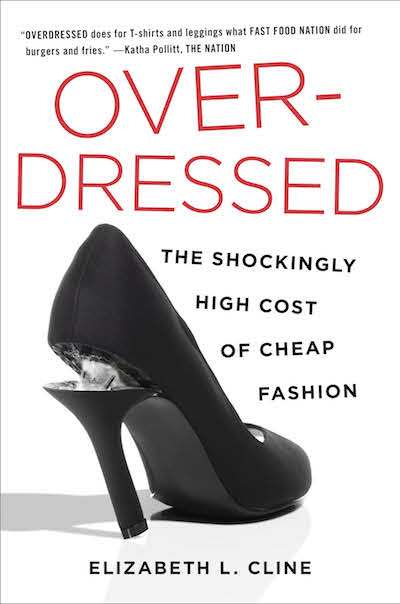
Overdressed: Elizabeth Cline Rips the Cheap Fashion Industry Apart at its Poorly Sewn Seams

overdressed 2

Here’s an incredible fact–I paid less than $30 per item on average for each piece of clothing in my closet. . . That clothes can be had for so little money is historically unprecedented. Clothes have almost always been expensive, hard to come by, and highly valued; they have been used as alternate currency in many societies. Well into the twentieth century, clothes were pricey and precious enough that they were mended and cared for and reimagined countless times, and most people had a few outfits that they wore until they wore them out. How things have changed. We’ve gone from making good use of the clothes we own to buying things we’ll never or barely wear. We are caught in a cycle of consumption and waste that is unsettling at best and unsatisfying at its core.

–Elizabeth Cline, Overdressed

In Overdressed, Elizabeth Cline recalls her first trip into H&M, the Swedish fast-fashion giant now considered the second largest global clothing retailer, in much the same way I recall mine. With her heartbeat racing, she was wow’ed and woo-ed by “gleaming white walls and polished ash wood floors.” She quotes a fashion blogger who first walked into fast-fashion retailer Forever 21 and felt like “a kid in a candy story.” The affordable, indeed truly cheap, yet trendy clothing made shopping sprees possible for those on the tightest budgets. By the time H&M hit the Bay Area, the buzz was at a fever-pitch, and it seemed to be all fashion magazines talked about. Fast-fashion’s prices flabbergasted me at first, seeming too good to be true, but now I’ve grown to expect them. As Cline explains, we’ve acclimated to the sort of cheap fashion Zara, the pioneer of the fast fashion industry and now the world’s largest clothing retailer, H&M, and Forever 21 offer.

But what does it mean for fashion when consumers expect to pay $14.99 for a full detailed dress, or $5 for a t-shirt? Cline explores the dysfunctional state of cheap fashion from production, as clothes are made by workers overseas paid under a living wage; to the expectation of constant consumption, as fast fashion relies on constantly updating stock and huge amounts of product sold to make profit. She follows the trail of what we buy from our closets, to donation centers like Goodwill, to the textile recyclers who agree to take cubed “bales” of compressed unwanted clothing, weighing half a ton each, which become rags or get shipped off to Africa.

Cline explores the history of fast fashion, eye-opening for me in a way I’ve never really considered trade regulation and how directly it affects my life. First, let’s establish some basics–clothing is made for much cheaper in developing countries, where workers can be paid as little as $68 a month. Got it? Cheaper imported clothing means fewer jobs for well-paid garment workers in the U.S. It means more resources used on shipping clothes from across the globe to stores here. Cline explains the Multi-Fiber Arrangement, “a convoluted system of quotas that limited the import numbers of more than one hundred categories of clothing” from developing countries into industrialized ones from 1974 to 2005. The MFA expired in 2005, based on a decision ten years earlier by the World Trade Organization. This flooded the U.S. with incredibly cheap clothing, priming us to pay less in a system of great deals that is ultimately unsustainable.

I also learned how little I know about what I’m putting on every day–Cline talks about the fabrics and stitches used in much of the stuff we wear, many of which are derived from plastics and blended in ways that are non-recyclable. She interviews a 67-year-old woman whose childhood dolls wore clothing better made that what we’re wearing today, sewn with a blind hem, a “labor intensive and subtle type of stitch” that’s not often used any longer.

The blurb on the front of the book says, “Overdressed does for t-shirts and leggings what Fast Food Nation did for burgers and fries,” and this is a simple way to explain the dysfunctional fashion industry, only because we all now understand the dysfunction of the fast food industry due to raised awareness thanks to previous exposés. Like the issues surrounding ethical eating, buying fair trade and ethical clothing seems currently priced out of range for many of us. If $5 for a t-shirt is too little, then $50 for a t-shirt also seems to be quite a stretch. Cline’s message, however, is that investing in a few well made basics will save us money in the long run, as well as start a more sustainable cycle of consumption–the clothes will last longer, and create less waste as we’ll be keeping them.

She also suggests sewing, which sounded so bizarre to me when first presented in the book. That sewing would be so novel says something about the way I’ve come to view clothing. Cline opened my eyes to the power in modifying your own clothing, rather than tossing it for something new. As I read about Cline’s experience with sewing her own clothes, and offering to take in or hem something for a friend, I realized how life changing this simple skill could be.

Although published in 2012, this is a must-read for anyone who wears clothes today. Cline seemed to be more active in the media last year, and I wonder if this is because of a lack of press interest this year in this topic, or because Cline is at work on a new project. I’m interested to see what Cline’s follow up to this book will be–as Michael Pollan has shown in his detailed examination of the way we eat, this seems like just the tip of gigantic, compressed and unwanted, poorly sewn clothing bale of an issue.

Overdressed on Amazon.com/Powell’s.com/Indiebound.org

Review – Between Page and Screen by Amaranth Borsuk and Brad Bouse

Amaranth Borsuk and Brad Bouse‘s Between Page and Screen is one of the wildest books I’ve read. A collection of poetry found only when the page comes to the screen, the book itself features code which can be read by your computer’s camera at BetweenPageandScreen.com, thus presenting animated poems in an augmented reality–neither fully on the page, nor fully on the screen, but requiring both to exist.

The book’s boggling format is also its subject matter, as it consists of poems back and forth between feuding lovers P. and S. They’re recovering from a blowout and each trying to find their own place in the world as well as seek to understand the other. They may “share text’s fleshy network,” but they’re struggling to connect.

As this book is quite visual, and almost impossible to explain without some illustration, I’ve made a recording of my screen as I’m reading Between Page and Screen. Enjoy and pick up your own copy to get this crazy reading experience.

Between Page and Screen on Amazon.com/Powell’s.com/Indiebound.org

Review – The Children Act by Ian McEwan

the children act

When a court determines any question with respect to  …   the upbringing of a child  …   the child’s welfare shall be the court’s paramount consideration.

Few professions today seem to demand as much denial of personal life and emotion than that of a judge. When presiding over their courtroom, we expect judges to leave their baggage below the bench, drape themselves in robes, and become an impartial adherent to the law, dictating truth in places we’ve lost it ourselves. In The Children ActIan McEwan returns to form by exploring the toll this can take. Judge Fiona Maye finds herself floundering dangerously between stoic distance and wild, warm connection.

Maye is a prestigious and highly-respected family court judge, the type who’s written decisions they study in law schools. She’s confident of her ability to bring “reasonableness to hopeless situations.” She is, in every way, a reasonable woman. And then, thirty-five years of marriage in, her husband announces he’d like to have an affair. Thus Maye is set adrift in her own family drama, a personal woe she has little time to consider as an entire court full of other family’s legal woes awaits her, and her steadfastness, her competence.

In the midst of an argument with her husband, Maye receives an emergency call that she’ll be presiding over a case in which Jehovah’s Witnesses have refused a life-saving blood transfusion for their 17-year-old son, Adam, on religious grounds. The media attention surrounding the case is high, time to make the decision is short.

What follows is, in that uniquely McEwan fashion, a story of people crashing into each other and then tearing apart, leaving pieces forever behind. Brutal, impossible connections that mold us as we stand there stunned, mesmerized and unthinking for just a wide-eyed second too long, these are McEwan’s specialty. The New York Times review of The Children Act explains of McEwan’s writing, “there is a moment of crisis or extremity that shatters his characters’ lives, reveals the innermost workings of their hearts or triggers a reassessment of everything they’ve believed.” His characters are rarely prepared for or aware of this extremity as it falls upon them, and I think this is why his books feel so authentic, so tragic–this is how life happens. We don’t realize what mattered until we have time to look back.

The Children Act on Amazon.com/Powell’s.com/Indiebound.org

Recap of Hieroglyph Q&A with Neal Stephenson and friends

hiero book

Hieroglyph: Stories & Visions for a Better Future, released this week, is an anthology which encouraged authors “to contribute works of ‘techno-optimism’ that challenge us to dream and do Big Stuff.”

The entire idea came about when Neal Stephenson gave a talk at the Future Tense conference in early 2011, where he “lamented the decline of the manned space program, then pivoted to energy, indicating the real issue isn’t about rockets. It’s our far broader inability as a society to execute on the big stuff.”

Michael Crow, Arizona State University’s president, heard this lament and suggested to Stephenson that perhaps the problem began with Stephenson himself, and other sci-fi writers like him who weren’t thinking big enough in their ideas. Thus, Ed Finn and his Center for Science and Imagination at ASU stepped in, connecting some serious scientists with those great masters of imagination, science fiction authors.

The culmination of these connections are boggling, vivid, and seriously delightful: a structurally sound twenty-kilometer-high steel tower (that would be really high, for those lacking perspective); cities that function like ecosystems, either through technology built to act as biology or through biological infrastructures; a world where machines have been entirely replaced with living matter; or a psychedelic revolution where we’re tripping out on quantum mechanics rather than any sort of drug.

I had the opportunity to attend a Hieroglyph release event with many of the authors, most notably Neal Stephenson, and both of the editors, at Kepler’s Books in Menlo Park on September 10th. No better place to talk about science and imagination than in the heart of so much innovation, Silicon Valley, right?

first panel

Hjelmstad, Stephenson, and Finn.

After a quick introduction by Finn, who also edited the book, the first panel featured Stephenson and Keith Hjelmstad. Hjelmstad is a professor of structural engineering at ASU who worked with Stephenson on his idea for the book, the Tall Tower. The idea originally came from an old paper by Jeff Landis, Stephenson said, but he realized quite quickly he needed professional help. He was doing fine until he took wind into account. “99.9% of the problem is wind,” he said, with a very, very high building.

Hjelmstad said the “desire to make it real” drew him to the project–he even had a graduate student e-mail him about a design detail that morning. As the world of engineering is often bogged down with many codes and lawyers, which can kill creativity and innovation, this project offered something different.

Stephenson and Hjelmstad eventually came up with something that “looks like a tower, but flies like a kite,” as it was necessary to harness the wind for stability. This was sort of a new way of looking at a building–an organic idea.

There was a brief Q&A after the Tall Tower talk, in which Stephenson shrugged off a question about Google Glass and Snow Crash very modestly, saying the book’s concepts were around before he wrote about them. He said that he doesn’t think science fiction necessarily invents these ideas, but “creates hypothetical futures with the ideas used in a practical way.”

Someone asked about the Tall Tower’s shadow–“diffuse, gray, delightful.”

Most memorably, someone in the audience began animatedly offering up their own idea for some sort of force-field glove which would propel fireballs, just incredibly off-topic. I was sort of baffled, as we were talking about the Tall Tower, and expecting another question, but Stephenson just rolled with this new idea. He suggested some things to think about related to projecting fireballs, saying he knew some people who did amazing stuff with fire, and to a round of applause, concluded that “any engineering problem can be solved–you just have to figure out your objective and the legal ramifications.”

second panel

Newitz, Anders, Rucker, and Cramer.

The second panel featured Hieroglyph‘s second editor, Kathyrn Cramer, and three contributors: Annalee Newitz of io9 fame; Rudy Rucker, a founder of cyberpunk; and the award-winning Charlie Jane Anders.

Newitz said at one point that the most audacious thing about Hieroglyph is that these stories focus on humanity surviving. I think this is a huge, interesting point, and I tend to agree. There is quite a bit of fatalistic, dystopian fare out there right now. Do we really think we’re that bad?

I hadn’t ever heard of Charlie Jane Anders, but her commentary made me definitely want to check out her work. Also, Rudy Rucker seemed wildly wise, like some sort of buddha in writer’s garb, and I’m excited to read his stuff as well.

thingers with hiero

Optimistic cat is techno-optimistic.

The conversation is ongoing, as Project Hieroglyph itself is designed to be an interactive and open experience–don’t let the book’s pages, with all their permanence, fool you. You can contribute your ideas, and perhaps change the world, or just start changing the world’s story.

Hieroglyph at Amazon.com/Powell’s.com/Indiebound.org

Review – One of Us by Tawni O’Dell

One of Us is haunted in all the right ways, with memories and rumors, psychic dogs channeling ghosts while very human monsters slip by undetected.

Review – The Secret Place by Tana French

the secret place

     You forget what it was like. You’d swear on your life you never will, but year by year it falls away. How your temperature ran off the mercury, your heart galloped flat-out and never needed to rest, everything was pitched on the edge of shattering glass. How wanting something was like dying of thirst. How your skin was too fine to keep out any of the million things flooding by; every color boiled bright enough to scald you, any second of any day could send you soaring or rip you to bloody shreds.
That was when I really believed it, not as a detectives solid theory but right in my gut: a teenage girl could have killed Chris Harper. Had killed him.

Tana French, The Secret Place

Detective Frank Mackey’s daughter, Holly Mackey, has some bad luck where murder is concerned. We met her in Tana French‘s third Dublin Murder Squad book, Faithful Place. In that story, Holly, along with Detective Mackey and the rest of his family, seemed inescapably weaved into the investigation of a long-forgotten disappearance.

In French’s new novel, The Secret Place, it’s six years later, and Holly has sprouted up into a young woman, all sarcasm and hair-tosses. Once again, a murder investigation has found her. She comes to Detective Stephen Moran, also from Faithful Place, with a note she found on an anonymous board at her posh boarding school, Kilda’s. The note claims to know who killed a boy from a neighboring school on Kilda’s grounds last year. Last year, the investigation went nowhere. This year, Moran is determined to solve the case and move up to Murder from what he sees as the dead end of Cold Cases. Detective Antoinette Conway, a door-slamming, in-your-face woman in a Murder Squad that likes its women flirty and accommodating, agrees to let Moran ride along and talk to the girls. Holly came to him, after all.

Thus the setup for a day of teenage interrogations, alternated with flashbacks of Holly and her girl gang the previous year, leading up to the murder.

At first glance, The Secret Place seems to be a clash of two starkly different worlds. Placing these brash and calculating detectives into the dreamy, fantastical boarding school world of adolescent girls, with all their wide-eyed, moon-struck whimsy and best-friends-forever chatter, Tana French might as well have set this book on another planet. Moran and Conway could be wearing space suits as they walk through the bizarre landscape of the boarding school’s halls, listening to the choir’s melodies echoing from down a corridor, watching nuns walk slowly over the well-manicured lawns.

But slowly, slowly, French lets us see that perhaps these boarders are the detectives perfect match. The girls are compared to carnivorous jungle beasts multiple times–jaguars with sharp, ripping claws, “big cats released for the night.” At one point Detective Moran says he knows he’s outnumbered by some of them as if he saw three guys with “a bad walk roll around the corner and pick up the pace towards you.” These girls are giggling ugg-wearing thugs; they’re long-haired, lip-glossed, yes, but they’re manipulative, and maybe murderers.

Or are they? Moran seems to ebb back and forth in his views just as the girls seem to gain and lose their confidence. One moment these are young women in total control, and the next moment they’re kids, panicking, hysterical, too young and so easily manipulated. It seems like the detectives aren’t sure if it is naivety tripping them up, or its opposite.

As the long day passes, the girls are kept in seclusion from the rest of the school, made available for the detectives to interview in groups and individually, kept quarantined to prevent their teenage gossip and outbreaks of hysteria from catching. A less talented author could have made this feel tedious, as the single day of investigation alternates each chapter with a flashback to Holly and her three best friends before the murder took place.

But this isn’t a less talented author, this is Tana French, who takes the police procedural out of the squad room and finds it wherever she chooses–the darkness of the woods or the isolation of an abandoned construction site. She finds it here, too, amidst the art projects of teenage girls and the glades they find magic in at night. The flashbacks give the reader a chance to compare conclusions formed by the detectives in each interview with what actually plays out, what behaviors each girl reveals contrasted with her actual role in friendships and crimes, in an amateur sleuth’s ideal setup. Layers upon layers of motive and manipulation are peeled back in a way that seems possible only amongst teenage girls or incredibly dysfunctional families, where so much of what matters is how others behave.

And for those that are concerned (no spoiler alert needed), this is a Tana French novel that answers the question “Whodunnit?” clearly, so you won’t feel left cheated if you are looking for a solve. But don’t expect to understand everything that happens on the grounds of Kilda’s, as so much of the magic of adolescence isn’t meant for the outside world.

The Secret Place by Tana French on Amazon.com/Powell’s.com/Indiebound.org

If you like this book, try reading: