Renee Knight’s ‘Disclaimer’ Is This Summer’s Big Thrill

disclaimer

Imagine picking up a book, and being drawn into its story. But suddenly the action swerves, the story turns much darker, and you find yourself appear in the text, a character recognizable except for a name change. The book begins to reveal a secret–a secret you’ve kept to yourself for years, that simply no one could know. And yet, there it is, drawn out on the page, this horrible action, stepping out of the past and into this plot.

When you flip to the disclaimer at the beginning of the book, that page with copyright information which assures the novel’s status as a work of fiction and says, “Any resemblance to any persons living or dead…,” the entire disclaimer is crossed through with a red line. Someone, you realize, is playing with you. Someone, you realize, has written this book just for you.

This is what happens to Catherine Ravenscroft in Renee Knight’s novel Disclaimer. Catherine, successful documentary film maker, transforms from a successful businesswoman into a bundle of nerves as she tries to trace The Perfect Stranger, the novel infiltrating her life and her history, down to its source.

In alternating chapters, the author of the novel is revealed, but this is a story of appearances and expectations, two of the most difficult things to interpret. By the end of the book we’ve learned many times over, thanks to Knight’s nuanced characters, just how much looks can deceive, and just how far the stories we tell ourselves can be from the truth.

Disclaimer on Amazon.com/Powell’s.com/Indiebound.org

Robert Charles Wilson’s ‘The Affinities’ Is ‘Divergent’ For Grown Ups

Affinities

I loved Robert Charles Wilson’s sci-fi Spin trilogy, about an earth which loses its night sky and what comes after those lights go out. When I heard he had a new novel out called The Affinities, I was super eager to pick it up.

The concept of The Affinities is a little bit Match.com, a little bit socialism. Adam Fisk is an early adopter of Affinity Testing. Thanks to the new field of socionomics, he’s led through a battery of tests which may qualify him for one of twelve Affinity Groups. This isn’t just a dating service, though, or a group of like-minded folks: affinity group members get each other from their first meeting, often live together, hire each other, and (eventually) care for their own much more than they do the rest of society.

Lucky Adam tests into the elite Tau Affinity, and the book skips forward to a world brimming over with the potential of affinities able to work perfectly together, people finely tuned for trust and cooperation, but cooperation with only a slice of humanity. Tau is at war with Het, another prominent affinity, and Adam and his family are caught in the crossfire.

As a lover of Wilson’s previous trilogy, this felt rushed to me. The glossing over of Adam’s nestling into the Tau Affinity, and the global shift as affinities rose from an early phenomena to an over-arching issue, felt like an introduction rather than the first half of a novel. And although other reviewers have noted the obvious parallels with social networking, I couldn’t help but think of the Divergent series and other sci-fi with social testing elements as I read. So, if you love Divergent (hey, no shame in that!) and are looking for a story that takes on some of its issues on a more plausible, understated level, this is your book. And if you haven’t checked out Spin yet, make sure to add it to your list.

The Affinities on Amazon.com/Powell’s.com/Indiebound.org

The Real Alex Vause Speaks Out: Cleary Wolters Goes Humble In New Memoir ‘Out of Orange’

out of orange

Cleary Wolters finished watching TV with her declining mother. After tucking mom into bed, she went back to the television. Remote in hand, she watched a woman in an orange jumpsuit step out of a van with a familiar pinstripe pillow. She heard the phrases “lesbian lover” and “drug smuggling” as she watched a montage of prison life. Then she saw Donna from That 70’s Show wearing her own trademark glasses, and she realized she was watching a trailer for her own life. Made into a television show! Can you even imagine?

That story, of how Cleary Wolters, AKA the real Alex Vause, found out about the show, is told in the prologue of her new memoir Out of Orange. I found it to be the most interesting one in the book. To have your life’s illegal choices made into a hit television show without your consultation, seems bookworthy in itself. In relating her story, Wolters seems determined to keep events rooted in her downfall, in the unglamorous truth behind her life as a drug smuggler. I give her props for refusing to hype up her time in the drug trade, but this translates to a memoir unpeppered with Hollywood-style action or Kerman’s own meditations on the inequalities of the justice system.

Wolters loses enchantment with smuggling early on in the story, but fears the powerful African drug boss Alaji so much that she finds herself recruiting others to smuggle drugs to avoid the risky job herself. Wolters experience of smuggling is often one of waiting around for a call in a foreign country, watching money spent at hotels burn through previous earnings, hoping to recoup costs on the next run. It sounds unbelievable stressful, and although there are some glimpses of the high life, with wads of cash thrown around a room or champagne drunk in a warm ocean, the majority of the story documents the struggle of Wolters and her sidekicks as they try to stay above water.

Throughout the memoir juicier stuff is (intentionally?) glossed over–the level of partying among the group (Wolters mentions popping pain pills, but doesn’t expand on the habit), time spent at Alaji’s compound in Africa early on, her motivations for drug smuggling, her feelings for Kerman throughout their time together. She spends quite a bit of time on details difficult to care about without a bigger picture–different cats and their Wolters-caused plights, morning damage control of forgotten drunk fights from the night before, hotel amenities and airport surroundings and where to plot down next. Is all this important? Of course. Does it relate to any larger message on Wolters as a person, justice, drug use in America, being in a relationship with Piper Kerman, or Orange is the New Black? No.

So, what’s the deal with Piper? If you are Orange in the New Black obsessed, read the book. It gives more background on how exactly Piper (real last name Kerman) met Wolters, and ended up being recruited by Wolters. First for watching her cats while she traveled the world, and eventually for traveling with her. Although this is Wolters story, her love affair with Kerman comes on slow and strange, and much more about it is revealed here than in Kerman’s own memoir. Which makes me wonder–will Kerman write another, more personal memoir now, as her first was so focused on the injustices of the prison system?

If you don’t want to read the book, here’s the breakdown: Kerman and Wolters meet at a restaurant where Kerman waitresses. When Kerman comes over to Wolters’s house with a group of people, Wolters is impressed by Piper’s handling of her freaked out cats, who are scared after a move. The kitties love Kerman. Really, Kerman’s downfall could be blamed on her cat whisperer tendencies here. There’s a heavy love of kitties throughout Out of Orange: prison cats, San Francisco cats, cats recruiting Kerman to the darkside. Although the attraction between the cats and Kerman is instant, the attraction between Wolters and Kerman isn’t. Wolters gets the pretty blondie’s phone number, but nothing happens that night.

When Wolters needs someone to watch her kitties and house sit for her during her next smuggling trip, who does she think of but cat whisperer Kerman! She meets Kerman and lays it all down–the drug smuggling, the need for a cat sitter. Thus begins an odd sort of relationship, where Kerman stocks Wolters’s home with healthy foods and tends to her cats, sleeps nude in a guest bedroom, but they remain just friends. There is one scene in the memoir where Wolters gets home from a trip abroad and tries to wake up a sleeping Kerman, throwing money around. I believe this is in the TV show, right? So yes, that happened.

Eventually, Kerman becomes more involved with Wolters, and travels with her. Kerman dresses like a sexy businesswoman, sleeps nude, and spends way more of Wolters money than Wolters secretly desires. Internally, Wolters is losing control of everything. They pose as a couple, although their relationship is a strange business/friendship deal full of power issues. Kerman is the hot one, Wolters is the one with the drug money. Wolters is hoping to groom Kerman for her role in the smuggling operation, but Kerman doesn’t even know this. Kerman clearly likes the attention and the life of luxury, but the luxury part can’t hold out much longer. They never seem to get the payoff they’re hoping for. Finally, they have a threesome with sidekick Phillip, which opens the doorway for the Wolters and Kerman relationship.

Their breakup is as sudden as their hookup. At a hotel in Brussels, Kerman tells Wolters she “can’t do this anymore.” Wolters understands and lets her leave.

When Wolters is arrested, she does ask for protection for a list of people including Kerman. She is terrified that Alaji will kill them all, if he finds out that she has been arrested. As Alaji was involved romantically with Wolters’s sister, she immediately thinks her sister is in danger. Eventually, Wolters claims, what she said didn’t matter as they all pled guilty to conspiracy.

Amazingly, “Alaji,” who is really Prince Buruji Kashamu (is it okay to say this?) has won a senate seat in Nigeria. I wonder what he thinks of the show. Or when we’ll get his memoir…

Out of Orange on Amazon.com/Powell’s.com/Indiebound.org

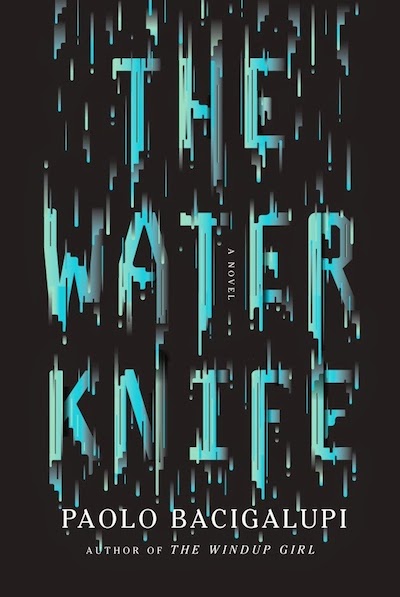
Summer Reads: Paolo Bacigalupi’s ‘The Water Knife’ Will Freak You Out And Make You Thirsty

The Water Knife

I recently moved from California, in the midst of one of its worst droughts on record, to Arizona, a desert state in perpetual drought. Water is on my mind. So Paolo Bacigalupi‘s new novel The Water Knife, released this week, hit home with me, as it takes place in a Phoenix post-“big daddy drought,” and the city is drowning in constant dust storms. Refugees from Texas live in shanties around Red Cross/China Friendship water pumps.

If you read one book this summer, let it be this one.

After big daddy drought, nothing matters as much as water rights. States are at each other’s throats, closing their own borders and seeking technology to cover rivers and prevent evaporation. The bureaucracies of water management are now militarized. The Southern Nevada Water Authority, led by the fierce boss Catherine Case, is an unapologetic power player, sacrificing suburban sprawl as she cuts off water to outlying areas to save the wealthy epicenter of her city. Rich Chinese and Vegas businessmen live in an enclosed, sustainable arcology that purifies and reuses water, a carefully created ecosystem full of green parks to walk through and lush moisture in the air, for those who can afford to get inside.

Angel Velasquez is Case’s right hand man, salvaged from the gang life and transformed into a water knife, a man who gets things done to keep his city drinking water. Amidst lawsuits and injunctions and national guard troops, Angel is the man you send to bomb out a treatment plant on the Arizona border, before the Zoners send in their own troops. He’s the man who makes sure rivers flow your way, leaving other states dry and thirsty.

And in Phoenix, people are thirsty. We meet reporter Lucy as she throws on her filter mask and grit goggles, and heads out in a blinding dust storm to find out more about the news of a murder she sees on the hashtag #phoenixdownthetubes. There’s Maria, a Texas refugee who’s trying to resist the pull of easy prostitution money for one more day.

Angel, Lucy, and Maria collide in their struggles for survival, and each is memorable, but none stands out more than their landscape. Severe drought brings third world conditions to America in a way that reads both haunting and close to home, with our current drought situations. Today, there is news that water related crimes in California are increasing. Everything we’ve taken for granted, Bacigalupi takes apart.

But Bacigalupi’s message in the book, and in interviews, is that current droughts shouldn’t be a surprise, as we should be planning for them. In The Water Knife, Marc Reisner’s 1986 non-fiction book Cadillac Desert: The American West and Its Disappearing Wateris treasured and handed down as a sort of bible. All the characters marvel at how even in the eighties, people could have seen this coming, known about these limited resources, and not done anything.

I think I’d do a disservice not to mention cli-fi as a growing term, attached to this book and others that address our future as it relates to climate change. Is this a buzz term? I’m not sure. Bacigalupi wrote about this in his review of Welcome to the Greenhouse a few years ago, where he said that the term climate change in relation to fiction makes him squirm, but it is being dropped all over the place. So, think what you will about that. And really enjoy your next glass of cool water, on behalf of these characters!

The Water Knife on Amazon.com/Powell’s.com/Indiebound.org

Cadillac Desert on Amazon.com/Powell’s.com/Indiebound.org

In Laura Van Den Berg’s ‘Find Me,’ Forgetting Kills As It Saves

Find ME

The reviews are divided on Laura Van Den Berg’s first novel, Find Me. While the masses on Goodreads were unimpressed, Salon triumphantly declared Van Den Berg the best young writer in America, and the literati offered high praise. I’m torn between the two camps.

Find Me is the tale of a hospital, and the woman living within it. That woman, Joy, stands in opposition to her name. Before a man knocked on her door in a virus-shielding space suit, offering her a ride on a bus to the hospital, she chugged Robitussin and watched the world fall apart around her, as a mysterious illness ate away at people’s minds and their memories. Joy seems immune to the sickness, and takes the ride to the hospital, where she is studied and coddled and kept sequestered from the real world, or what has become of it.

The patients remember and recite random facts, assuring themselves and the nurses of their health. Pilgrims make way to the hospital, standing in front of its entrance and wondering about its search for a cure. There is routine, and there are disastrous breaks to that routine.

And then, Find Me isn’t the tale of a hospital at all. I didn’t read anything about the book before beginning, so I was surprised, but Joy leaves the hospital and delves more deeply into her history, swimming through memories as she journeys through surreal landscapes, looking for a mother she knows is hers but has never met. The book is cleaved into these two stories–one of stasis, and one of journey.

This isn’t a book about the big answers, but it is a book about the knife-stab into the gut of small ones. In a time when so many authors are writing about collective memory, like in J. and The Buried Giant, Van Den Berg has chosen to sweep all that aside. She’s drilling down to how memory serves us each or acts as a tormentor, a friend or foe, and how sometimes forgetting is the only thing that keeps us alive.

Some have compared this book to Margaret Atwood’s The Handmaid’s Tale, and while I don’t think all these big build-ups serve Van Den Berg (as readers then pick up Find Me with wild expectations), I do think she manages to create a female character that is first, a vivid, broken, whole character, and second a woman. This is something Atwood excels at, making women people first, and what the world perceives they should be, second. Joy is surprising at every turn, often disappointing in her sheer humanness, feeling so solid I could touch her.

On the reverse of this, if you aren’t wooed by Van Den Berg’s even, enchanting prose, which zips you seamlessly into a foggy frame of world just two or three days of sleep removed from our own, if you are a big plot eater hoping to sit down to a big plotty dinner, then you might get a tad frustrated here. Find Me doesn’t tie up all its ends, it takes the ties out of the shoelaces and goes barefoot. It ties up ends you didn’t know it had. It walks right into Donnie Darko territory. I’m talking bunnies. I’m talking sexual abuse. Luckily, those two plot points never meet. But be prepared for the tragic, the weird, and most of all, the lack of a storybook ending.

Find Me on Amazon.com/Powell’s.com/Indiebound.org

Further Reading:

Samantha Hayes Brings Twists To A Small Town In ‘What You Left Behind’

what you left behindIn the opening scene of Samantha Hayes’s new mystery What You Left Behind, a couple joyrides on a stole motorcycle, with deadly consequences. This scene winds it way through the novel, as DCI Lorraine Fisher goes to visit her sister Jo in the country, and stumbles upon mysterious characters and mysterious crimes. In the fictional village of Radcote, a cluster of teen suicides still haunt the community. Jo’s son, Freddie, is clearly struggling, upset about Jo’s separation from husband, Malcom, and whatever keeps him furiously gazing at his phone day and night. But what exactly is Freddie involved in, and what does it have to do with the family who lives in the manor house, who lost their son in the outbreak of suicides last year?

Samantha Hayes proved herself a master of the red herring with the first book featuring DCI Lorraine Fisher, Until You’re Mine. I recommend it, although you don’t need to read it to pick up What You Left Behind.

One of Hayes’s best tricks seems to be to fall into stereotypical characters, and then pull out of them. There were several times, especially with Gil, an autistic (and suspect) member of the manor family who likes to take long walks alone at night, that I thought to myself,”Is she really stereotyping this character this hard? Am I really falling for this?” But (I’m not a fan of spoilers, so without giving too much away) Hayes manages, as she did with Until You’re Mine, to pull off a twist I totally didn’t see coming, as my attention was directed so many places.

If you are looking for a compulsively readable, spooky and fast-paced series to take to the beach or the pool this summer, look no further, as Samantha Hayes has got you covered.

What You Left Behind on Amazon.com/Powell’s.com/Indiebound.org
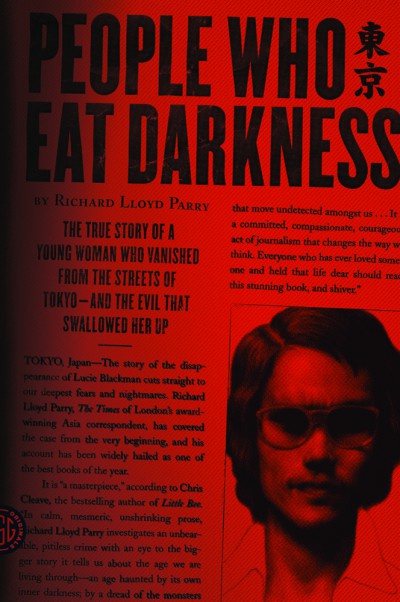
The Tragic Tale of Lucie Blackman: A Londoner Disappears In Tokyo

pplwhoeatdarkness

At first the story was a puzzle, which developed over time into a profound mystery. Lucie emerged as a tragic victim, and finally as a cause, the subject of vigorous, bitter contestation in a Japanese court. The story attracted much attention in Japan and Britain, but it was fickle and inconsistent. For months at a time there would be no interest in Lucie’s case, then some fresh development would bring a sudden demand for news and explanation. In its outlines the story was familiar enough— girl missing, body found, man charged— but, on inspection, it became so complicated and confusing, so fraught with bizarre turns and irrational developments that conventional reporting of it was almost inevitably unsatisfactory, provoking more unanswered questions than it could ever quell.

This quality of evasiveness, the sense in which it outstripped familiar categories of news, made the story fascinating. It was like an itch that no four columns of newspaper copy or three-minute television item could ever scratch. The story infected my dreams; even after months had passed, I found it impossible to forget Lucie Blackman. I followed the story from the beginning and through its successive stages, trying to craft something consistent and intelligible out of its kinks and knots and roughness. It took me ten years.

–Richard Lloyd Parry, People Who Eat Darkness

People Who Eat Darkness is an example of true crime being stranger than fiction right from the start. Beautiful, young Londoner Lucie Blackman was a hostess in the Roppongi District of Tokyo, lighting the cigars of Japanese businessmen and flirting with them as they drank. She went for a drive to the seaside with one of the men from the club, and never came back. Her panicked roommate, who immediately suspected something was wrong, received a phone call from a man insisting that Lucie had joined a cult and wouldn’t be coming home. Although roommate Louise begged to speak with Lucie, the man refused to let Louise speak with Lucie. “She’s not feeling well,” he said, “she’s starting a new life now.”

Roppongi - photo by David Fuchs

Roppongi district of Japan, where Lucie Blackman worked as a hostess – photo by David Fuchs

Thus starts the strange and tragic tale of Lucie Blackman’s disappearance. People Who Eat Darkness has popped up on so many best of true crimes lists as of late I took it as a sign to read it, and I wasn’t disappointed. Well-written true crime books are hard to find, as they often get so bogged down with dates and facts that they lose some of their humanity, or at the other end, they pay so little respect to the humans involved that they feel flagrant.

Richard Lloyd Parry, as a London correspondent living in Japan, was witness to the entire investigation surrounding Lucie’s disappearance, and ultimately, became an odd sort of part of the story himself, when the man put on trial for Lucie’s death sued him for libel. He is in the unique position to identify with Lucie, as much as an older man can, as a foreigner living in Japan. He seeks, vigorously, from the book’s introduction onwards, to establish and understand Lucie as a human, rather than as just part of a headline. He takes this compassionate stance with every person involved in the story, from Lucie’s misunderstood father who doesn’t seem to behave correctly in the aftermath of Lucie’s disappearance, to her murderer, whom Parry examines through his history and familial experience as well as his shocking, atrocious acts.

Roppongi - photo by David Fuchs

Roppongi – photo by David Fuchs

Without giving too much of the story away here, I think the story of Lucie’s disappearance also illustrates the difficulty of investigation in general, as police have a bizarre brush with their bad guy before they have all the facts, and they let him off. Tokyo as a city is known for its relative safety, and the police are simply unprepared to handle this sort of dark stuff, once it is exposed. The sad story of Lucie, with all its odd turns and stops, reminds me of how different the real world is from the mystery novels I love to read. If mystery novels are full stories chiseled out of a raw piece of marble by an author, true crime is an author stumbling through a quarry after police and criminals and victims, picking up rocks, trying to hold as many as he can in one basket before they all fall loose. From the confusion surrounding what exactly a hostess does to the odd ruling in the trial, Parry manages to patiently explain the convoluted case and its circumstances, while keeping up the pace.

People Who Eat Darkness on Amazon.com/Powell’s.com/Indiebound.org

The Suppressed Rage, The Suppressed Everything, Of Howard Jacobsen’s ‘J’

129.Howard Jacobson-J coverJ is a novel of omission, a novel of everything unsaid brewing up like an earthquake from under the ground.

Howard Jacobsen has built a world in which something happened. Something bad. This is a dystopian state that chooses not to talk about its dystopia, a world moved on by moving away, and now this holocaust-like massacre of some future group is referred to as “WHAT HAPPENED, IF IT HAPPENED.” Responsibility has been taken by all, or by no one, equally. Everyone apologizes for nothing specific. People’s names have been changed, attempting to wipe the slate clean and start over.

Social media, attributed with a role in WHAT HAPPENED, IF IT HAPPENED, has been replaced with flashing utility phones equipped for making and receiving local calls. Gone is conceptualism in art, as the “benign visual arts” now focus on landscapes. Gone is so much expressing discontent, from rock music to Proust, all blamed in part for the atrocities. And yet, not gone is everyone’s anger, as spouses argue and drivers rage.

So much in J lives in what isn’t known, what is forbidden, the opposing viewpoints never even aired, people privately stewing over their secrets at night, the treasures stored in boxes. I’m typing the letter “J” here, but in the book it is always J with two lines through it, as main character Kevern’s father “puts two fingers across his mouth, like a tramp sucking on a cigarette butt he’d found in a rubbish bin. This he always did to stifle the letter j before it left his lips.” Throughout the book, j is typed as the title’s two-lined, stifled, silenced j.

Amidst this negative backdrop, with its history subtracted and its culture forgotten or denied or disallowed, two people fall in love.

Ailinn identifies with the title’s namesake whale in Moby Dick, always pursued. “But when people describe having the wind at their back it’s a sensation of freedom I don’t recognize. An unthreatening, invigorating space behind me?–no, I don’t ever have the luxury of that.” Raised in an orphanage, unfamiliar with her history but aware of Ahab at her heels just the same, she grows up to shape paper into flowers beautiful and strange, alien to the landscape.

Kevern, in a village full of men not hesitant to beat their wives or each other, is not the type to hit a woman. A few kisses here and there, yes, but he’s a man who drives his car rarely and slowly, who disarrays his slippers and teacup in the hallway just-so as a security system against intruders when he goes out. He is a cautious, kind man.

When Kevern sees Ailinn for the first time, a girl with “black hair–thick and seemingly warm enough to be the next of some fabulous and he liked to think dangerous creature,” he is smitten.

As the book progresses, as Kevern and Ailinn’s love story progresses, less is omitted and more is stated outright. Kevern and Ailinn are both outsiders, that much is clear. But what does it mean to be an outsider, after WHAT HAPPENED, IF IT HAPPENED? Neither one of them know their own history, nor that of their country or its crimes. Gradually, a bit of their history is revealed. Never enough for a full picture. This isn’t that kind of book.

J starts slow, as Ailinn and Kevern’s love story builds and each of their characters develop, but the last half of the book makes a powerful and shocking statement about the other as necessary for identity. The intentional vagueness of the actual atrocities allow for sweeping, wise statements and tight, tragic glimpses that might lose power with a more fleshed out description of the crimes. The ending is astonishing, beautifully done, and makes the entire book more memorable.

J on Amazon.com/Powell’s.com/Indiebound.org

Emily Schultz’s ‘The Blondes:’ Viral “Blonde Fury” Strikes Women and Our Standards of Beauty

blondes-coverEmily Schultz, founder of Joyland Magazine, has written about an epidemic in The Blondes. This is the story of a virus, yes, and about its outbreak. But like Megan Abbott, Schultz’s horror bubbles up from society’s standards for women and their appearances. This is an epidemic that seems to step down off billboards and rock the collective consciousness, as much of the world demands its women trustworthy, both well-coiffed and well-behaved.

We learn of the virus through the memories of Hazel, narrating to her unborn child. Both the child’s existence and the virus’s bloom up around Hazel’s innocent graduate student life, a Canadian visiting New York indefinitely, hoping to clear her head of romantic entanglements. The story alternates between then, Hazel’s life in New York as the virus hits, and now, as Hazel holes up in a cabin alone, pregnant, wondering if the woman she was living with will return or if she’ll be forced to give birth alone.

Hazel explains in the book’s opening, to her unborn daughter:

We are not like men; men shake hands with hate between them all the time and have public arguments that are an obvious jostling for power and position. They compete for dominance— if not over money, then over mating. They know this, each and every one. But women are civilized animals. We have something to prove, too, but we’ll swirl our anger with straws in the bottom of our drinks and suck it up, leaving behind a lipstick stain.

The virus, nicknamed “Blonde Fury,” removes the veil of civilized nature that Hazel refers to here. Although the science behind the virus isn’t explained, and is referred to vaguely, it targets blondes. It targets the image of blondes we are all familiar with–women towering tall in high heels and perfect lipstick. It leaves them snarling and disheveled, animal-like, unable to be subdued by uniformed men. It hits a group of flight attendants, as they storm down the hall of an airline. It turns what we’ve been taught to identify as beautiful into something animal, furious and deadly.

Men are told what to watch out for on the news. Women who have anxiety are quarantined, suspected of having the virus. Suddenly, the female is feared. The story of the outbreak itself, like all virus tales, is strange and surreal, and Hazel’s own lack of direction leaves her adrift in the effects of the virus both in Canada and the U.S., an observer in both her own life and the world. At times hilarious, at times lonely, The Blondes always relays a striking picture of a world quick to adapt to “Gold Fever.”

You can watch the sort of strange, perhaps not representative of the book at all, trailer here:

The Blondes by Emily Schultz on Amazon.com/Powell’s.com/Indiebound.org
Important Book of the Day – Jon Krakauer’s ‘Missoula’

missoulaJon Krakauer’s Missoula: Rape and the Justice System in a Small Town uncovers the staggering mistreatment of University of Montana rape victims by the Missoula, Montana justice system. Stranger rape is an easy issue to talk about, as the lines between right and wrong are clear. Acquaintance rape, especially when a party is also too inebriated to give consent or consent seems unclear–this is where college rape culture lies, and this is where Jon Krakauer finds himself investigating. Men who can’t recall exactly what happened because they drank so much, women who awoke from a blackout with someone on top of them.

What shocked me most was the varying treatment Krakauer chronicles between victim and assailant by law enforcement. As women are immediately challenged about their claims, the men brought in for questioning are comforted. “You aren’t thinking of committing suicide, are you,” they are asked the men. At one point, a woman with clear bruises around her throat who was drugged with GHB is asked if she could have just fallen down the night before.

Krakauer notes throughout the book that despite the title of Jezebel’s article, ‘My Weekend In America’s So-Called ‘Rape Capital’ (the author is referring to a quote given by a student), Missoula’s seemingly high rape statistics are quite normal. They just aren’t commonly discussed, as rape isn’t commonly discussed.

I remember reading Jon Krakauer’s Into Thin Air, his personal account of an Everest climb gone wrong, in a buzzy good-book-haze, totally unaware of some of the aspects of climbing the highest mountain of the world. I had the same feeling again when I read his Under the Banner of Heaven, a terrifying look at the fundamentalist LDS church. Krakauer never shies from providing riveting accounts on the toughest of topics, attitudes towards acquaintance rape in Missoula are as scary as any of the other material he’s covered.

Missoula on Amazon.com/Powell’s.com/Indiebound.org

Further Reading: