Review – Before I Go To Sleep by S. J. Watson

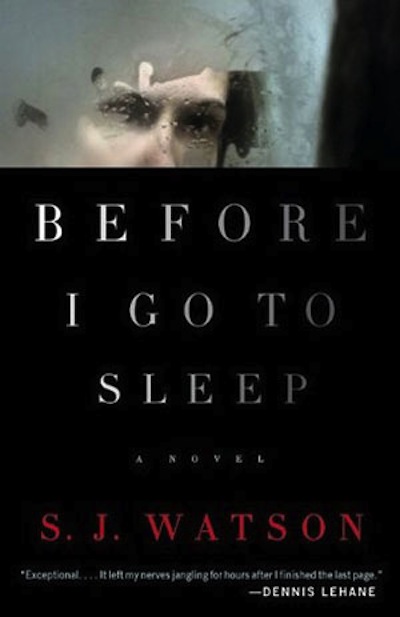
before i go to sleep

Imagine waking up in an unfamiliar bed. You vaguely recall going out with friends, assume you drank too much as the previous evening is blurry. You assume you went home with a guy you don’t know too well. Things are hazy. Looking up, you see a woman’s robe and slippers. An older woman’s robe and slippers. Looking over, you see an older man in the bed. You, being a twenty-something yourself, are confused. Did you somehow get picked up by an older, married man? Sliding quietly out of the bed and into the bathroom, the mirror image shocks you: the woman in the mirror isn’t the twenty-something you remember, but an older woman with an aged face you can’t recognized. You turn, and see pictures and notes on the bathroom wall. YOUR HUSBAND. BEN. The notes explain, plastered next to photos of you and the older guy from the bed. Photos of you both over a span of what must be decades–decades missing from your memory entirely.

He’s woken up now, this older man, and he’s standing in the bathroom door. You’ve never seen him before, you are sure. “I’m Ben,” he says. “I’m your husband. You had an accident. You don’t remember. But its okay.”

This is how each day begins for Before I Go To Sleep’s Christine, who has short term memory loss. She’s unable to form new memories the way most of us recall yesterday and three days ago–only her long term memories are deeply stored in her mind, sometimes hazy and sometimes bright and flashing, causing each day to be a shock of new realizations and old grasps at reality. All new memories formed wash away as she crawls into bed and falls asleep, causing the next morning to be a repeat of the jarring scene above, as she awakens confused. Each day is a puzzle for Christine, with acquaintances made strangers, routines unknown, and endless trust placed in those around her.

That trust, so crucial for her survival, as she awakes each day in bed with a stranger who walks her through their life together, begins to erode slowly when she gets a call from a Dr. Nash. He’s been seeing her secretly, he says, without her husband Ben’s approval. He recommended she keep a journal. The journal is hidden, and he tells her where to find it. In the front of the journal, Christine reads in her own handwriting: DON’T TRUST BEN.

And thus begins the mystery of Before I Go To Sleep, a puzzle where the entire plot has been erased with Christine’s short term memory. This is the worst type of unknown, a different sort of dread and fear–rather than not knowing who waits for her down a dark hallway, Christine is unable to remember her own motives for previous actions, or her own reasons for choosing to trust or distrust those in her life. She is unable to act as her own protector, holding those around her accountable for past events. She finds herself forced to take the word of her husband and her doctor about what she has said she wanted, or needed. She frantically writes in her journal, attempting to document everything each day, as she knows she won’t be able to remember it all clearly the next.

Before I Go To Sleep has been on my to-read list for years, as it was published in 2011 and I never got around to seeking it out. I happened upon it on a clearance shelf at a bookstore, and I’m glad I picked it up. I’m the type of person who always judges and calculates the mystery as its happening, and this was one I thought I had figured out towards the middle. I was ready to dismiss the book as too simple, with glaring hints everywhere about the plot’s outcome and an overly naive narrator. Luckily, there was a twist towards the end that I hadn’t expected, and it kept me interested and renewed my faith in the book. Thrillers like this are just the right level of easy to fall into, like a warm bath that isn’t too hot. Once you are in this book, you don’t want to get out again.

It is impossible not to compare this book, or really any short term memory psychological thriller, to the 2000 movie Memento (which was inspired by a short story, “Memento Mori.”) But there is non-fiction documenting short-term memory loss as well. Before I Go To Sleep‘s author S. J. Watson was influenced by Forever Today: A Memoir of Love and Amnesia by Deborah Wearing. Oliver Sacks discusses the case of an older man who believes himself to be a young sailor in his classic The Man Who Mistook His Wife For A Hat: And Other Clinical Tales. Sacks says of his work with this man, in “The Lost Mariner,” “I kept wondering, in this and later notes–unscientifically–about ‘a lost soul’, and how one might establish some continuity, some roots, for he was a man without roots, or rooted only in the remote past.” Sacks recommends his lost mariner keep a diary, just as Dr. Nash recommends to Christine in Before I Go To Sleep.

This type of mystery, which explores the weaknesses and faults of the human mind, is disorienting and a bit maddening. Presenting more than just an unreliable narrator, Before I Go To Sleep reminds us how delicate and frail our perception of the world is, and how easily that view can be shattered.

Before I Go To Sleep by S.J. Watson on Amazon.com/Barnesandnoble.com/Indiebound.org

If you liked Before I Go To Sleep, put these books on your to-read list:

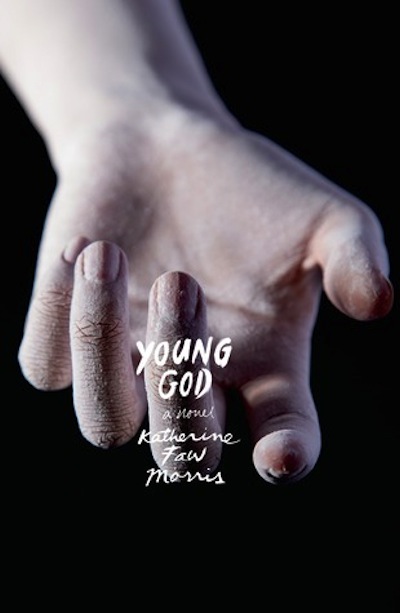
Review – Young God by Katherine Faw Morris

young god

Reading Young God is like being punched in the face over and over. It’s like eating sour candy until your tongue feels raw and your stomach aches but you just keep eating the candy anyways, knowing it isn’t fun anymore and it has possibly turned into a quite negative experience but dammit, there’s half a bag left. This book has few redeeming qualities but that doesn’t make it easy to put down.

We meet Young God‘s heroine Nikki, thirteen, in an opening scene that sets the tone for the rest of the novel: her momma falls off a diving cliff the wrong way, high on attention from a guy and who knows what else, and splits her head open. Nikki quickly runs from the scene of the accident with her mother’s lover and his backpack full of drugs, and the book is off and running at the pace of an adrenaline high. Nikki seems to be the girl the adage about years alone not truly measuring how much one has lived was made for, and this isn’t a tale of redemption as much as it is one of survival of the fittest and the maddest in a mad mad world.

Constantly fearing child services, just a call away, Nikki fights or flights her way from druggie guy to druggie dad, without the luxury of self-analyzation or insight surrounding the desperation of her situation. Things go from bad to worse, and from icky to really really icky, so if you can’t handle to darker stuff then this isn’t the book for you. It reminded me a bit of Tampa by Alissa Nutting in its breezy, un-analytic writing style of the most horrible aspects of human nature. Sometimes the murderers and rapists and pimps aren’t carrying on intense internal dialogue about life and ethics as they go about their dark business, these books seem to say. Sometimes people are just acting and reacting, bouncing off each other and feeding their animal drives and fleeing from consequences. A jarring statement to make, which leaves protagonists with little room for development, and even littler opportunity for us as the reader to comprehend any of their behavior. But hey, that’s life. To me this style of writing about this sort of subject is scarier than any horror novel.

I’m not sure how I feel about country noir as a genre in general. I haven’t read enough of it to make any sort of judgement, but I certainly hope we don’t see the emergence of Appalachian horror stories of poverty and blight as amusing simply because of the locale. The most intriguing characters aren’t stereotypes but the opposite, asking us to challenge our preconceived notions about the world and the way we see it. I became interested in this story after seeing a blurb shared on Elle’s Facebook page which declared the book a mix of Winter’s Bone and Breaking Bad. It feels to me as more a mix of Spun and Go Ask Alice. But Morris is a child of Appalachia herself, and she dated older men as a young rebellious thing trying to figure out her place in the world.

In the Elle interview, Morris says she cut down the novel from a longer version, and I would love to see the original story. I understand the purpose in editing it down to something brutally short for effect, but I need a bit more of a character’s internal dialogue to relate to their world. Young God is a story of drugs and violence, but its purposeful lack of depth makes it pulpy and a bit too grotesque for my taste.

If you like Young God, check out these books: 

Further reading:

Review – The Tyrant’s Daughter by J.C. Carleson

the tyrant's daughter 2

When reading the summary of The Tyrant’s Daughter by J.C. Carleson, I hadn’t even considered it could be a YA novel. Written by a former CIA agent, the book follows an unnamed Middle-Eastern despot’s family after his assassination. His wife, daughter, and son flee to the United States with the help of a shady CIA officer, where they struggle to adapt to life as non-royals while watching their home country self-destruct on TV.

But this is a YA novel, written from the perspective of the assassinated leader’s fifteen-year-old daughter, Laila. Sheltered for most of her life, she’s blissfully unaware of the atrocities her father committed against his people before his death. To her this man wasn’t a tyrant or dictator, but a beloved family member. Laila’s move to the US brings new adjectives used to describe her home and her father, like brutal and tyrant, and she struggles to synthesize new information and old.

The reader sees the world through the filter of Laila’s experience and upbringing: a school dance shocks not only because of the gyrating, but also because the crowd of bodies brings flashbacks of angry mobs. Afflicted with undiagnosed PTSD, Laila steps into classic YA fiction scenes only to be quickly jolted out of them with reminders of how different her own values are from those of American society.

Ideas from this book developed from author J.C. Carleson’s real life experiences as a CIA officer. She spent time in Baghdad in 2003, and saw elaborate playhouses left behind at one of Saddam Hussein’s compounds after he fled, which included multiple levels, an intercom system, and an elevator. This caused her to wonder the mindset of the children playing in such a wonderland–did they understand the circumstances around the man who built them such toys? As these questions stewed in her mind, years later, she noticed her son’s nonchalant reaction to the noise explosions which became a regular part of their life on a military base. Rather than jump to sounds of war, he would simply turn up the volume of the TV.

The Tyrant’s Daughter manages to come across as not ignorantly US-centric, as a book written by an American about the Middle East for young readers certainly could. Maybe because of Carleson’s experience, there is depth here that questions our American world view as insistently correct. Laila’s American friends seem insecure and boy-obsessed, and Laila charts her best friend’s countless style phases through the photos decorating her wall, a reminder that our freedom to express ourselves through clothing never really makes us as comfortable as we’d like. As shocking and flawed as Laila’s own culture seems to be, ours is certainly far from perfect.

The Tyrant’s Daughter by J.C. Carleson on Amazon.com/Powells.com/Indiebound.org

If you liked this book, try these non-fiction titles:

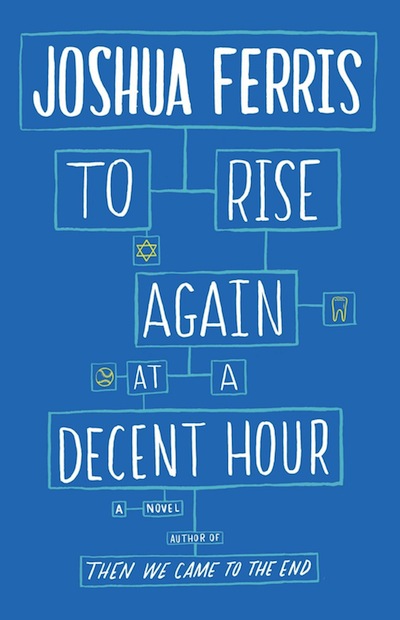
Review – To Rise Again at a Decent Hour by Joshua Ferris

to rise again at a decent hour

I encouraged my patients to floss. It was hard to do some days. They should have flossed. Flossing prevents periodontal disease and can extend life up to seven years. It’s also time consuming and a general pain in the ass. That’s not the dentist talking. That’s the guy who comes home, four or five drinks in him, what a great evening, ha-has all around, and, the minute he takes up the floss, says to himself, What’s the point? In the end, the heart stops, the cells die, the neurons go dark, bacteria consumes the pancreas, flies lay their eggs, beetles chew through tendons and ligaments, the skin turns to cottage cheese, the bones dissolve, and the teeth float away with the tide. But then someone who never flossed a day in his life would come in, the picture of inconceivable self-neglect and unnecessary pain— rotted teeth, swollen gums, a live wire of infection running from enamel to nerve— and what I called hope, what I called courage, above all what I called defiance, again rose up in me, and I would go around the next day or two saying to all my patients, “You must floss, please floss, flossing makes all the difference.”

Joshua FerrisTo Rise Again at a Decent Hour

I unfortunately read this book in a month with several dentist appointments, for a crown (my first ever!) and multiple fillings.

“I’m reading a book about a dentist,” I said to my dentist. He’s the simple, happy sort of dentist who chats continuously while my mouth is forced open with a metal contraption for an hour and a half, chatting as he drills and buffs like we’re having a cup of coffee, oblivious to my non-participation in the conversation.

“Oh yeah? Is he a good guy, or a bad guy, or what?” My dentist asked. Considering this question, when presented with To Rise Again at a Decent Hour‘s protagonist, Paul O’Rourke–a dentist beleaguered, a man so without his own religion he obsesses over the families of the women he dates, their Jewish rites or Catholic sternness, a man so exhausted from working to afford his prestigious Manhattan office he has no time to enjoy the New York around him–I didn’t even know the answer to the question.

Like an alien anthropologist studying our civilization for the first time, Joshua Ferris has always written with fresh eyes on things most of us find unremarkable. He explored the desperation of the American office worker in his first novel, Then We Came to the End, and the madness of undiagnosed illness with The Unnamed. With To Rise Again at a Decent Hour, he presses further into the harshest landscapes of our modern culture, with an at times shocking, always funny, always sad examination of a dentist’s search for a religion that may not exist.

O’Rourke is struggling through the usual rituals of dentistry, regretting his decision to forgo a private office in his business’s floorplan, gazing into the eyes of his masked dental assistant and wondering what exactly she is thinking, when he discovers his identity has been hijacked online. The hijackers may or may not be part of the oldest, most secret religion of all time, and they begin using O’Rourke as a figurehead for tweets and posts about their sacred texts and past persecutions. Yes, this is an incredibly odd, brilliant book.

Joshua Ferris writes like the lovechild of Don DeLillo and Christopher Buckley, if those two authors were trapped as cubicle-mates in a droll office environment where technology constantly broke around them. Sometimes I worry that more than any other living author, Ferris will be remembered as the voice of our time period’s mad combination of consumption and lack of self care, our dizzy running on a wheel to nowhere. This worries me not because he’s a bad writer, but because his writing seems to reveal so much of modern society’s malaise while staying honest, never slipping into some sort of too-cool-hipster-Hollywood apathy.

To Rise Again at a Decent Hour is unique in that it is alarmingly funny, so depressing at times that it is hard not to laugh out loud. This bitter humor is Ferris’s specialty, it seems, as it runs through each of his previous books. Ferris is a fan of humor in fiction, and doesn’t think we see enough of it. He said in a recent Paris Review interview, “We’re here also to make one another laugh, and to use humor to mitigate some of the shit and misery that goes on. I think the best advice I could give a young writer would be ‘Don’t forget about the funny.’ Humor is a part of life, so make it a part of your fiction.”

Don’t be fooled, however. This is the humor of a man laughing his way to hell. Those hoping for a light read should look elsewhere. The funny is there, yes, but Ferris’s power lies in his razor-sharp depiction of some of the desperation and loneliness of daily life, and the greater questions hanging over these daily routines we all struggle through alone. Now please, don’t forget to floss.

To Rise Again at a Decent Hour on Amazon.com/Powells.com/Indiebound.org

I’m assuming that because of the Amazon/Hachette dispute, as I’m writing this the hardcover is $26 right now at Amazon, $18.20 at Powell’s.

Further Reading:

Everything You Need to Know about the New ‘My Dad Is the Zodiac Killer’ Book, The Most Dangerous Animal of All by Gary L. Stewart and Susan Mustafa

13-zodiac-most-dangerous-animal-cover.w500.h750

The Zodiac Killer, identity unknown, never seems to leave the cultural landscape for long. He terrorized Northern California right at the time when flower power and cultural revolution began to fade into something more dissonant, and he set the tone for the next decade in the city of San Francisco as one full of violence and heartbreak.

HarperCollins recently released a book to exclamatory headlines, “Man Claims Zodiac Killer is His Father!” The publisher kept the contents of The Most Dangerous Animal of All: Searching for My Father . . . And Finding the Zodiac Killer under lock and key until its release date. The book’s author, Gary L. Stewart (along with true crime writer Susan Mustafa), relays the history of Earl Van Best, a cold-hearted organ-player who lived in San Francisco. Here’s what you need to know:

ice cream romance

Best and Chandler’s relationship,
the illegal “Ice Cream Romance”

  • Gary L. Stewart was the product of the doomed “Ice Cream Romance” between Judy Chandler, 14 and Earl Van Best, 27. Best saw Chandler walking off a school bus and fell in love, despite their 13 year age difference and the legalities surrounding sex with a minor. More news clippings on the romance can be found on Stewart’s site.
  • Paul Avery, who reported on the Ice Cream Romance, would later receive a card from the Zodiac killer and be considered one of his targets. Reporters at the SF Chronicle would wear buttons saying “I’m not Paul Avery.”
  • Shortly after Chandler gave birth to their child, Best abandoned the baby in an apartment hallway. The baby would be rescued, adopted by loving parents, and named Gary. As an adult, he would be contacted by his birth mother Judy, leading him to his birth father’s history and identity.
The Zodiac's first cipher, part 1 of 3.

The Zodiac’s first cipher,
part 1 of 3.

  • Best was taught ciphers by his father, who worked as an intelligence officer in the Navy. The Zodiac sent ciphers, many unsolved to this day, to various newspapers.
  • Stewart claims to have found E.V. JR Best in one of the Zodiac’s ciphers, and Earl Van Best Junior in another.
  • A fingerprint comparison of a blood print taken at a Zodiac crime scene and Best’s fingerprint show a similar scar.
  • Expert handwriting analysis has indicated that writing from Best’s marriage certificate and the Zodiac’s letters are a match. As I was writing this, SFGate’s blog released an article contesting the handwriting sample, saying it may not be Best’s handwriting at all.
  • In an incredible twist, Judy Chandler went on to marry Rotea Gilford, San Francisco’s a highly decorated San Francisco homicide investigator who worked on the Zodiac case, and went on to become involved in San Francisco politics.
  • Stewart implies that Gilford’s buddies on the force knew Best was the Zodiac and purposefully hid his identity to save the department from ridicule and preserve the reputation of (now deceased) Rotea Gilford and his wife.

The book itself leaves much to be desired, as there is an achingly awkward Part 2, “Signs of the Zodiac” written from the exact perspective we are so unsure of: Earl Van Best’s history and his place in the crimes. Speculation as to Best’s actions and motives combine with too much scene-setting to remind the reader that this is a re-enactment of history we really have no idea about.

Where the truth really lies, in Stewart’s discovery of his father as a man who closed him in a chest when he cried, abandoned him on an apartment landing, and then possibly murdered an unknown number of people, is only explored in Part 3 of the book, “The Truth Deciphered.” I question if a true crime writer was the right choice for such emotional subject matter, as the book seems to drift between facts of the case and guesses about what could have happened, totally lacking the deep symphony of heartbreak and fear that must be running through Stewart’s mind as he learns more and more about his father.

Compared to a truly fearless exploration of family history and adoption like The Mistress’s Daughter, by A.M. Homes, The Most Dangerous Animal of All leaves many questions unanswered. Did Judy Chandler wonder if her former kidnapper/husband was the Zodiac before Stewart begins to dig? Was it even ethical for a mother to reach out to the child of a closed adoption where there is so much pain involved?

This isn’t the first time someone has claimed an elaborate cover-up regarding the Zodiac Killer case, or even the first time someone has claimed their father was the Zodiac. The San Francisco Police Department has been underwhelmed with the book’s accusations, saying they ignored Stewart not because of a cover-up, but because of a lack of evidence. San Francisco police public information officer Albie Esparza recently said, “You can’t imagine how happy we’d be to have this case solved, since it’s been open so long,” he said. “If anyone has any details, any information is greatly appreciated by Homicide. Any time we can close a case and bring closure to families, that’s what we strive for.”

The Most Dangerous Animal of All on Amazon.com/Indiebound.org

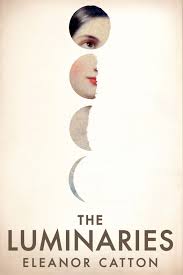
Review – The Luminaries by Eleanor Catton

the luminaries gif

Reading The Luminaries is like being dropped in the midst of New Zealand’s Otago Gold Rush, blindfolded and totally without reference, and then being spun round in circles by a stranger and let loose to feel around the landscapes and stand near their inhabitants, prospectors and bankers and Chinese diggers and tattooed Māori streaming around you, the women left to pleasure and care for these teeming throngs of men nearly knocking you over as they rush this way and that, and just as you feel overwhelming lost amidst these endless characters, totally without equilibrium in this many-plotted story centered in a town where everyone wants to make it rich, Eleanor Catton comes and takes you by the shoulder and steadies you for just a moment, and you breathe in the smells of dirty men and sea water as ships wreck upon the beach and scavengers look upon the ships and you sigh and know that despite there being too much information here, maybe just too much life here, for one book to ever express, you must keep reading.

the luminaries full coverAnyone coming off of a Goldfinch buzz and wondering what their next ambitious, too-long book will be should look no further than The Luminaries. Both books are written with the crisp observations that make them so much more than plot recounted. These are stories of life, magnified. Stories of how life could be if we all drunk in details of each other’s quirks and charms, every insecurity and affect, every ugly part and every beautiful one, and then maximized them into sentence-formed still lives spilling over into paragraphs so illustrative of this human condition we’re stuck in they act like paintings on pages changing ordinary days into phenomenas, ordinary interactions into humorous, tragic, wonderful things worth documenting. This is how these books get to be close to 1,000 pages long–life magnified is a very big thing, indeed.

The Luminaries, as I’ve mentioned, is the story of New Zealand’s Otago Gold Rush, and the story of a plethora of characters drawn together by an unfortunate set of circumstances. Men in all sorts of businesses centered around profiting off of gold or the men who find it feel uneasily bamboozled, they all sense a caper of some sort, and yet trying to pin down who has down wrong when is like trying to sift the gold dust apart from the dirt. The plot is complicated, and meant to be, as that’s the fun and beauty of the thing. Also, this is a book that uses the word “whore” quite a bit. Prepare yourself for that.

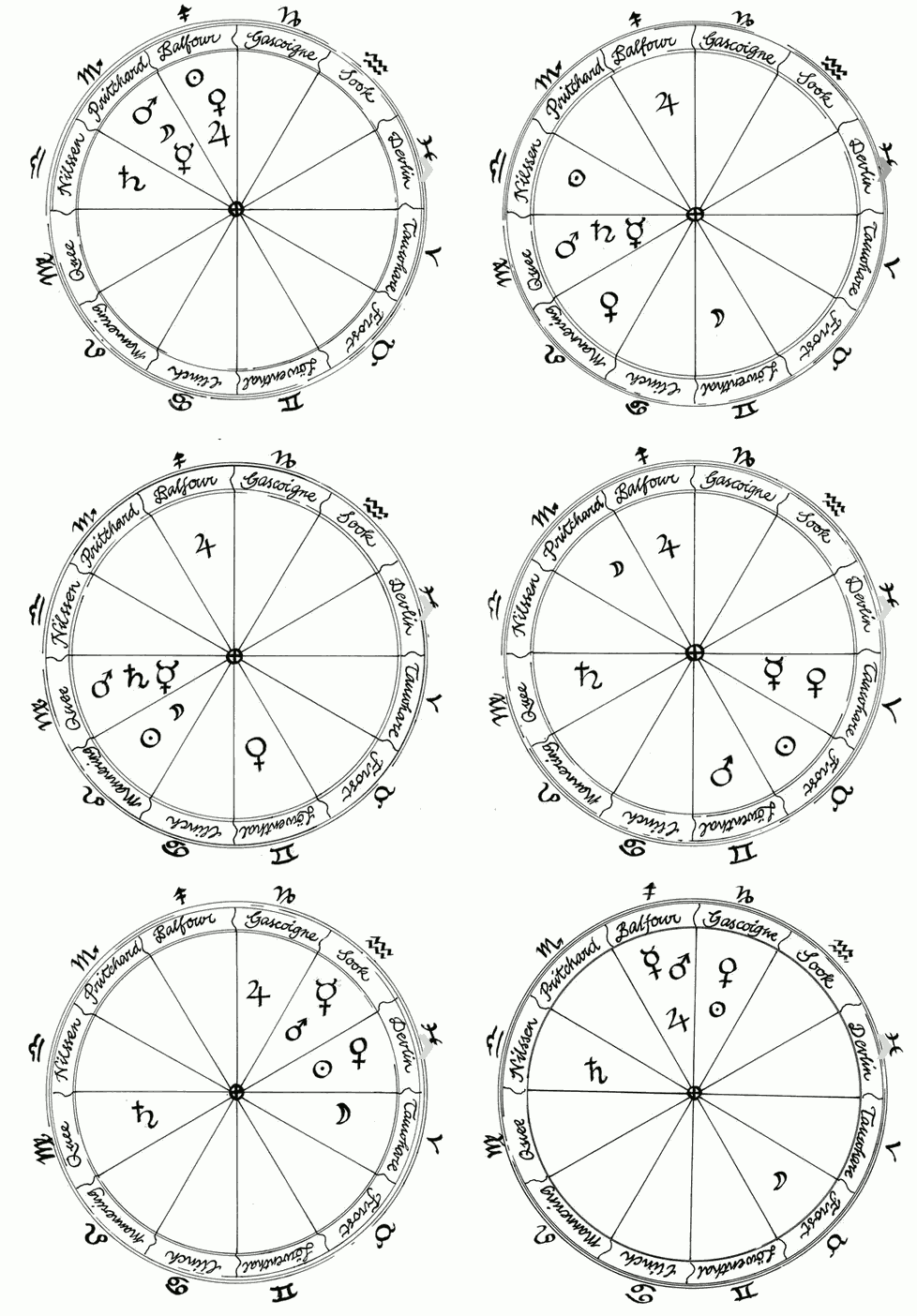
Catton includes all sorts of bells and whistles, but she really didn’t need to, as her writing stands on its own. There are astrological signs and charts of each character’s place on the zodiac, and there are chapter lengths that get progressively shorter by half until it seems almost hard to keep up with all the pieces that are being put together. As I listened to The Luminaries on audiobook, I missed much of this but gained narrator Mark Meadows deftly juggling the varied accents required amidst the cultural mish-mash of gold rush New Zealand. I appreciate getting lost in layers of meaning as much as the next book nerd, however, and I’ll be picking up a hard copy of the book to read again for further understanding of the whole astrological subtext.

I was quite fed up with non-linear narrative as a plot device, especially as so many authors now seem to use it as a cheap trick to create a sense of suspense where otherwise there would be none. The Luminaries, while not traditionally non-linear, told its story with such elegant disregard for linear storytelling that it renewed my faith in non-linear narrative. I wasn’t even aware of the story as non-linear until the elegant end of the book, which brought things to a fully circular close. “Oh,” I thought. “I see.” Books with a satisfying ending, that have so many twists and motives and lies and running through them, are rare indeed.

Eleanor Catton, author of The Luminaries via

Eleanor Catton, author of The Luminaries via

This was one of those books, that if you tune into the book world of things, became mildly controversial. The longest book to win the Man Booker Prize, by the youngest ever author to win it, The Luminaries is an astounding (literally record-breaking, although we save that sort of term for sports) achievement. After winning the prize, Eleanor Catton said in an interview with The Guardian that old male reviewers don’t take young women authors seriously, and they reviewed the book negatively. From the article:

I have observed that male writers tend to get asked what they think and women what they feel,” she says. “In my experience, and that of a lot of other women writers, all of the questions coming at them from interviewers tend to be about how lucky they are to be where they are – about luck and identity and how the idea struck them. The interviews much more seldom engage with the woman as a serious thinker, a philosopher, as a person with preoccupations that are going to sustain them for their lifetime.

I want to acknowledge Catton for voicing this issue, as a young woman of such mighty talent in the book biz. I’m sure this is something most women can relate to, as I have found myself sometimes saying to friends, “I wish people would want to know my mind, rather than see if I’m dateable.”

Some negative reviews by women asked why a young woman would write a book featuring only two women, one being a whore. This seems the saddest, most limiting sort of criticism–judging someone’s book content because of their sex seems to be an alarming double standard placed on a woman by a woman.

The Luminaries on Amazon.com/Indiebound.org 

Further Reading:

Review – Nickel and Dimed by Barbara Ehrenreich

nickel and dimed cover


Nickel and Dimed: On (Not) Getting By in America is wealthy and successful journalist and author Barbara Ehrenreich‘s experiment on living and working at the poverty level, seeking minimum wage jobs around the country and the housing she could afford based on her pay.

Ehrenreich’s ability to persuade was proven most memorable in the last chapter, where she takes off her minimum-wage job mask and allows herself the freedom to write a fiery, elegant critique of the American economy as that well-studied woman she is. I think the problem with fish-out-of-water journalism is that it focuses on the journalist’s experience, which by definition must be naively awkward: Ehrenreich is surprised managers are able to search her purse, and she goes into a staff meeting at a diner expecting discussion of marketing plans rather the usual rote rules and regulations. Take a fish out of water, it will flop and it will flail at every turn. Although Ehrenreich is an activist of all kinds, with a rich history of working towards social change, it is clear from some of her astonishment she has worked with quite a bit of autonomy for a long time now. This seems to me to almost diminish the experience of those who work around her, who have grown up working in retail and service industries, and know exactly what to expect, but still can’t make it. I would have much rather read a book where the eloquent Ehrenreich told one or two of their stories in detail, with her unadorned, jarring yet insightful commentary and research added along the way.

Her insights about low-paying, repetitive work and the things it does to your mind were so right on, these sorts of bizarre changes to your behavior and thought patterns. At one point, she says menial labor results in a type of “tunnel vision”:

“Work fills the landscape; coworkers swell to the size of family members or serious foes. Slights loom large, and a reprimand can reverberate into the night. If I make some vacuuming error, which I do often enough, I can expect to spend part of my evening reviewing it and rebutting the reprimand. . . “

Although not a minimum wage worker, this has certainly this has always been my work experience in the customer service and retail industries, and the experience of coworkers around me who obsess about mistakes and fear repercussions for slight infractions . Many years after working at a call center, I still have bizarre dreams of the queue of calls waiting to be answered, or of trying to stay away at my desk early in the morning, jerked awake by yet another ringing phone.

The chapter on working at Walmart was especially relatable for anyone who has worked retail, as Ehrenreich describes the bizarre animosity which develops between staff (who spend all day folding, straightening, organizing) and customers (who spend all day tossing beautifully arranged items about, picking them up with grubby fingers, allowing teething children to gnaw on merchandise as casually as they would a snack). Working in retail, there always seems to come a point of modern showdown: staff standing behind register, glaring at a customer who enters their store or area late in the day, daring them to touch any of the perfectly arranged, elegantly hung, exactly stacked merchandise. Your sense of reality goes, day in and day out, straightening the same area over and over again. Ehrenreich begins to feel this late in the day, as she tires of putting away go-backs in the Walmart women’s section:

“I cannot ignore the fact that it’s the customers’ sloppiness and idle whims that make me bend and crouch and run. They are the shoppers, I am the antishopper, whose goal is to make it look as if they’d never been in the store.”

At one point she comments that she relates to the clothes more than the customers, and feels protective of the space. All this, yes, is exactly my experience when working in retail. She has such a knack for perception, working in that environment such a short time but being able to describe the experience so exactly.

The glimpse into Walmart itself was terrifying to me, much more than Ehrenreich’s struggle to make it at a restaurant chain or housekeeping service. Although the cruelty of the home-dwellers towards the cleaners is cringe-inducing, to the point that I wished Ehrenreich would have revealed herself as a journalist and asked these people what they were thinking in acting in such a way, the true villain in Ehrenreich’s book is the corporation, and the supervisors loyal to it, all getting rich off the back-breaking work of people not able to afford more than a bag of chips for lunch or allowed to sit down when their feet ache. I knew Walmart was bad, I live in the Bay Area and its impossible not to absorb that sort of information just by breathing the air here, but I didn’t know how bad. After reading Ehrenreich’s experience at Walmart (no discussion of pay before orientation, and anti-union talk in orientation, especially), I knew I had to learn more.

I watched the 2005 documentary Walmart: The High Cost of Low Price, which acted as a nice addition to Nickel and Dimed. It featured ex-Walmart managers explaining the corporation’s extreme union-busting activities: flying in a specialist team by private jet to take over the store and install monitoring equipment at the first mention of the word ‘union’ by the staff. Clearly I’m a bit behind on learning about this stuff, but I can’t help but feel its good to know just the same.

Then the Walmart documentary reminded me of the “Who Is Dependent on Welfare” video which floating around the internet, which explains not only the concepts Ehrenreich wrote about in this book but also mentions the issue as it relates to Walmart specifically.

Reading this also made me think of There are No Children Here: The Story of Two Boys Growing Up in the Other America by Alex Kotlowitz, one of the most effective works of investigative journalism I’ve ever read. Kotlowitz, rather than focusing on his experience, documented the life of two boys living in Chicago’s Henry Horner Homes in the early nineties. More than reading about a privileged white man playing a game of trying to make ends meet and seeing if it can be done, Kotlowitz documented the sheer horror of day-to-day life for these two little people, each with their own shining little personalities being painfully shut down by constant violence and poverty, at Henry Horner Homes. And Ehrenreich touched on this here, but I would have loved for her to go so much further–I wish she would have offered to give these people a bit more of a voice. When Ehrenreich insists the poor are living in a state of emergency moment to moment, it seems like a much more fair solution to be witness to their struggle and offer them a voice and a platform for their actual crisis, rather than imitating or experience with that same crisis as an experiment.

Nickel and Dimed: On (Not) Getting By in America by Barbara Ehrenreich on Amazon.com/Indiebound.org

There are No Children Here: The Story of Two Boys Growing Up in the Other America by Alex Kotlowitz on Amazon.com/Indiebound.org

Review – The Martian by Andy Weir


the martian by andy weir_Fotor

If you love taking things apart and seeing how they work, if you had a soldering iron in middle school because you actually needed it for your various hobbies, or if you are obsessed with duct-taping solutions to life’s many problems, The Martian by Andy Weir is the perfect science-based thriller for you.

In Weir’s not-too-distant future, NASA has successfully sent two manned missions to Mars. The Martian focuses on the third Mars mission attempt, which goes badly in the most unpredictable of ways. Mark Watney, astronaut, botanist, and engineer, and protagonist is left behind when a dust storm causes the rest of the crew to evacuate in a blinded tizzy. Watney’s crew mates, thinking he has been mortally wounded, blast off the planet in the agreed-upon getaway craft, unwittingly leaving this single guy stranded on the Red Planet. Thus Watney becomes a sort of Martian himself, trying to frantically use all his knowledge in every clever, jury-rigged Survivorman-esque type trick in the book to stay alive until help can reach him. Sort of like the hardest test he’s ever taken, but hands-on, and often his oxygen, food, or water supply hangs in the balance. Billion dollar NASA-built equipment falls to pieces around him as he tries to push it past its intended use date or break it apart into more appropriate survival gear, and Watney plays genius-level whac-a-mole with complex problems in his struggle to stay alive long enough for rescue.

I confess I’m not a big fan of biology and chemistry myself, which is a bit frightening to realize as they are the basic building blocks of life, right? What can I say, I’m just an arts and letters type of girl. I found The Martian slow to get into as Watney tells his story through journal entries, detailing complex explanations and calculations of the many processes which Watney must depend on to survive, which went right over my head. I’m sure this aspect of the book was a welcome change from the usual thriller for the more skeptical among us, who are constantly bombarded with miraculous feats of survival with no explanation or logic behind them. If you wonder where the science is in much of your science fiction, its right here in The Martian, waiting for you.

Where the book came alive for me (and where my interests usually lie) was in NASA’s reaction to the predicament of this lone man stranded on Mars. Once characters at NASA are introduced, their struggle to balance the constant badgering of the media, and what comes to be the world’s obsession with this single man and his lone struggle for survival, with their own ultimate powerlessness over his situation created a much more interesting story. (Of course, CNN dedicates an entire program each evening to updating people on Watney’s status.)

The premise of The Martian is such an intriguing one that the book is difficult to resist, as the idea of a man being lost on an uninhabitable planet with only science to save him is haunting–there’s power there, as we made it to Mars, and then there’s fear there, as while we made it to Mars, we couldn’t make it back. As a firm grasp of science in the book is what makes the trip to Mars possible, that idea is then twisted when Watney must use those same skills, as an engineer, to harness the resources of a hostile planet and make it habitable. Can science dig us out of the messes we use it to plunge into? Watney, alone on Mars, armed with engineering and botany degrees and the supplies his team abandoned, attempts to answer that question.

The Martian by Andy Weir on Amazon.com/Indiebound.org

Further Reading:

Happy California Bookstore Day!

Saturday, May 3rd is California Bookstore Day (CBD). This is the day all of us Californians tip our hats to the indie bookstores we love, celebrating their existence as stack-laden and sometimes mildly claustrophobic utopias of browsing, where we can still quietly lose track of time as we peruse in search of the answer to that never-ending question, “Where is my next favorite book hiding?”

What would a celebration of bookstores be without some special books and book-like materials published specifically for these underdogs of the free market? One of the greatest aspects of CA Bookstore Day, aside from (duh) bookstore love, are the unique offerings created by authors and artists exclusively for participating indie bookstores. For once, this stuff won’t be cheaper on Amazon.

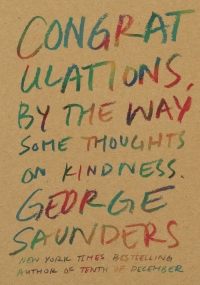
This year, the pickings are awesome. They include a $20 special edition of Congratulations, By the Way, an expansion of George Saunders’s convocation speech to Syracuse University. These will be signed, numbered, and doodled upon (?) by the author.

Saunders cover

A literary map of California will be available for $40, created especially for CBD.

3 Fish Studios Bookseller copy

Perhaps the most seriously awesome of the items available will be a wooden stencil with a quote taken from Don DeLillo’s White Noise, “California deserves whatever it gets.”

2-21 AG Book Stencil WOOD 2

Here is the whole quote for inquiring minds, from page 66 of DeLillo’s White Noise:

This is where California comes in. Mud slides, brush fires, coastal erosion, earthquakes, mass killings, et cetera. We can relax and enjoy these disasters because in our hearts we feel that California deserves whatever it gets. Californians invented the concept of lifestyle. This alone warrants their doom.

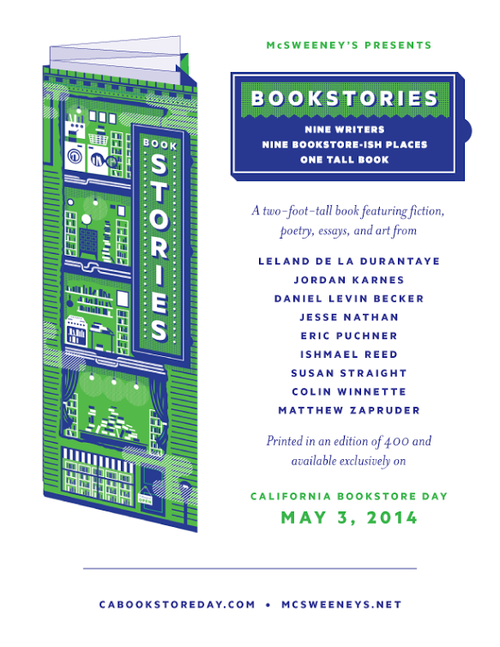
Although the stencil and its homage to DeLillo is seriously amazing, leave it to the mad hatters of publishing over at McSweeney’s to come up with a beautifully designed concept book so awesome it (literally) tops all other offerings. The publisher created a 2-foot-tall, free-standing, accordion-style book for CBD. In this work of art (which includes a hidden foldout illustration of California landscape), called Bookstories, McSweeney’s poets and authors (Californians, of course) “explore through short pieces the best bookstore they know of that doesn’t exist.”

mcsweeneys

I’m waiting for McSweeney’s to release an wearable book, or maybe an edible one. There’s always next year…

Visit cabookstoreday.com to get all the details, including which bookstores are participating.

And if you don’t live in California, be glad you don’t have to worry about your state falling into the ocean in an earthquake! Just kidding… Maybe your state has something similar to CA Bookstore Day? If not, maybe you are just the person to start this celebration of those little special places that sell books. Maybe this event needs to go national!

Review – The Storied Life of A.J. Fikry by Gabrielle Zevin

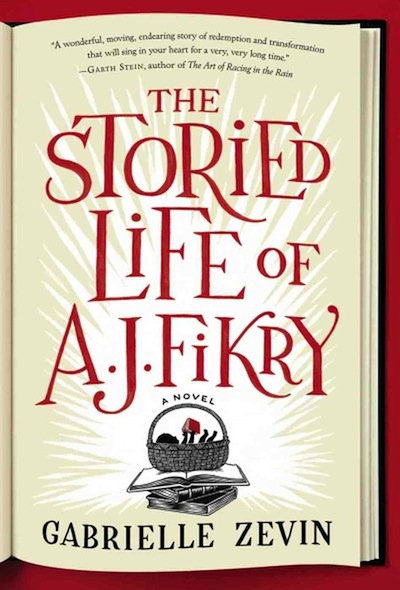
the storied life

I do not like postmodernism, postapocalyptic settings, postmortem narrators, or magic realism. I rarely respond to supposedly clever formal devices, multiple fonts, pictures where they shouldn’t be—basically gimmicks of any kind. I find literary fiction about the Holocaust or any other major world tragedy to be distasteful. I do not like genre mash-ups a la the literary detective novel or the literary fantasy. Literary should be literary, and genre should be genre, and crossbreeding rarely results in anything satisfying. I do not like children’s books, especially ones with orphans, and I prefer not to clutter my shelves with young adult. I do not like anything over four hundred pages or under one hundred fifty pages. I am repulsed by ghostwritten novels by reality television stars, celebrity picture books, sports memoirs, movie tie-in editions, novelty items, and — I imagine this goes without saying — vampires.
― Gabrielle ZevinThe Storied Life of A. J. Fikry

If you are still pining for Ajax Penumbra, the lovable curmudgeon of a bookstore owner introduced in Mr. Penumbra’s 24 Hour Bookstore, than The Storied Life of A.J. Fikry is the book for you. We meet protagonist Fikry as he seems to be drinking, eating, and grouching himself to death. As the owner of Island Books, his community’s only bookstore, he stocks books strictly to his limited tastes. He lives above the bookstore, and he frequently blacks out over his plate of frozen noodles after an evening of heavy drinking alone.

And then, an unfortunate (or fortunate?) series of events occurs: something is lost, and a little baby is gained. The mom abandons the baby to Fikry, hoping to give the charming tiny girl an opportunity to grow up amidst books and become quite a smart person someday. Yes, this explains the little baby in a basket on the book’s cover. As Fikry finds himself frantically googling how to raise a 2-year-old baby, the community rallies around him and his charming mystery child. Like magic, the irritable old man settles into his place in the world as a book lover who spreads that love to others, the curious baby reminding him that he has knowledge to share.

I knew I had to get this book when I received its (audio version) press release, with a quote from Scott Brick, the book’s narrator and my favorite narrator of all time, singing the novel’s praises:

I was told up front that The Storied Life of A.J. Fikry was a beautiful book, but I was still completely unprepared for just how beautiful. I was absolutely stunned by the experience of narrating Gabrielle Zevin’s latest book. It drew me in from the very first page. It was the kind of book that I might ordinarily find myself finishing after only three days in the studio, yet I found myself stretching it to four, then five, simply because I hated the idea of it being over. I wept while recording it, more than once. I’ve been blessed to narrate over 600 audiobooks thus far, and this book instantly pushed its way to the top of my list of absolute favorites. I told someone recently that I wish I could redo the book, and they asked, ‘Why, did you not like the way it turned out?’ I said ‘No, I just wish I could have that experience of reading every word again over and over again.’

Wow, right? If Scott Brick loved it that much, I’m all in. Although I didn’t get the audiobook version, the novel totally drew me in from its first pages, and I drank up the entire book over the course of a few days. The combination of flawed, honest, real characters and constant fiction references made for quite fun reading. Despite all the wit, there is a lot of heartbreak here, and I can usually do without a bit more of the sappy stuff. I appreciated Fikry’s clever banter with those around him much more than the commentary on love and loss. But beware, if you are the teary type–get your tissues ready.

The brilliance of The Storied Life of A.J. Fikry is in its book talk, as this is a book written for readers to truly appreciate. Fikry knows the town’s sheriff enjoys mysteries, and gradually suggests more complex mysteries until the policeman is reading Kate Atkinson’s Case HistoriesFinally the cop leaves genre behind entirely, and runs a book club out of Island Books for his police force. This is what happens to your friends when you are a lover of books, the story seems to be saying–it is impossible for that love not to rub off, even just a little bit, on those around you.

Reading is often isolating, in our world of constant competition for attention, where movies are now in IMAX 3D, video games now read your movements so you don’t even press buttons while you play, and Buzzfeed produces countless lists that spread insidiously through the internet just begging to be read like little itchy viruses. When so many things with bright lights and big noise compete for our spare time, reading for pleasure can sometimes get left behind with its quiet little books snuggled onto shelves or hidden within a flat e-reader. But books like The Storied Life of A.J. Fikry are a secret duck call to all the readers out there in the world, reminding us how powerful our pastime is, and how much stories matter. Human connections are made, vibrant discussions develop, and babies who read books blossom into book-loving writers themselves. Reading is, perhaps more than any other pastime, a study of human nature and human experience, and this is something The Storied Life of A.J. Fikry celebrates on every witty, heartbreaking page.

If you live in my home state of California, this is a great book to pick up at a local bookstore on May 3rd, CA Bookstore Day. What better way to celebrate the power of bookstores than with the story of Island Books and its owner.

The Storied Life of A.J. Fikry by Gabrielle Zevin on Amazon.com/Indiebound.org

Further reading: