Musings of a different nature

Thoughts on life and the media we consume as we live.

Post-Christmas Poetry Post – Victoria Chang’s The Boss

theboss_cover_FINAL

Although I don’t read a bunch of poetry these days, sometimes I stumble upon something that stops me in my tracks and speaks to me as the truth for our times in a way only a poem could. This happened to me with a poem from Victoria Chang, “The Boss Tells Me,” featured in The Believer‘s June 2013 issue, quoted here as I couldn’t get the spacing right to copy the whole thing: “I can align/myself with the bystanders who have different/standards for another year I can mortgage my heart/in monthly installments for another year I can fill/my garage with scooters and things/with motors like Mona at the end of the hall with/her loan and home and college bills who never/sees anything in the office never seems to hear/anything in the office but her own/heartbeat her own term sheet for another year”

Like this poem, all the rest included in The Boss are so relevant to today’s struggles and so jarring in the most beautiful and breathtaking of ways. Like much of the best poetry out there, Chang isn’t afraid to go to the dark side–she writes of the ennui and injustice (like the chicken and the egg) of American corporate culture (“no keyboard competes with the tap-tap/of his heart”), the struggle in explaining the lost American dream to her children (“we plug away despite plagues in other countries/we are still in awe of the boss and/the law and all the dollars the doll I once had is now my/daughter’s doll she will dream of balls and/gowns and sparkly towns when should I tell her all the/towns are falling down”), and watching her father forget the American and its politics entirely as he ages (“he can’t/remember his passwords can’t get past/his words can’t figure out what the pass is for can’t/access his accounts can’t remember/ass-kissing for his large accounts can’t account/for himself can no longer count”). The words, stanzas, and themes in The Boss all fall apart into a sort of stuttering and skipping word-play of delirium that reaches a powerful crescendo by the end of the book.

The Boss was published by McSweeney’s Poetry Series. McSweeney’s never ceases to amaze me with the quality of work they publish, since publishing my favorite book of all time The Children’s Hospital by Chris Adrian. In order to get a copy of The Boss, I signed up for a subscription to the McSweeney’s Poetry Series and got a better deal than I would have even on Amazon–when does that happen? Subscribe for 4 issues of the poetry series, starting with The Boss or the next book, for $40.  Chang was recently reading at Moe’s Books in Berkeley and I regrettably missed it, as I wasn’t feeling well. Such is life.

Reading poetry always feels more meditative to me than reading a novel, as I’m not seeking a conclusion or larger plot twist yet to come. I wonder if this is why not many people read poetry, or why I tend to not seek it out as much myself. While reading a book can feel, in a way, like almost accomplishing something, poems ask that I try to not accomplish anything while reading them–they offer nothing, and ask that I simply be open to absorbing their words. This seems rather counterintuitive in American society today, where the demands are always to do more, better, faster. I think this is why poetry was also the perfect medium for Chang to express her points–our time spent getting stuff done in office jobs and our many struggles to get ahead may make this book of poems all the more difficult to get through, but all the more meaningful if we manage to pick it up and appreciate it.

McSweeney’s Poetry Series on McSweeneys.net

The Boss on Amazon.com/McSweeneys.net

Related articles

Also, can anyone who knows how to cut and paste something into a blockquote and keep its original spacing feel free to post a comment and let me know how that works? Thanks!
Cataloging Influences – My Author Alphabet

alphabet2

Inspired by the Litquake post Cataloging Your Influences by Christopher Schultz, who was in turn inspired by the post A is for Achebe on BookRiot, I created my own author alphabet. Building an author alphabet allows you to catalog your favorite authors and influences with a twist. I first brainstormed all of my favorite writers, and then used either their first or last initial to place them into my alphabet. It was tricky to place each author so all my favorites would get a place on the list.

Here is my alphabet:

Chris Adrian
Charles Bukowski
Agatha Christie
Don Delillo
Edgar Allen Poe
David Foster Wallace
Italo (Giovanni) Calvino (ha! I had to look up his middle name.)
Ted Hughes
Kazuo Ishiguro
Jorge Luis Borges
Stephen King
Jonathem Lethem
A.M. Holmes
Vladimir Nabokov
Orson Scott Card
Sylvia Plath
David Quammen
Thomas R. Pynchon
Saul Williams
Lynne Tillman
Ellen Ullman
Kurt Vonnegut
Colson Whitehead
X – I couldn’t come up with an ‘X’…
Cormac McCarthy (I cheated here but couldn’t come up with a ‘Y’ fave author)
Mark Z. Danieleweski

I left out but would have liked to include:

Dave Eggers
Chuck Palahniuk
Margaret Atwood
Robert McCammon
Kate Walbert
Victor Lavalle
China Miéville
Phillip K. Dick

Which authors would make your list?

Ender’s Game – Finally, a movie!

photo

So there’s a movie!  Ender’s Game, the science fiction book that we all know and love, has finally been adapted for the big screen.  I went and saw it yesterday, and I was bracing myself for the worse.  That being said, I thought Ender’s Game (the movie) was well done.  It stuck to closely to the plot of the book, albeit abbreviating everything madly for time.

Anytime a book I feel strongly about is adapted to the big screen, I’m ready for disappointment as its impossible to translate my personal reading experience into a film (how awesome would that be, though?).  The great thing about reading is each reader’s mind builds our own unique ideas of what the story looks like.  In this sense, books have access to our imaginations in a way I think films don’t.   Movies, while fun, are entertaining in a different way:  unless the creators of the film have a specifically nutty or imaginative vision, it can be a challenge to top a story you have already detailed to your own liking.

With the challenge of book adaptation in mind, I think the movie did a great job of casting and bringing to life some of the book’s characters: especially notable were Bonzo (Moisés Arias), Ender’s battle school enemy, and soft-spoken and small Bean (Aramis Knight), Ender’s sidekick.  Asa Butterfield as Ender does a great job balancing Ender’s insecurity and intelligence, especially through the first half of the movie.  A bit ill-suited for his brief part, I thought, was Jimmy Pinchak, who played Peter.  The visuals are, of course, stunning.  Battle School is viewed from space, with the Battle Room as a gigantic dome looming to the side, and the shot is startling.  The alien planets, and the videos of legendary battles between human and alien ships, are a great reminder for someone who doesn’t go to the movies too often (like me) of how neat today’s special effects can really be.

My main complaint is that this the movie was about 20 minutes too long.  I won’t give anything away here for those who haven’t read the book or seen the movie, but I think much of the last bit could have been saved for the next film.  Ender’s Game has sequels and prequels and novellas and spin-off series, and if there isn’t a sequel to the film it would be ironic as the book has just so many follow-ups.  It would also be a shame to not let the other characters (Bean especially pops to mind) have more screen time.

As I’ve mentioned before, Ender’s Game influenced my love of science fiction as a genre when I was young, as it seemed to with so many others.  (Before Orson Scott Card there was perhaps only H.M. Hoover, author of Away Is a Strange Place to Be, a young adult novel read to my rapt 3rd grade class by a librarian–hearing this book may have been the highlight of my mainly unpleasant elementary experience.)  My dad gave me a copy of Ender’s Game that I have lovingly kept even today, now worn, with a cracked binding, banded in a sparky hair band that reveals the book’s era.

I think Ender’s Game helped me see how far an author could really go within a novel.  I’m not sure how old I was when I read it, but I know I had begun moving from Nancy Drew toward Michael Crichton and John Grisham with my sister’s help. Coming from young adult fiction, the very seemingly huge amount of thin pages and hefty total weight of each paperback Crichton novel was daunting.  I remember my sister sitting me down and telling me about Congo, “You can read any amount of pages, the length just doesn’t really matter.  You can read that.” Hence I was able to take on the longer-than-Y.A. Ender’s saga series, and then move on to the rest of the big world of grown-up books.

I do think Ender’s Game has influenced a bunch of science fiction today, and I saw the Ender’s Game movie with a friend who asked me “This is like a Y.A. story right?” as we were walking into the theatre and talking about the book.  Comparing Ender’s Game to the Y.A. stories of today, there is a reminder of how it sort of translates into the same material and how it also sort of doesn’t.  Ender’s Game has a young underdog who struggles with bullies, but while The Hunger Games exudes love and revolution, Ender’s Game weeps manipulation and mourning.  Not as glamorous, by far.   When I was talking to my friend about the book’s sequels as we were walking out of the theatre she asked, “Man are they going to make a movie called Genocide?”  I think that is a very good question.

Ode to Daylight Savings 3

Ode to Daylight Savings 3


ODE TO DAYLIGHT SAVINGS 3

This is an ode to daylight savings!
With ads stalking me all day,
pouncing lions while i’m a slow something,
with fires burning up parks and down apartments,
with my waistline slowly expanding,
with another thing to buy,
another to do, and then another thing demanding,
with time spent at stoplights and
freeways and off ramps and highways
and toll plazas and tunnels,
with just trying to live and just getting around,
with madmen mad at the transit security administration
which didn’t exist until sept. 11, 2001,
with so many social media networks now and
now my friends not on any of one them,
all i needed was a single extra hour.

Being Human 2013

being-human-2013-26

I’m excited to say I will be attending the Being Human 2013 conference in San Francisco this Saturday!  The all day event is focuses on “the science and mystery of human experience”, with talks by anthropologists, neuroscientists, and other great thinkers of our time.

A lot of smart people are speaking this year, and I hope I don’t wig out from sitting for a long time trying to listen to them all. I was first drawn to the event because of my love of Robert Sapolksy‘s random talks and YouTube videos drifting around the internet.  Sapolksy is a professor at Stanford University teaching in several departments, has received a MacArthur Genius grant, and has an epic beard.  He wrote the fairly-readable tome Why Zebras Don’t Get Ulcers, which discusses the effects of chronic stress on the human body, among many other books.

Robert Sapolksy discussing dopamine:

He also has a ton of lectures and talks available free for download at iTunes U.  I can definitely get lost in his stuff for hours!

Another epic guest is Paul Ekman, the facial expression guru who was the inspiration for the popular (but cancelled) drama TV series Lie To Me.

And how random is this?  Marquese Scott, the epic dancer from that viral dubstep video floating around the internet, is going to perform.  I love that in the midst of all these intellectuals discussing human nature, this guy is going to bust out some moves.

Marquese Scott doing his thing:

Scott seems to be the greatest thing since the beloved David Elsewhere (remember this classic vid?):

Anyways, back to being human.  Other great thinkers will be there, including psychology professor/author Joshua Greene, neuroscientist/author David Eagleman, physician/author Esther Sternberg, some transhumanist lady who sounds INTENSE when talking about prolonging human life, and neuroscientist Richard Davidson.

Here are the mad thinkers I’d love to see included in Being Human in the future:

  • Martine Rothblatt – She has had such an interesting life.  I’m not sure if it is accurate to say she invented satellite radio, but she worked with NASA on satellites and then founded several satellite communication networks, including the first satellite radio networks in 1990.  When her daughter got sick with pulmonary arterial hypertension (a rare disease with no good drugs on the market to treat it), Martine founded a biotech company, got a PhD in bioethics, and helped prolong her daughter’s life by bringing a new drug to market.  20 years later, her daughter is doing well.  Now Martine is into transhumanism and while I don’t know about all of that, reading Jon Ronson’s encounter with Martine’s intelligent robot was quite entertaining
  • William Gibson – Yes, I went there!  Gibson may not be a neuroscientist, but I think he is one of the great thinkers of our time.  He is imagining this stuff far before anyone begins to research, develop, or prove it.  His interview in The Paris Review kept me up all night thinking about the present state of things, and the future.
  • Marlene Zuk – I recently read Zuk’s Paleofantasy, and I’d love to see her debate or discuss her ideas futher, with others in her field.  As I noted in my review of her book, I felt she really lacked the discussion of why our society is turned towards a longing for a more caveman-like lifestyle right now.

I’ll have an update after the festival about what incredible insights I learn, and what new authors and books I discover. Hopefully I can get my Why Zebras Don’t Get Ulcers signed by Robert Sapolsky!  And then in a week or so, I’m going to see Michael Chabon in discussion at a Park Day School benefit.

Being Human Festival 2013

The Bone Season by Samantha Shannon – What went wrong?

BoneSeasonSamShannon

I recently read the “highly anticipated” novel The Bone Season, by Samantha Shannon.  Reading this book just confirmed two of my beliefs:

1)  Marketing campaigns can easily hurt the books they are promoting.

2)  The best non-fiction authors do an amazing job of incorporating facts seamlessly into their stories.

First, point one.  Marketing campaigns can hurt books and disappoint their readers.

All the readers who reviewed The Bone Season on Goodreads seemed to feel the same way about it I did.  Way too much information being thrown out, with a beginning that is almost comical thanks to its info-dumping.  I wanted to love this book so much (as did every other reviewer on Goodreads, it seemed).  A cool young woman publishing a hit?  What isn’t there to love about that story.  Someone, somewhere compared this poor girl to JK Rowling and immediately set her up for failure.  As we saw with The Cuckoo’s Calling, JK Rowling’s writing can’t even build a new JK Rowling-level of success.  The blurbs for this book are also overly optimistic–U.S.A. Today called The Bone Season a combination of George Orwell and J.R.R. Tolkein!  No pressure, right?  What this means is the expectations for The Bone Season were incredibly high.  Readers were expecting an Orwellian brand-new Lord of the Rings series that could create a Potter-worthy hysteria.  With that sort of hype, of course readers are going to be disappointed.  I often feel this way when a book is declared a “hit of the summer” or “next Girl with the Dragon Tattoo” or “new Hunger Games”.

In Janet Maslin’s brilliant and brutal review of The Bone Season at the New York Times, she calls it “a human interest story, not a book.”  She points out that much of the hype around the book has been on the author and her success-the movie options, the money.  Obviously the average reader isn’t looking for a literary masterpiece, but the fact that books have become hollow hype machines similar to blockbuster movies is something to notice.

And that brings me to point two:  The Bone Season’s writing itself.  It takes skill to make information become digestible  and the best non-fiction authors are masters of this.  I think studying how great non-fiction incorporates facts into vivid stories would absolutely help The Bone Season become readable.  This is such an information-laden book (granted, the information conveyed is regarding a fictional world but there is a ton of it), I think it would have benefitted from a more journalistic narrative.  Great non-fiction books pack an incredible amount of information into a readable story.  I think The Bone Season would have benefited from the focus on creativity and details which build a picture of the facts.  There is a saying in writing that you “Show, don’t tell,” and The Bone Season is a book of telling.  Great non-fiction manages to show all its information.  Spillover, a non-fiction book by David Quammen about the spread of zoonotic diseases, is 600 pages of scientific facts and history.  Quammen is such a brilliant writer that these facts go unnoticed in the story.  Bad Pharma, a huge non-fiction book covering the pharmaceutical industry’s faults, reads more clearly than The Bone Season.  I think great non-fiction has the ability to place the reader in a story rather than simply conveying a story’s information.  I also think this was exactly what The Bone Season was lacking.  The Bone Season was a textbook of information, a list of ideas with little explanation as to why we should care.

How would I fix The Bone Season?  Clearly there is a world inside Samantha Shannon that needs to get out.  We all want to hear about this world she has created and fall in love with it, we just need her to show us what its like there.  I would start with Paige at the protests in Ireland when she was six.  Make that the introduction to a book entirely based upon Scion’s beginnings in a world which sees ghosts, and Scion’s growth from Paige’s view.  Cut the rest of the plot, with its aliens and secret islands.  Get rid of some action and focus on the context.  I would focus on conveying all that information thrown at us in The Bone Season’s first chapter into an entire book, tidbit by slow tidbit.  Once we understand the creepy world under Scion rule in a clear way, other books could bring in more information.  The second book could focus on Paige’s gang, and allow us to get to know them better.  And maybe, by the third book, when all this information is embedded into our memories in a less overwhelming way, we could approach the whole alien demon species thing.  We’re all cheering for you, Samantha, but please give us something we can work with next time!

There is some absolutely great and really dark stuff in The Bone Season.  The idea of masks that seal to a person’s face, making them unrecognizable, was wonderful.  The terms of endearment were beautifully executed in the dialogue, pulling off a new-world slang that rang true.  There is a lot of great stuff here, and I will definitely read the next book with hopes of a smoother story.

The Bone Season on Amazon.com

10 Books With Epic Movie Potential

I was inspired by the blog post and ongoing conversation over at A Little Book of Blogs about the best book to film adaptations.  I started thinking about the best (and worst) movies I’ve seen based on books.  I actually started writing a blog post including a list of my faves, but while writing it I realized that most my favorite book-to-movies are pretty obvious (The Shining, The Silence of the Lambs, Fight Club, Blade Runner, etc.) and have been heavily discussed all over the internets already. This made me begin to think of all the great un-movied books, which are sitting on my shelves and just begging to be made into epic films.

1. House of Leaves by Mark Z. Danielewski

A terrifying documentary analyzed in obsessive detail by a blind man?  A house which seems to be growing extra rooms and hallways?  An addict falling into madness?  How has this not been turned into a bizarre and creative masterpiece of a film?

2.  Gun, with Occasional Music by Jonathan Lethem

This hard-boiled detective novel is set in a twisted, dystopian future where intelligent animals live as (to some degree) equals in human society.  Gun, with Occasional Music is begging to be one of the coolest mystery movies ever made.

3.  The Children’s Hospital by Chris Adrian

The world ends, and who does god save?  The staff and patients of a children’s hospital, which elevates above a flood-filled world.  Angels, plagues, nefarious youth…  All the makings of a great film are included in this book.

4.  The Dublin Murder Squad books by Tana French

Tana French is one of the best mystery writers living today, and her books are each vivid tales with their own unusual settings (the woods, a creepy house full of young and attractive youth, abandoned track housing, the rough spot in town).  Her Dublin Murder Squad cops practically step off the page and into the real world.  Great actors and actresses could make each of these parts oozy with emotion and amazing to watch.

5.  Rebecca by Daphne Dumarier

I know, I know.  This classic has already been a movie, a play, a TV series, and an opera (really).  This just means the story is that good, and we are due for a modern remake.

6.  The Lost Memory of Skin by Russell Banks

This was one of the best books I read last year, and I think this type of complicated antihero tale set against the lush backdrop of Florida would make a painful, powerful, memorable film.

7.  The Delivery Man by Joe McGuiness

Film rights supposedly sold years ago for this glimpse into the world of the young, surprisingly innocent deviants of Las Vegas.

8.  Chanel Bonfire by Wendy Lawless

Wendy Lawless recalls her mother’s sociopathic behavior.  Even though this is a memoir, much of the stuff is hard to believe and definitely worth building a film around.  Chanel Bonfire, the movie, could be the adaptation that Running with Scissors was meant to be.

9.  Oh the Glory of It All by Sean Wilsey

In the same category as Chanel Bonfire, Oh the Glory of It All is Sean Wilsey’s memoir of growing up with an insane San Francisco socialite for a mother.  This is a sprawling book which would need some heavy editing for a film version, but Wilsey’s emotional struggles and process of healing are uniquely relevant to the modern struggle of every adolescent who has been given every opportunity but taken none.

10.  State of Wonder by Anne Patchett

Hidden deep in the rainforest of Brazil, a pharmaceutical company’s research doctor has gone rogue.  A woman is sent to find her.  I’m imagining this as an Apocalypse Now meets Dr. Quinn Medicine Woman.

What books do you think are begging for movie adaptations?

On Franzen.

jonathan-franzen-TIME

Today, Huffpost Books tweeted, “A handy guide to why Jonathan Franzen pisses you off so much http://bit.ly/16zC8XH

And yet, he doesn’t.

I’m OK with Franzen as a grump, as a man who finds filming clips for Oprah so cheesy that he can’t help but say so.  I don’t need my authors to be shiny happy people.  I think many people are driven to express themselves through art due to pain and discomfort with their lives and the world around them, and their ability to tune into that wierd “Is there something wrong here?” frequency we all resonate with to some degree is what makes their work great.  As Franzen says in his essay Scavenging, “The pain of consciousness, the pain of knowing, grows apace with the information we have about the degradation of our planet and the insufficiency of our political system and the incivility of our society and the insolvency of our treasury and the injustice to one-fifth of our country and four-fifths of our world isn’t rich like us.  Traditionally, since religion lost its lock on the educated classes, writers on other artists have assumed extra pain to ease the burden for the rest of us, voluntarily shouldered some of the painful knowing in exchange for a shot at fame or immortality . . . Men and women with especially sharp vision undertook to be the wardens of our discontent.  They took the terror and ugliness and general lousiness of the world and returned it to the public as a gift:  as works of anger or sadness, perhaps, but always of beauty too.” (How to be Alone, 202)

Some have wondered why The Corrections or Freedom receive more attention than other books – is Jonathan Franzen a privileged white male author, steamrolling the rest?  As I discussed in a previous post, we know there is a documented phenomenon called The Matthew Effect, and success breeds success.  However, I believe Franzen’s fiction would be critically acclaimed regardless of who wrote it.  Freedom and The Corrections are each epic, aching odes to the loneliness and neurosis of Americans and the families they struggle to survive with.  These books manage to be timeless while being completely relevant.  I started to cite some quotes here from Freedom and The Corrections that illustrated this but thought they’d just go on and on, so here’s just one from each book:

“It’s all circling around the same problem of personal liberties,” Walter said. “People came to this country for either money or freedom. If you don’t have money, you cling to your freedoms all the more angrily. Even if smoking kills you, even if you can’t afford to feed your kids, even if your kids are getting shot down by maniacs with assault rifles. You may be poor, but the one thing nobody can take away from you is the freedom to fuck up your life whatever way you want to.” (Freedom, 361)

“So, what, you got cigarette burns, too?” Gitanes said.

Chip showed his palm, “It’s nothing.”

“Self-inflicted. You pathetic American.”

“Different kind of prison” Chip said.” (The Corrections, 135)

Franzen’s How to be Alone: Essays ends with a brief piece called “Meet Me in St Louis”.  In it, Franzen describes the activities required as preparation for Oprah’s Book Club.  At the producer’s request, he visits his hometown with a TV producer and cameraman to film some footage for air on the show.  As the essay opens,  Franzen repeatedly drives slowly over a bridge, attempting to look thoughtful and excited, while semis blare at him from behind and the producer speeds along next to him in a van with the sliding door open, filming and shouting orders into a walkie talkie.  For some reason the show is really insistent on filming in Franzen’s childhood home, something he wasn’t comfortable doing.  (He writes in the essay of the brutal grief he felt saying goodbye to the home, seeing the remains of his mother’s last lonely days before his death, how hard that final goodbye to a home he was raised in and lost both parents in truly was.)  He becomes so anxious during the filming process he gets a hot, itching rash.  A tree grows in his childhood front yard where the family scattered his father’s ashes, and he cedes this personal point to the producer, lets him in to this level of loss, and they begin filming at the tree.  The producer eggs him on, asking him to think of his dead father in order to display more emotion for the camera.  At that point, Franzen blurts out, “This is so fundamentally bogus!”  And for god’s sake, I would have done the same.

This is the man we’re angry with?  This itchy, stress-rashy, too heartbroken to step in an old home, admittedly clinically depressed, lonely man who expresses himself to us in such raw words in essays and books because, perhaps, it is the only way he knows how?  This man who is almost certainly constantly fretting the decline of the serious literary novel, whose life’s work is fading from our society before his very eyes, who can’t stop watching a television if he owns one?

What I’m thinking is, “Just let the man write, and then let the man publish what he writes.”  I don’t need artists to be made in the image I create for them.  I don’t ask for a certain form of cheery media darling to appreciate creators or their work, and I certainly appreciate the fact of writing, and reading, as a solitary activities.  It would be a bizarre world if we all ran around all smiles and handshakes, drinking redbull and ready for the next interview, just so excited to be here.

It makes me wonder how many of the great writers of our history would be treated if they were alive today, for their lack of social or media prowess.  I imagine Sylvia Plath as she portrays herself in The Bell Jar, fired from a magazine internship, trying to please the masses through tweets while working on her writing at her mother’s home.  I imagine James Joyce, tottering, struggling to see, with Nora at his side, peering into the Oprah cameraman’s lens.  The modern judgement we’d pass on Ernest Hemingway’s life:  all reckless drinking and fighting, all the mad love and near death, and then death.  We’d certainly classify him as a grump.  But it isn’t a writer’s job to be liked or kind, to be a film star or a guest on a TV show.  A writer’s ability to communicate needs to shine only on the page.

AMBER.

Amber alerts now squealing through my phone,
they’re chasing me down at home, in case I missed
the signs on the freeway or
the news on the tv and the internet,
they’re worried I’ll stumble upon a
childknapper, unprepared.

Perhaps in the dark,
fumbling for a glass of water.
Perhaps awaking to use the restroom at night:
flipping on the light switch and my white bathroom gleams
so bright with me and a young girl and a man holding a license plate and I know
exactly what to do.

The Cuckoo’s Calling and The Matthew Effect.

51m4P63APoL

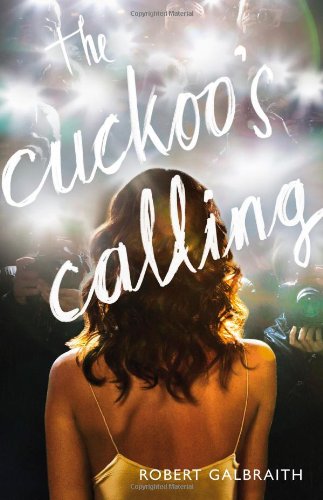
Let’s talk about this new JK Rowling book, shall we? Quick summary of events thus far: A new mystery novel is published in April, by “Robert Galbraith”, called The Cuckoo’s Calling. There’s no excitement at its release – according to the nytimes.com the book sells about 500 copies in the US.  And then, last week, the big reveal, in a tweet: Robert Galbraith is JK Rowling. This is leaked to the friend of the wife of someone at JK Rowling’s law firm, who tweeted a hint to a Sunday Times reporter. He investigated, confronted the Rowling camp, and they confirmed. This is the stuff epic films are made of.

And now we’re here, all caught up in this present moment. The secret is out, and it is big news. Bloggers, blogging.  Reporters, madly covering the story.  Readers, reading. And suddenly, this book is hot. I’m reading it – but I’m not alone, because everyone else is reading it. As I’m writing this, The Cuckoo’s Calling is #1 on Amazon.com both Kindle store and book store; it is #1 on Audible.com; bookstores are ordering more copies as they can’t keep it in stock.

And yet – we’re looking at the same book, the exact same work of mystery fiction, that has been in existence since April.  It was there, and none of us took note or cared to read it.

This is an amazing real life illustration of what sociologists call the Matthew effect, name from this Bible passage:  “For unto every one that hath shall be given, and he shall have abundance: but from him that hath not shall be taken even that which he hath.”  – Matthew 25:29, King James Version

The idea here is that success breeds success – the most renowned scientist gets all the credit for the discovery, although the others working under him or her may put in more work.  Researchers have shown that bestseller or top ranking lists influence what we think we like and what we decide to purchase.  If you are already famous, we want to make you more famous.  If you aren’t famous?  We might be a little less interested in what you’re selling, and it might be a little bit harder to break through.

JK Rowling illustrated this for us in a glaringly obvious way.  She made The Cuckoo’s Calling an overnight success, thanks to her existing fame.  The quality of her novel did not change. She is reportedly sad that she was outed so soon, and I am too.  It is now impossible to listen to The Cuckoo’s Calling on my delightful little wireless headphones without some sort of bias in mind.  As I’ve read most of the Potter books quite a while ago, and I read a ton of mystery fiction, I keep thinking of the writing as somehow cartoonish or fanciful.  But is that really there, in the book?  Or is it just in my mind, an association with a children’s author?  I can understand why JK Rowling would want to break away from all the baggage her other tales bring, as they are so stylized.

I think keeping her identity hidden would have been a wonderful sort of social experiment.  What would we all really say, if we never knew it was her?  More importantly, what would everyone not say as we were all too busy reading the other things we were planning to read, before this secret was revealed?  Would the book just fade away, a sequel never published?  The Matthew effect and book sales before the big reveal say yes, it’d be difficult for The Cuckoo’s Calling to gain success without that Rowling glimmer, shimmer, and shine that we all want to touch.

Further reading:

Robert Galbraith’s official page

nytimes review of Cuckoo’s Calling

Robert Merton’s ‘The Matthew Effect in Science”

The Matthew Effect: How Advantage Begets Further Advantage by Daniel Rigley on Amazon

Outliers: The Story of Success by Malcolm Gladwell on Amazon