book reviews

7 Audioworthy Apocalypses

1. The Passage by Justin Cronin, narrated by Scott Brick

Image

When I speak of The Passage I refer to it as “the epic apocalyptic novel The Passage” each time, as this book’s epicness can not go unmentioned even once in conversation. Scott Brick, the best audiobook narrator known to man, reads this one with the sadness of a dusty old cowboy sitting at a campfire in the middle of the night while vampires are creeping in on all sides around him. Yes, that’s right–The Passage is a vampire book! This doesn’t make it simple, though. It isn’t an action movie disguised in book form, not a vampires-are-sexy sort of book or a teens swooning sort of book. Cronin maps out each gripping and startling detail towards the fall of man and the rise of vampires, and then each step towards survival in the post-vampire world. He builds up such a detailed culture around the historical narrative of the vampire attack, it asks for genealogy and maps and wikis and other such fan-stuff. Cronin’s writing is well paced, informal, authentic, unafraid to take on big ideas and small details. Like the best authors, he describes things in a way that makes them just a bit sharper than real life.  The Passage unabridged has a listening time of almost 37 hours – it is a story that stays with you for a bit.  I recall a friend getting into my car while I was listening to this and being like “OMG is this still that same book?  That book is so long!”  Yes, yes it is.

2. Swan Song by Robert McCammon, narrated by Tom Stechschulte

Image

A book that starts with the line “Once upon a time, we had a love affair with fire,” is clearly a winner worth pursuing. This isn’t for the weak (is any apocalyptic listening?), as McCammon lays down a harsh and brutal future, exploring a loss of humanity among people after nuclear bombs fall and things get rough. Listening to Swan Song is like being dropped into a nightmare, and I mean that in the best way possible. Add to the epicness narrator Tom Stechschulte–he reads this book like he’s really mad about it, and it is the perfect tone to take. The unabridged audio of Swan Song clocks in at almost 35 hours–a true apocalypse takes a while.

3. The Stand by Stephen King, narrated by Grover Gardner

Image

Any apocalypse list is incomplete without The Standoriginally published in 1978, and now a classic of post-apocalyptic fiction. The Stand gained a larger audience with a mini-series in the 90’s, and there have been constant low murmurings of a Stand movie in the works. The unabridged audio was released last year in updated format (previously it was on tape), and the tale is the longest on the list at just under 48 hours listening time. Two days straight!

4. Oryx and Crake by Margaret Atwood, narrated by Campbell Scott

Image

A brief tale compared to the previous three audiobooks we’ve covered, Atwood spins a creative and enchanting story here with less of the gore of much apocalyptic fiction but all of the evil. Atwood can write about anything and make it seem wistfully romantic, and this makes Oryx and Crake all the more sinister. At about 10 hours listening time, you can knock this one out in a single night where you stay awake and force yourself to listen, concerned about the growing number of audiobooks in the world and your lack of ability to listen to them all.

5. Odds Against Tomorrow by Nathaniel Rich, narrated by Kirby Heyborne

Image

So far we’ve covered the classics–the biggest vampire epic novel of recent history, a really long and creepy book from the eighties, and The Stand by Stephen King.  Odds Against Tomorrow is the new kid here. Rich has written an apocalypse for today’s thinking man, for Wall Street Bankers, for capitalist America. He’s written this book for everyone who keeps working even after their office fire alarm goes off. This book is funny, weird, and dark. It approaches apocalypse from a totally different angle, and different is good. Odds Against Tomorrow is also a lesser time investment at 10 hours listening time.

6. 14 by Peter Clines, narrated by Ray Porter

Image

Peter Clines is another fairly new author, but he is here to stay.  This man is serious about his end of the world.  This book is what Chris Matthews is constantly calling everyone on The Bachelor/Bachelorette–a “fan favorite.”  I discovered 14 by looking at reviews of another book on Audible.com, and someone had posted “This book is great but if you have to pick one book right now get 14!  Get this one later!” The urgency convinced me. 14 is another creative apocalypse, very outside the box. A sort of steampunk-ish Clue game of our world’s end. Some people may argue that this doesn’t even qualify as apocalyptic fiction and I would say those people may be right, but check it out anyways. One thing I think is really funny, another author gave this book a blurb that says “A riveting apocalyptic mystery in the style of LOST.”  The TV show?  I think this book has more in common with… books. Again, its a shorty – almost 13 hours.

7. Alas, Babylon by Pat Frank, narrated by Will Patton

Image

That’s right, we’re taking it back. Way back. Alas, Babylon wasn’t the first post-apocalyptic novel (it was originally published in 1959), but it is a quick beautiful read that still has relevance today. Will Patton does a great job narrating, as he sounds smooth like a song, but sad like he knows the bombs have destroyed most of America. Patton clearly knows how to do apocalypse, he was in the movie Armageddon and he currently stars in the alien-apocalypse TV series Falling Skies. He is an expert at experiencing apocalypse. Some novels seem racist, sexist, simple, or just poorly written as time plods on but Alas Babylon maintains its original power.  It is a read-in-highschool novel, as it should be.  For those of us who didn’t get to this one in school, the audiobook clocks in at just over 11 hours.

Review – Virgin Soul: A Novel by Judy Juanita

Image

Call it the sunny side of the Bay, call it the town.  Whatever name you give it, Oakland has the rich and revolutionary history expected from a city bridging to San Francisco and bundled up against Berkeley. Oakland is also uniquely its own city, with its own successes and struggles.

Originally a port city built up with the business of railroads, folks called Oakland the “Detroit of the West” by the 1920’s for its automotive factories and booming economy.  During World War II, Oakland built ships and canned foods, and the exodus of Southern workers to the area created a melting pot of cultures and belief systems.  Post-WWII, Oakland (and the rest of America) witnessed white flight, as wealthier citizens fled further East to the suburbs.  Once a shining star of productivity, post-WWII Oakland began to feel its economy slow and its racial tensions rise.

And this brings us to Virgin Soul, a novel by Judy Juanita based on Juanita’s own experiences growing up in Oakland.  Geniece Hightower, the novel’s star, is a snappy and smart African American woman on the cusp of revolution.  She enrolls at Oakland City College in 1964 and is surrounded by activists and intellectuals.  Geniece soon learns about the black power movement, and her activism eventually leads her to the Black Panther Party.  The novel is broken into four parts:  Freshman, Sophmore, Junior, Senior.  We follow Geniece as she gets an education, but classes are rarely mentioned – confronted with inequality from all sides, meeting men and women both inspirational and heartbreaking, navigating a world not yet equipped to handle an empowered black women – Geniece’s education is of a different sort.

Virgin Soul reads lyrical and very much like poetry – it doesn’t surprise me that Juanita is also a successful poet.  On going to Oakland City College:  “But we called it City, a raggedy, in-the-flatlands, couldn’t-pass-the-earthquake-code, stimulating, politically popping repository of blacks who couldn’t get to college any other way, whites who had flunked out of University of California, and anybody else shrewd enough to go free for two years and transfer to Berkeley, prereqs zapped (3).”  Juanita creates a perfect voice for her protagonist, a balance of the questions running through Geniece’s mind, funky lingo of sixties, and moments of brilliant clarity.

I imagine Juanita has captured the tone of the time perfectly – I wasn’t there, but she was, and she’s built a magical, mad world around Oakland’s past.

Virgin Soul: A Novel by Judy Juanita at Barnes & Noble.com

Judy Juanita’s web page

Review – The Cuckoo’s Calling by Robert Galbraith (J.K. Rowling)

51m4P63APoL

I previously wrote about The Cuckoo’s Calling and The Matthew Effect, in the aftermath of the big reveal of J.K. Rowling as the true author and Robert Galbraith as her pseudonym.

I’ve been putting off a full review of The Cuckoo’s Calling because I think it is so hard for me to separate the actual book from the hype surrounding J.K. Rowling.  In a way this shows how relative everything is – how much an opinion of a book can be influenced by factors other than the actual text of the book itself.  Books just can’t be read in a vacuum, so life goes on.

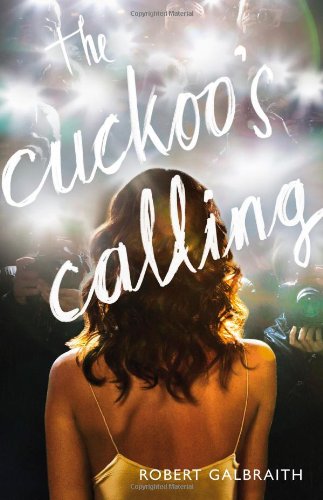
The Cuckoo’s Calling is like this:  Idolized celeb-model falls out apartment window, police deem this a suicide.  Down-on-his-luck, ex-military, prosthetic legged PI Cormoran Strike and his eager, recently acquired temp worker Robin are approached by the model’s family to investigate the death.

The concepts here are current – J.K. Rowling has crafted a plot which is culturally relevant and very now .  The focus on our obsession with celebrity culture and the paparazzi reminded me of Between You and Me by Emma McLaughlin and Nicola Kraus.

Rowling is clearly a wonderful writer, and there are scenes throughout the book illustrating this.  In one scene Rowling describes Strike’s experience amid the paparazzi snapping photos madly as he tries to escort a model out of a club.  The description of the madness of being submerged in this sea of cameras is vivid and almost horrifying, and makes me have a bit of sympathy for celebrities who are constantly caught in flash bulbs.  Rowling also aces internal dialogues, all that talk/fear/story each of us has going on in our head.  PI Cormoran Strike and his temp worker Robin have wonderfully depicted internal debates about their interactions with each other, as so often happens in reality.

That being said, I think the appeal here of both subject matter and characters is strikingly female.  As other reviewers have mentioned, it would have been difficult to believe that this book came from a man, a war veteran, as Robert Galbraith is presented.  Strike’s concerns in life seem written by a woman to me and incongruous with his character – he waits until his temp is gone to use the restroom, is constantly spraying air freshener in his office, is hesitant to speak his mind to Robin or reveal to her that he has only one leg.  Cormoran Strike is not truly a gruff PI, but perhaps what a woman would love a gruff man to be.  Presented with the popular Scandinavian mystery characters of our time, Strike appears rather tame.  Think of Inspector Erlendur of Jar City, who abandoned his wife and children as a young man and only visits his home to fall asleep in a lounge chair;  Lisbeth Salander, a bisexual, unfriendly hacker who tortures for revenger;  Jo Nesbo‘s Harry Hole, who sinks into opium addiction and leaves his job at the police force entirely. Strike’s character works for the tone of the book, and will appeal to readers who enjoy cozy mysteries more in the style of Agatha Christie than the currently popular fare of bleak dysfunction.

The great joy of the true cozy mystery is its simplicity – instead of hackers, serial killers, torture, gore, chase scenes, or other bells and whistles, cozies present a crime, a scene of the crime, a list of suspects.  Rowling has created a baffling mystery out of these simple elements.

The Cuckoo’s Calling by Robert Galbraith on Amazon.com

Review – Paleofantasy by Marlene Zuk

41ybrGBQGbL._SL500_AA300_PIaudible,BottomRight,13,73_AA300_

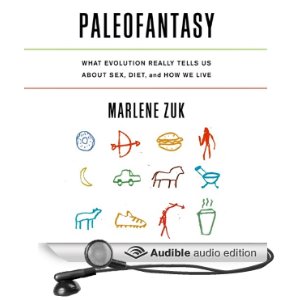
Paleofantasy: What Evolution Really Tells Us About Sex, Diet, and How We Live was an enlightening, if expansive, book for me.  I don’t think I read the subtitle before buying the book on Audible.com, or I may have been a tad bit less surprised by the evolution and anthropology lessons I received.  I expected more of a straightforward discussion of the Paleo-type diet – they say eat these foods, Marlene Zuk says eat these foods.  Diet books often play out this way.  Paleofantasy is so much more than a diet book, however.  It is a series of lessons behind many of the concepts in evolution, with studies cited to explain certain points.

The chapters are:  1) Cavemen in Condos, 2) Are We Stuck?, 3) Crickets, Sparrows, and Darwins — or Evolution before Our Eyes, 4) The Perfect Paleofantasy: Milk, 5) The Perfect Paleofantasy:  Meat, Grains, and Cooking, 6) Exercising the Paleofantasy, 7) Paleofantasy Love, 8) The Paleofantasy Family, 9) Paleofantasy in Sickness and in Health, 10) Are we still Evolving?  A Tale of Genes, Altitude, and Earwax.

Zuk does a great job of staying neutral, addressing the misconceptions and assumptions that many Americans have about our Paleolithic ancestors.  Instead of trying to make a specific case (stop doing this, do it this way instead) she just wants to set the record straight.  She addresses everything from the idea of cavemen needing to spread their seed for the survival of our species, to our paleolithic ancestors’ ability to consume grains and evolution of the digestion of grains, to barefoot running.  Paleofantasy is filled with the usual inconclusive terms of science Americans hate to hear, such as “it is hard to know for sure” and “this is more complicated than it seems”.

As you can imagine, in a book that takes an entire chapter to discuss a human’s ability to digest milk, there is a huge amount of information presented.  I was listening to this on audiobook, and at some points I felt like it was too much to be hearing rather than reading on the page.  I listened to some chapters twice just to absorb their info.  Some Goodreads reviewers mentioned, and I agree, that this is “just the facts” journalism, not dressed up in a more pop non-fiction style like many current non-fiction books that aim to create a more vivid experience.

The only thing that stood out as completely incorrect in Paleofantasy was the source of Zuk’s paleo-fan quotes.  She seemed to repeatedly quote commenters from paleo chat boards or blogs.  This seemed a bit odd to me – it felt like lazy journalism in a book full of studies from researchers at various universities, and felt like picking out the most purposefully uneducated members of a community (let’s be real – message boards aren’t known for the breadth of their knowledge base).  There are a ton of highly educated and respected Paleo people out there, who have published books and speak regularly and would have been much more logical and worthy opponents to address.

Another thing I would have liked to hear more about, and I realize this may have been out of the scope of Zuk’s book, was a theory of what psychological motivation is behind the Paleo movement at this time in our society.  I think Paleo is more a backlash to our current culture than anything else.  People are uncomfortable with processed foods, pervasive and rapidly developing technology, desk jobs, television, media and pressures of a passive consumption culture — all of these modern developments that don’t feel right.  Whether or not it scientifically makes sense, a group of folks out there are yearning to be more like our ancestors (disconnected from elliptical machines, eight hours a day behind a computer screen, the pervasiveness of the internet, processed food).  I see this yearning coming from a place of unhappiness with the status quo, a feeling that we aren’t going down the right road.  I think Paleo is an odd reaction to the massive level of technoshock we’re all living through.  So many of us struggle to know simply how to eat, so many Americans struggle just to move regularly – there is something appealing about becoming more animalistic, getting in touch with our natural history, and listening to our instincts more.  Returning to nature has its appeal- regardless of current or past evolution.  In a way Zuk’s ability to look beyond her science here might have been interesting, I would have liked to hear her insights.

Zuk also only briefly mentions the Paleo diet’s ability to help people visualize the elimination of processed foods from meals.  Processed foods are often the least nutritious, and choosing to eat what our ancestors ate before the food industry developed easily eliminates an entire range of junk foods (not to mention beverages) from a diet.  Of course there are other ways to do this, such as just realizing processed foods are unhealthy and avoiding them (I think Michael Pollan suggests not to eat anything your great-grandma wouldn’t recognize as food), but I think people like to have a bit more of a story than that around their diets.

This book affirmed my faith in the advice Michael Pollan:  “Eat food, not too much, mostly plants”.  Pollan often talks about how little we truly know about the food we eat and what happens to it inside our bodies, he talks about how limited the science of nutrition and digestion is today.  Paleofantasy illustrates we don’t know much, and we have a long way to go before finding the “best” way to eat, move our bodies, and be with each other.

Paleofantasy by Marlene Zuk at Audible.com

Important book of the Day – The Intuitionist by Colson Whitehead.

whitehead-the-intuitionist

“What does the perfect elevator look like, the one that will deliver us from the cities we suffer now, these stunted shacks?” —The Intuitionist, Colson Whitehead

This is a near perfect book with striking language – Colson Whitehead’s metaphors are worth pausing over and re-reading.  He writes such gems as “In person he is too flesh, a handful of raw meat.  Dogs have been known to follow him, optimistic.”

Centering around the elevators we all must ride in to rise up, quite literally, allows for allegory on so many levels – the concept’s brilliance comes from its simplicity.  A black female elevator inspector tries make it in a white elevator inspector’s world, intuitionist trying to make it in a rationalist’s world, all of us built up on top of each other in these big cities waiting to take the ride up to that next level.

I think this is a book that kids will be reading in high school in America when all of us are long gone.

The Intuitionist by Colson Whitehead on Amazon.com

Review – The Interrogator: An Education by Glenn L. Carle.

interrogator_custom-s6-c30

With Claire Danes regularly losing her marbles as a CIA agent on Homeland, and Jessica Chastain doing whatever it takes to get Bin Laden in Zero Dark Thirty, it seemed an appropriate time to read The Interrogator: An Education and glimpse what really happens in CIA interrogations.

Glenn Carle is a career spy for the CIA – he’s traveled the world, telling lies, manipulating agendas, gathering information.  The Interrogator is his memoir of being pulled off a desk job to interrogate a HVT (high value target), code named CAPTUS, possibly affiliated with Al Qaeda/Bin Laden.  Carle begins to realize the man he is meeting with is not the mastermind the CIA wants or needs him to be.  The CIA urges the interrogations to persist, and Carle finds himself in a unique moral dilemma.

Carle seems born to tell this tale – a spy with a penchant towards classic literature, a multilingual Harvard man who is just as comfortable sleeping in the jungle as debating politics and philosophy in the salons of Europe.  A contradiction, he stands as the lone intellectual in what he insinuates to be a meat-headed culture within the CIA.  His love of the classics shines through in his beautiful soliloquies on his situation (and what his situation means for the rest of us) throughout the book.  With an author less concise, these points could have easily strayed towards diatribe or rant.

I was bracing myself for a gore-filled memoir of torture, but this isn’t that book.  The amount of brutality here is limited to that which is suggested to Carle and which he always refuses, saying “We don’t do that.”

What stands out most about this book is what isn’t there – a huge amount of Carle’s account has been redacted by the CIA.  Although CAPTUS is never named in the book, his identity has been deduced as Pacha Wazir.  A Goodreads review lead me to an article called “Unredacting The Interrogator” at Harper’s online which sheds light on Pacha Wazir, as well as the locations featured in the book.

Carle meanders a bit, and the story is made better for it.  He dabbles in the stories of his personal life (his wife has struggled with alcoholism), explains his past and future roles at the CIA, takes time to expound on the inner-workings of the CIA, and analyzes the KUBARK manual and the effectiveness of torture in general.  He ends the book with specific suggestions he believes would improve the way the CIA develops its terrorism intelligence.  The book isn’t all straight information, however.  His writing is haunting, and it is hard to not be reminded of the noir detective fiction of the twenties and thirties as he describes himself as a lone man wandering the streets of a foreign land.

The most poignant scene for me, and the reason I think this book is an important read, is near the end.  Carle has come home from his mission and is at a dinner party.  Knowing he works for the CIA, a woman is asking “Why haven’t they found Bin Laden?  What are you guys doing?  If it was up to me, I’d just grab them all and make them talk.”  Carle’s experience illustrates how complicated a process tracking terrorism truly is, how the CIA is a bureaucracy like all other governmental agencies, how interrogation is a truly intimate process, and how a solution as simple as “making someone talk” by roughing them up is never the solution.

The Interrogator: An Education on Glenn Carle’s website

Further reading:

Harper’s “Unredacting The Interrogator”

Harper’s “The Interrogator: Six Questions for Glenn Carle”

Epic book of the day – Wool by Hugh Howey.

images

When a book features a blurb from Justin Cronin, author of the massive dystopian masterpiece The Passage, I’m ready to read.  Cronin says of Wool, “Howey’s WOOL is an epic feat of imagination.  You will live in this world.”  And he is for serious, as this book is the real thing.

I discovered Wool via an article on Howey’s underground success, and found I could download the first Part in the series for free for my Kindle through Amazon.  The book is broken into small easily consumable parts, short-story length interconnected tales of a future in which humans live in an underground silo.  I read Part One quick, and purchased Parts 1-5 right away.  This is everything that makes scifi worth reading:  the commentary on our social structures; exploration of our weird rituals and lore in societies; the struggles for control over knowledge, material wealth, and power in social systems.  I think this will be the new Hunger Games, a series that gets non-readers reading.  It is simple to understand and draws you in quick.

Wool – Part One blew my mind right away.  It reminded me a bit of how sucked in I was by the first chapter of Ender’s Game, called Third, when I read that for the first time in my childhood.  In the chapter Ender gets his monitor removed and brutally beats Stilson to prevent future bullying.  I thought it was so crazy the way Orson Scott Card drops in Ender’s age near the end – “Ender knew the unspoken rules of manly warfare, even though he was only six.”

That first part of Wool was so intriguing that it really brought me back to that Ender’s Game level of interest – I was dropped into this dystopian world, and right away I could see it all happening, all the rituals and beliefs and fears and concerns of these new people made so much sense to me.  I feel like the greatest science fiction I’ve read doesn’t stop to explain itself to the reader, it just lets the story play out while the reader watches from the sidelines and picks things up as the story goes along.

The concept of Wool, humans living in a silo underground, is one that has such a sweeping amount of plot to play with.  I’m always so interested in the myths and rituals and culture that build up in a society not like our own, and what these things say about our own culture.  I love the development of an entire world after ours in dystopian fiction (The Passage does such a great job of this, as does Oryx and Crake), and this book definitely leaves room to create a history of a people.  There are questions of maintaining power and control within the silo, and, without giving too much away, the daunting prospects of the entire world outside the silo’s safety.  And above all this, the constant sense of claustrophobia that comes with containment.

A group of people in an enclosed space always makes for interesting fiction – think of Stephen King’s Under the Dome.  I love cozy mysteries, and some of my favorite cozies take place in enclosed areas.  And Then There Were None by Agatha Christie takes place on an island during a storm, so guests are stranded.  The Beautiful Mystery by Louise Penny takes place in an isolated monastery, where the monks have little contact with the outside world and must be reached by boat or plane.  Science Fiction as a genre has a great opportunity to play with this tension by building situations where people are stuck together in enclosed spaces.

I’m excited to read the next part in the Wool series, called Shift.  I’m trying to put it off a bit for now, as I know I’ll just compulsively read it once I kindle it and get nothing else done in my life.

Wool – Part One by Hugh Howey on Amazon.com

Wool Omnibus Edition Parts 1-5 by Hugh Howey on Amazon.com

Shift Omnibus Edition Volume 2 by Hugh Howey on Amazon.com

Review – Woke Up Lonely by Fiona Maazel.

814Qu72DxGL._SL1500_

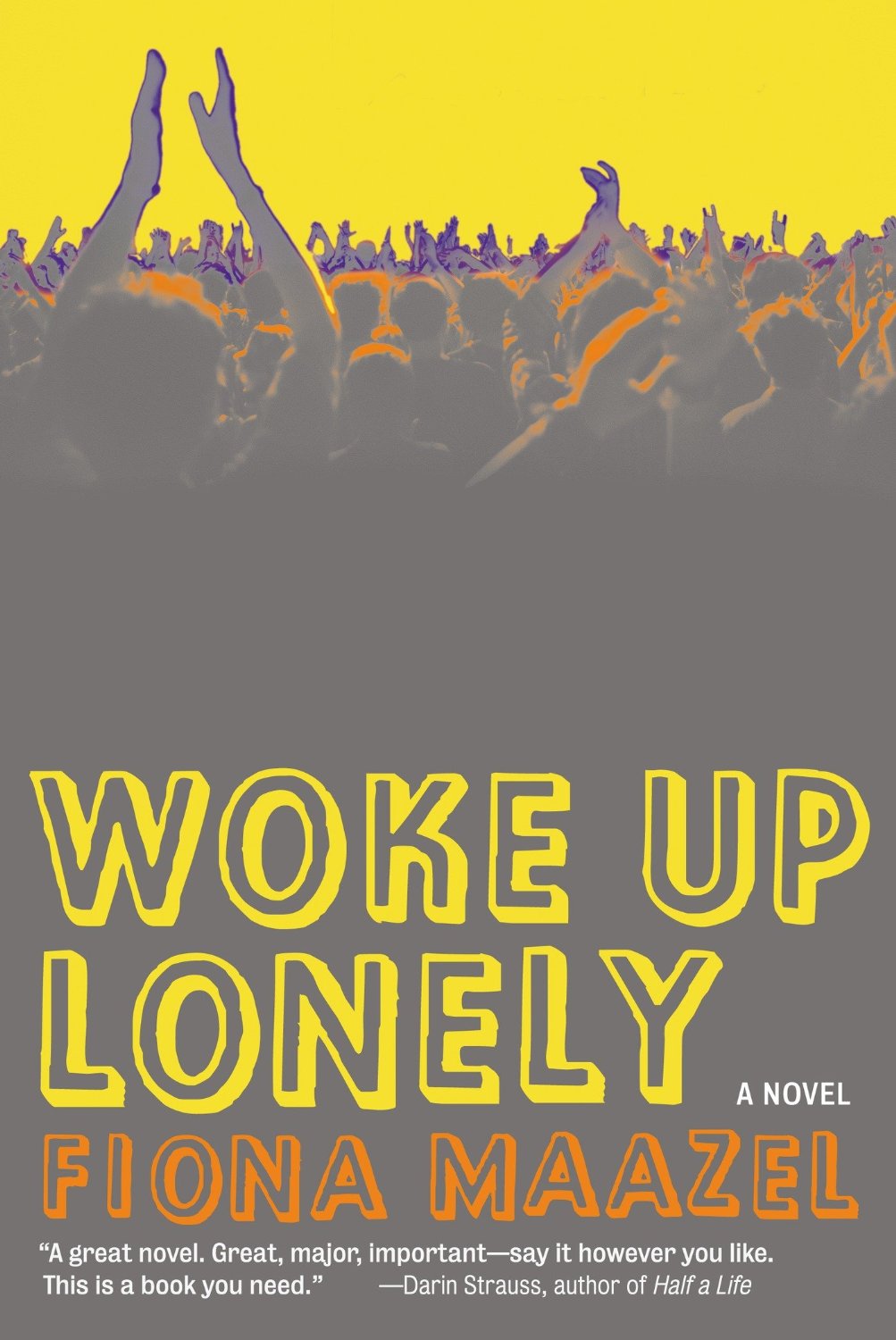
I’m still processing this book – at several times near the beginning I hated it, and was sure I’d put it down at any minute.  And yet I kept reading, as Maazel’s writing hit me in beautiful gasps and starts, mixed in with and nearly masked by all the madness of her stretched-thin plot.

The summary in a chick-mag hooked me instantly – a man develops a cult to fight the pervasive loneliness of our times, only resulting in his further isolation as the cult grows.  When I checked this book out from the beautiful Walnut Creek library and glanced at the Goodreads reviews before I started reading, however, it was rated 3 stars.  This means average, and I was worried.  People weren’t digging Woke Up Lonely, for some reason.

If Chuck Pahalniuk and Christopher Buckley were lovers and decided to adopt an African baby, Fiona Maazel might be that baby in its infancy.  One of the blurbs on the back compares Maazel to George Saunders, and I was like “WOAH let’s not go that far – George Saunders is a master of the craft!”  But then, I guess, I can see it.

What I kept getting tripped up on here was the incredible (meant in the literal, hard to believe, way) plot.  This book has a ton of bells and whistles: corrupt government officials, North Korean leaders, spies with full time makeup artists building alter egos out of face paint, an entire subversive tunnel city under Cincinnati.  I guess what gives me pause in comparing Maazel to great authors is I felt that there was such simplicity in the premise of and the concepts in the book, and yet the book itself was full of Buckley-ish mayhem that was meant to be cynical/funny but just didn’t make any sense.  I thought the plot was all fine as long as I was looking at it from a distance, not focusing my eyes too hard.  But if I stopped to pause and think what was happening in the book, I was like “What is this crap that I am reading?”

The saving grace for the plot was the writing – the main characters’ long expositions on love and loneliness are so sad and true, and Maazel has a gift for poetic one liners, like:  “I was stunned but then not, because if Norman was his own season, he came every year.” and “We were not excitably poor or evangelical, but we were striking for how little capacity any of us had to dream of a life outside the one we had.”

I would have loved a more simplistic book that showcased Maazel’s crisp writing and her premise, loneliness in the 21st century.  If you are thinking of reading this book, get ready for a messy and bumpy ride.

Woke Up Lonely: A Novel by Fiona Maazel on Amazon.com

Review – The Sociopath Next Door by Martha Stout.

51Pgmpk2WBL._SL175_

Yes, I gave The Sociopath Next Door a chance despite its fairly cringeworthy cover and title.  Being a huge lover of mystery fiction, I do find myself drawn to explanations of the icy cold killers and the master manipulators among us.  I discovered this book via Jon Ronson’s The Psychopath Test: A Journey Through the Madness Industry, a fabulous audiobook that I highly recommend.  Audible.com noticed my interest in the so-called Madness Industry and recommended I give The Sociopath Next Door a shot.

Martha Stout does a great job of not only explaining what makes a sociopath different, but discussing what bonds most of us as humans together.  She talks about empathy as a human sense that sociopaths seem to lack.  I found most interesting her digressions into the psychology of empathy – how most humans make horrible soldiers and fail to fire their guns at the enemy unless directly ordered to, etc.

The pitch of Dr. Stout’s book is that sociopaths are rampant among us – there are more of them out there, she says, than there are schizophrenics or certain types of cancer sufferers.  We are mainly just unaware of this specific disorder as it isn’t discussed or is more debatable in the mainstream.  I’m not too concerned about meeting sociopaths in my day to day life or how to wrangle with them on the daily, but I did find Dr. Stout’s examinations of and extrapolations from the human psyche to be interesting and well worth a read.

The Sociopath Next Door at Powell’s Books

Review – Love, Life, and Elephants: An African Love Story by Daphne Sheldrick.

9781250033376

I’m going to be real, I gave up on this book after dragging myself through 11 hours of the 14 hour long audiobook. My breaking point came when – shocker! – the millionth animal struggling to survive under Daphne’s care, or trying to survive in the wild after leaving her care, dies.

I love animals, and I want to love people’s heart-warming stories of living with animals. I like the idea of these stories. I like my own life, lived with two cats. I worked at the Humane Society and fell under the spell of fluffy unfortunates on the daily. But here’s the deal: I can’t get through these books. The quirky Enslaved by Ducks by Bob Tarte, the kitschily titled book about the PTSD dude with a dog, this dame’s adventures interfering with wildlife after her people (she greatly regrets) fail to colonize Africa. I find these books sweet and mildly irritating and vaguely un-notable. I think Daphne’s descriptions and view of the jungle as enchanting and full of delight is beautifully expressed, and I’d love for her to write a fiction novel that focuses more on people and events in that sort of rare environment – I’d find that intriguing.

I also do find a bit of her cultural belief system the elephant (ha! obvious pun there) in the room. At one point she talks of how she fears a one vote per one person system for an independent Kenya, stating this would give Africans a majority vote over whites. The concept of someone publicly believing Africans should receive less of a vote than white settlers based on skin color is so offensive/racist it made me question if I should have purchased the book at all. On a more debatable thought level than every human being equal to one vote, her husband devotes himself to ending poaching in their area only to be confronted with ideas of overpopulation and arguments for culling. I wonder if this “we know best” attitude of cultural interference is healthy for anyone – the wildlife they have decided needs saving, the indigenous people whose ways of life they have decided to interfere with, etc.

Interestingly enough, when I posted my review of this book on Goodreads and read the other reviews I discovered another reviewer had taken these non-discussed issues, as well as his personal relationship with Daphne Sheldrick, and written a book called, aptly enough, The Elephants in the Room: An Excavation. It was written by Martin Rowe, is launching in September from Lantern Books, and I’m sure it will be an interesting read.

As a final note, this is another book I listened to on audio, and it was read by the author.  This rarely works and always disappoints me.  Daphne Sheldrick is now an older woman, telling the stories of a younger one.  It was harder for me to get over the older voice – like I was being told a bedtime story of a yesteryear, the bygone days that I’m sure Sheldrick pines for.  I think a younger narrator may have suited the story better.

Love, Life, and Elephants on Barnes & Noble.com