mystery fiction

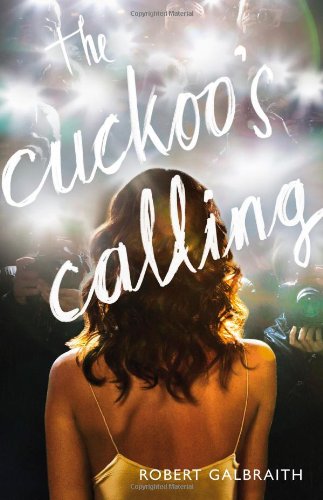
Review – The Cuckoo’s Calling by Robert Galbraith (J.K. Rowling)

51m4P63APoL

I previously wrote about The Cuckoo’s Calling and The Matthew Effect, in the aftermath of the big reveal of J.K. Rowling as the true author and Robert Galbraith as her pseudonym.

I’ve been putting off a full review of The Cuckoo’s Calling because I think it is so hard for me to separate the actual book from the hype surrounding J.K. Rowling.  In a way this shows how relative everything is – how much an opinion of a book can be influenced by factors other than the actual text of the book itself.  Books just can’t be read in a vacuum, so life goes on.

The Cuckoo’s Calling is like this:  Idolized celeb-model falls out apartment window, police deem this a suicide.  Down-on-his-luck, ex-military, prosthetic legged PI Cormoran Strike and his eager, recently acquired temp worker Robin are approached by the model’s family to investigate the death.

The concepts here are current – J.K. Rowling has crafted a plot which is culturally relevant and very now .  The focus on our obsession with celebrity culture and the paparazzi reminded me of Between You and Me by Emma McLaughlin and Nicola Kraus.

Rowling is clearly a wonderful writer, and there are scenes throughout the book illustrating this.  In one scene Rowling describes Strike’s experience amid the paparazzi snapping photos madly as he tries to escort a model out of a club.  The description of the madness of being submerged in this sea of cameras is vivid and almost horrifying, and makes me have a bit of sympathy for celebrities who are constantly caught in flash bulbs.  Rowling also aces internal dialogues, all that talk/fear/story each of us has going on in our head.  PI Cormoran Strike and his temp worker Robin have wonderfully depicted internal debates about their interactions with each other, as so often happens in reality.

That being said, I think the appeal here of both subject matter and characters is strikingly female.  As other reviewers have mentioned, it would have been difficult to believe that this book came from a man, a war veteran, as Robert Galbraith is presented.  Strike’s concerns in life seem written by a woman to me and incongruous with his character – he waits until his temp is gone to use the restroom, is constantly spraying air freshener in his office, is hesitant to speak his mind to Robin or reveal to her that he has only one leg.  Cormoran Strike is not truly a gruff PI, but perhaps what a woman would love a gruff man to be.  Presented with the popular Scandinavian mystery characters of our time, Strike appears rather tame.  Think of Inspector Erlendur of Jar City, who abandoned his wife and children as a young man and only visits his home to fall asleep in a lounge chair;  Lisbeth Salander, a bisexual, unfriendly hacker who tortures for revenger;  Jo Nesbo‘s Harry Hole, who sinks into opium addiction and leaves his job at the police force entirely. Strike’s character works for the tone of the book, and will appeal to readers who enjoy cozy mysteries more in the style of Agatha Christie than the currently popular fare of bleak dysfunction.

The great joy of the true cozy mystery is its simplicity – instead of hackers, serial killers, torture, gore, chase scenes, or other bells and whistles, cozies present a crime, a scene of the crime, a list of suspects.  Rowling has created a baffling mystery out of these simple elements.

The Cuckoo’s Calling by Robert Galbraith on Amazon.com

The Cuckoo’s Calling and The Matthew Effect.

51m4P63APoL

Let’s talk about this new JK Rowling book, shall we? Quick summary of events thus far: A new mystery novel is published in April, by “Robert Galbraith”, called The Cuckoo’s Calling. There’s no excitement at its release – according to the nytimes.com the book sells about 500 copies in the US.  And then, last week, the big reveal, in a tweet: Robert Galbraith is JK Rowling. This is leaked to the friend of the wife of someone at JK Rowling’s law firm, who tweeted a hint to a Sunday Times reporter. He investigated, confronted the Rowling camp, and they confirmed. This is the stuff epic films are made of.

And now we’re here, all caught up in this present moment. The secret is out, and it is big news. Bloggers, blogging.  Reporters, madly covering the story.  Readers, reading. And suddenly, this book is hot. I’m reading it – but I’m not alone, because everyone else is reading it. As I’m writing this, The Cuckoo’s Calling is #1 on Amazon.com both Kindle store and book store; it is #1 on Audible.com; bookstores are ordering more copies as they can’t keep it in stock.

And yet – we’re looking at the same book, the exact same work of mystery fiction, that has been in existence since April.  It was there, and none of us took note or cared to read it.

This is an amazing real life illustration of what sociologists call the Matthew effect, name from this Bible passage:  “For unto every one that hath shall be given, and he shall have abundance: but from him that hath not shall be taken even that which he hath.”  – Matthew 25:29, King James Version

The idea here is that success breeds success – the most renowned scientist gets all the credit for the discovery, although the others working under him or her may put in more work.  Researchers have shown that bestseller or top ranking lists influence what we think we like and what we decide to purchase.  If you are already famous, we want to make you more famous.  If you aren’t famous?  We might be a little less interested in what you’re selling, and it might be a little bit harder to break through.

JK Rowling illustrated this for us in a glaringly obvious way.  She made The Cuckoo’s Calling an overnight success, thanks to her existing fame.  The quality of her novel did not change. She is reportedly sad that she was outed so soon, and I am too.  It is now impossible to listen to The Cuckoo’s Calling on my delightful little wireless headphones without some sort of bias in mind.  As I’ve read most of the Potter books quite a while ago, and I read a ton of mystery fiction, I keep thinking of the writing as somehow cartoonish or fanciful.  But is that really there, in the book?  Or is it just in my mind, an association with a children’s author?  I can understand why JK Rowling would want to break away from all the baggage her other tales bring, as they are so stylized.

I think keeping her identity hidden would have been a wonderful sort of social experiment.  What would we all really say, if we never knew it was her?  More importantly, what would everyone not say as we were all too busy reading the other things we were planning to read, before this secret was revealed?  Would the book just fade away, a sequel never published?  The Matthew effect and book sales before the big reveal say yes, it’d be difficult for The Cuckoo’s Calling to gain success without that Rowling glimmer, shimmer, and shine that we all want to touch.

Further reading:

Robert Galbraith’s official page

nytimes review of Cuckoo’s Calling

Robert Merton’s ‘The Matthew Effect in Science”

The Matthew Effect: How Advantage Begets Further Advantage by Daniel Rigley on Amazon

Outliers: The Story of Success by Malcolm Gladwell on Amazon

Review – The Shining Girls by Lauren Beukes.

16131077

This book gets the gold star for over-hyped book of the summer.  I read its glowing review on the NY times, saw that Tana French gave a positive blurb on the cover, and I kindled it ASAP.  I fell in love with the premise, explained as a time traveling murder mystery.  I read lots and lots of mystery fiction and tend to get bogged down with the same old plot (as Beukes says in the NY times review, there are only so many plots in the world), so I keep an eye out for the creative and the bizarre. I don’t like gimmicks, however, and there is a fine line between neat and gimmicky. I think The Shining Girls crossed that line.

I wasn’t sure the non-linear, time-traveling angle brought anything into the story. I’ve mentioned in a previous post that we are in the age of non-linear novels, and this novel was non-linear to the max. The book’s story line travels in time, as does its serial killer. All this resulted in an effect as if I was watching a handful of Law and Order intros – travel in time, murder, go! I didn’t feel emotionally involved in any of it. The murders were gory; the descriptions of the different eras and girls existing in those times were stylized and cute, but too brief for me to begin to care.

The time-travel angle was unique, yes, but the characters didn’t pop for me. A spunky, undaunted, brave journalism intern. The jaded male journalist who used to cover crime, got burned, and now plays it safe with sports. They felt like stock characters, saying stock lines.

An aside here: I read an interview with Beukes in which she said she wasn’t making torture porn because each girl was a unique character, before getting murdered. I’m just not sure that the “torture porn” debate is something relevant to most mystery/thriller fiction, but more for horror flicks, and if anything I think this book was the most descriptive of tons of chicks getting slaughtered I’ve read in a long time.

The most interesting character in the book, The House, is totally unexplored and unexplained. Lauren Beukes sets up an interesting setting of a magical House which allows for time travel, and then doesn’t elaborate or explain it at all. It is, by far, the most standout and shining object in the novel and the only thing I would have liked to read about. And yet, there’s no there there.

The Shining Girls at Amazon.com

Review – Broken Harbor by Tana French/A Case of Redemption by Adam Mitzner.

brokenharbor_us_thumb

When our shadows showed faintly they were twisted and unfamiliar, turned hunchbacked by the holdalls slung over our shoulders.  Our footsteps came back to us like followers’, bouncing off bare walls and across stretches of churned mud.  We didn’t talk:  the dusk that was helping to cover us could be covering someone else, anywhere.  — Broken Harbor, Tana French

The thrill of a mystery can sometimes be cheap – I just finished a legal thriller, A Case of Redemption, by Adam Mitzner, that reminded me of this.  And that is why Broken Harbor, by Tana French, is so worthwhile.  Tana French has created an experience here, a bizarre world of baby monitors and built up dreams shattered and a development site that seems to be its own House of Usher.  French is a master of language, and although she has written three other books in this series she has chosen this one to reveal herself as such, to come out of the literary closet and really blow us all away with her ability to write a book.  The story is crisply gothic and full of the thinking type of police procedural that makes detective books great; the characters are deep and round and real.  This is definitely one worth reading, as are the first three (In The Woods, The Likeness, Faithful Place) if you haven’t checked them out.

A note on the concept for the Dublin Murder Squad series:  Tana French picks a minor character from the previous book, and focuses on that character for the next book.  And like a chain, the books connect.  French seems such a master at character development, it almost seems a shame to keep running from characters she’s already created, and I wonder if she’ll ever go back to past favorite detectives.  I think it speaks to her skill as an author that she is able to use devices which traditionally frustrate readers, such as ditching main characters and leaving loose ends, and she still has a large fan base.

Broken Harbor on Amazon.com

51M5k-jRmxL._SL175_

It did not bode well for my experience listening to A Case of Redemption by Adam Mitzner, narrated by Kevin T. Collins, that I was reading a hard copy of Broken Harbor at generally the same time.  It really amplified for me the difference in the quality of writing.  Where everything about Broken Harbor had been fresh and bizarre, everything about A Case of Redemption, a legal thriller, was stereotyped so heavily I almost laughed in a few placed.  Even the title was so blatantly unoriginal (A Case of Need, A Case of Conscience, A Case of Exploding Mangoes, A Case of Identity, A Case of Curiosities) it really let me know right what I was getting into.  In a sort of “ripped from the headlines with a twist” manner, a black rapper is on trial for murdering a white pop star he was dating.  I listened to this as an audiobook, and when poor writing is read aloud it starts to sound like bad acting.  The dialogue is strained, the sex scenes could use some lessons from Fifty Shades as they were more awkward than the imaginings of a 15 year old boy, and even the twists near the end couldn’t save what I felt had been a waste of a story.  What it feels like to me happens with Mitzner’s stories is he doesn’t have any sort of original voice.  I hear a story which isn’t quite as full of striking characters as a Grisham or Connelly novel, which doesn’t have that unique page-turning property of a Harlan Coben book.  Nothing special here.

A Case of Redemption on Audible.com

Why hello there!

I’m a lover of books. I can’t stop reading them, telling people (who aren’t asking) about them, buying them, selling them, browsing them, adding them to wishlists, checking them off my lists, reading reviews of them, listening to them. I’m creating this little site to share my love with you – the good, the bad, and the ugly.

I mainly read mystery (currently Broken Harbor by Tana French, just finished Red Dragon by Thomas Harris), popular fiction (on my to-read shelf: the first four Game of Thrones novels by George R. R. Martin), literary fiction (trawling through 2666 by Roberto Bolano, just started and then sort of put off Swamplandia! by Karen Russell, listening to The Dinner by Herman Koch), memoir (currently in the middle of In the Body of the World by Eve Ensler), and non-fiction and essays (on the to-read shelf: The Omnivore’s Dilemma by Michael Pollan, and currently in the middle of How to Be Alone by Johnathan Franzen). Oh, and I love a good science fiction or speculative fiction story but for some reason these aren’t in my spotlight right now.

This site will be full of reviews that I won’t insist to be unbiased, chock full of my own opinions. I like to take into account our current cultural climate while considering the medium and the message of the books I read.

All for now.